Workflow Automation for Education: Reclaim 15 Hours a Week

Discover how workflow automation for education saves teachers 10-15 hrs/week, boosts course completion by 25%, and eliminates administrative burnout. Practical guide for educators.
How Workflow Automation for Education Is Giving Educators Their Time (and Sanity) Back
You Became an Educator to Teach, Not to Manage Spreadsheets
If you're a teacher, school administrator, or online course creator, you already know the feeling: it's 9 PM, you're still answering enrollment emails, manually updating grade sheets, and trying to remember which students haven't logged in this week. The thing you actually love, teaching, creating content, helping students succeed, keeps getting pushed to the bottom of the list.
You're not alone. Nearly half of educators report experiencing secondary trauma or burnout, and a significant portion of that exhaustion comes not from the classroom itself, but from the relentless administrative workload surrounding it. Studies show that teachers spend hours every week on tasks that could be handled automatically, enrollment confirmations, progress updates, parent communications, grading logistics, while the work that actually improves student outcomes gets squeezed into whatever time is left over.
For online course creators, the challenge looks slightly different but feels exactly the same. You spent months building a curriculum you're proud of, and now you're losing 10 to 15 hours every week manually processing payments, sending welcome emails, chasing down struggling students, and handling support tickets, instead of creating the next course or improving the one you have.
Here's the good news: workflow automation for education isn't a futuristic concept or an enterprise-only luxury. It's a practical, accessible solution that educators and course creators at every scale are using right now to reclaim their time, reduce burnout, and actually improve student outcomes.
In this guide, you'll learn:
- The four highest-impact automation use cases for educators and course creators
- Real before-and-after scenarios with concrete time and revenue numbers
- A 90-day implementation roadmap to get started without overwhelming your schedule
- Why the right automation platform matters for educational institutions
What Is Workflow Automation for Education?
At its simplest, workflow automation means connecting your apps and tools so they talk to each other and handle repetitive tasks without you lifting a finger.
Instead of manually copying student data from your enrollment form to your LMS, then sending a welcome email, then adding them to your community platform, automation handles the entire sequence instantly when someone signs up.
Instead of checking who hasn't logged in for a week, then drafting individual check-in emails, then tracking responses, automation monitors engagement and triggers personalized outreach automatically.
The technology isn't magic. It's simply a way to take the repetitive, predictable work off your plate so you can focus on the human work that actually matters: teaching, mentoring, and creating transformative learning experiences.
Use Case 1: Automated Student Enrollment & Onboarding
The Problem: First Impressions Are Everything, and Yours Are Delayed
When a student decides to invest in your course or program, they're excited. Motivated. Ready to learn. But if they have to wait hours (or days) for access, manually hunt for login credentials, or navigate a confusing onboarding process, that enthusiasm evaporates quickly.
For educational institutions, the stakes are even higher. A confusing enrollment experience doesn't just frustrate students, it creates administrative chaos. Staff spend countless hours fielding "Where's my access?" emails, manually provisioning accounts, and troubleshooting preventable issues.
Research consistently shows that poor onboarding is one of the leading causes of student dropout. When students don't feel supported in their first interactions with your program, they assume that's how the entire experience will go.
The Before Scenario
Meet Sarah, an online course creator who teaches digital marketing to small business owners. Her enrollment process looked like this:
- Student fills out a Typeform and pays via Stripe
- Sarah receives a notification and manually creates their account in Teachable
- She drafts and sends a welcome email with login instructions
- She manually adds the student to her ConvertKit email sequence
- She invites them to her private Facebook group
This process took 15-20 minutes per student. With 50 new students each month, Sarah was spending 12-16 hours just on enrollment tasks, often delayed by hours or days when she was traveling or focused on content creation.
Her students? They paid $997 for a course and then waited, confused and frustrated, sometimes for 24+ hours before getting access.
The After Scenario
After implementing enrollment automation, Sarah's process now looks like this:
- Student fills out a form and pays
- Automation instantly creates their course account, sends personalized welcome email with login credentials, adds them to the email sequence, and sends the Facebook group invite
- Student has immediate access and receives a guided onboarding sequence over the next 7 days
Time saved: 12-16 hours per month
Student experience: Instant access, consistent communication, clear next steps
Business impact: 25% reduction in refund requests due to enrollment confusion
The ROI
- Time savings: 5-10 hours per week for course creators; 20-30 hours per week for institutions with larger volumes
- Completion rate improvement: 25-30% increase when students receive immediate, guided onboarding
- Staff satisfaction: Elimination of repetitive, low-value manual work
How to Implement Student Enrollment Automation
Month 1 Quick Win:
- Map your current enrollment flow, every touchpoint from payment to first lesson
- Identify the delays and manual handoffs
- Build a simple automation that triggers on payment confirmation and handles account creation + welcome email
- Test with a small group before rolling out fully
Tools that connect easily:
- Stripe/PayPal → LMS (Teachable, Thinkific, Kajabi, Canvas)
- Form tools (Typeform, JotForm) → Email platforms (Mailchimp, ConvertKit, ActiveCampaign)
- CRMs (HubSpot, Salesforce) → Communication tools (Slack, email)
Use Case 2: Smart Grading & Assessment Workflows
The Problem: Grading Is Eating Your Teaching Time
Teachers and instructors consistently report that grading is one of the most time-consuming aspects of their job, and often the least fulfilling. Hours spent on repetitive assessment tasks mean less time for lesson planning, one-on-one student support, and professional development.
For online course creators, the challenge is scale. When you have hundreds of students submitting assignments, manual grading becomes impossible without hiring a team, which cuts deeply into margins.
The result? Delayed feedback (which reduces learning effectiveness), inconsistent grading standards, or simply avoiding certain assessment types altogether because they're too administratively burdensome.
The Before Scenario
James runs a coding bootcamp with 120 students per cohort. His grading workflow involved:
- Students submit assignments via Google Forms
- James downloads each submission manually
- He reviews code in a separate environment
- He writes individual feedback emails
- He manually updates a spreadsheet tracking completion
- He sends follow-up reminders to students who haven't submitted
Each assignment took 8-10 minutes per student. With 6 assignments per cohort, James was spending 96-120 hours on grading alone, nearly three full work weeks every cohort cycle.
Students often waited 5-7 days for feedback, by which time they'd moved on to new topics and the feedback felt less relevant.
The After Scenario
James implemented an automated grading workflow:
- Students submit through an integrated LMS with auto-graded quiz components
- Code submissions trigger automated tests that check for basic functionality
- Assignments that pass automated checks get instant confirmation; those that don't trigger specific feedback about what failed
- James receives a filtered list of submissions that need human review
- Automated reminders go to students with missing assignments at 24, 48, and 72 hours
- Grade data syncs automatically to his student tracking system
Time saved: 60-70% reduction in grading time (from 100+ hours to 30-35 hours per cohort)
Student experience: Instant feedback on objective criteria; faster human feedback on complex work
Learning outcomes: Students can iterate immediately instead of waiting days
The ROI
- Time savings: 8-12 hours per week for individual educators; 40-60 hours per week for larger programs
- Feedback speed: From 5-7 days to immediate (automated) or 24-48 hours (human-reviewed)
- Consistency: Standardized rubrics applied uniformly across all submissions
- Student satisfaction: Faster feedback correlates strongly with course completion and satisfaction scores
How to Implement Smart Grading Automation
Month 2 Focus:
- Audit your current assessment types, which are purely objective (multiple choice, code tests) vs. subjective (essays, creative work)?
- Implement automated grading for objective assessments first
- Build workflows that route subjective work efficiently to graders with clear rubrics
- Create automated reminder sequences for missing assignments
Key integrations:
- LMS platforms (Canvas, Blackboard, Moodle) → Gradebooks
- Quiz tools (Typeform, Google Forms) → Spreadsheets/databases
- Code testing platforms → Student notification systems
Use Case 3: Student Engagement & Retention Automation
The Problem: Students Disappear and You Don't Know Why
Student dropout is expensive, both financially and in terms of the human potential lost. For online course creators, a student who drops out represents lost revenue and a potential refund request. For educational institutions, attrition affects funding, reputation, and most importantly, student futures.
The tragedy is that many dropouts are preventable. Students don't usually leave because they can't handle the material, they leave because they feel disconnected, overwhelmed, or unsupported at a critical moment. And by the time you notice they're struggling, it's often too late.
The Before Scenario
Maria runs a 12-week professional certification program. Her engagement process was entirely reactive:
- Students enrolled and received initial access
- Maria checked completion rates manually every few weeks
- When she noticed a student falling behind, she'd send a personal email
- Sometimes students responded; often they didn't
- By week 8, she'd typically see 30-40% of her cohort disengaged or dropped out
The problem? Maria was always behind. She was identifying at-risk students weeks after they first started struggling, when catching up felt overwhelming and dropping out seemed like the only option.
The After Scenario
Maria implemented an engagement automation system:
- Day 1-3: Automated welcome sequence with orientation and community introduction
- Week 1: Check-in survey automatically sent; low scores trigger personal outreach
- Ongoing: System tracks login frequency, lesson completion, and assignment submission
- Trigger 1: No login for 3 days → friendly "Everything okay?" email with support resources
- Trigger 2: Lesson incomplete after 7 days → offer of study group or office hours
- Trigger 3: Missed assignment → automated extension offer with catch-up plan
- Milestone celebrations: Automated recognition when students hit 25%, 50%, 75%, 100% completion
Results:
- Completion rates improved from 60% to 85%
- Student satisfaction scores increased significantly
- Maria's personal outreach time became focused and strategic, not reactive
- Revenue increased 25% due to higher completion and fewer refunds
The ROI
- Completion rate improvement: 25-30% increase typical
- Revenue impact: For a $1,000 course with 100 students, improving completion from 60% to 85% means $25,000 in protected revenue per cohort
- Time investment: 2-3 hours upfront to build sequences; runs automatically thereafter
- Student outcomes: Students who complete are more likely to purchase advanced courses, refer others, and become advocates
How to Implement Engagement Automation
Month 2-3 Implementation:
- Identify your dropout points, when do students typically disengage?
- Build milestone-based celebration sequences (progress recognition is powerful)
- Create intervention triggers based on behavioral signals (inactivity, missed assignments)
- Design "soft touch" check-ins that feel personal, not robotic
- Include clear pathways to human support when automation isn't enough
Engagement signals to track:
- Login frequency and recency
- Lesson/video completion rates
- Assignment submission timing
- Quiz scores (sudden drops indicate struggle)
- Community participation
- Email open/click rates
Use Case 4: Administrative Task Automation for Educators
The Problem: Administrative Work Is Consuming Teaching Time
Teachers and educational staff consistently report that non-teaching tasks consume a shocking portion of their work week. Attendance tracking, grade entry, parent communication, report generation, compliance documentation, the list is endless, and it all takes time away from the core mission of education.
For online course creators, administrative tasks multiply as you scale. What worked when you had 20 students breaks down completely at 200 or 2,000. Suddenly you're managing a business instead of creating content, and the joy that drove you to teaching in the first place gets buried under operational complexity.
The Before Scenario
A typical week for Jennifer, a high school teacher:
- 3 hours: Taking and recording attendance, following up on absences
- 2 hours: Entering grades into multiple systems (LMS, district gradebook, parent portal)
- 2 hours: Responding to parent emails and scheduling conferences
- 1 hour: Generating progress reports and intervention documentation
- 1 hour: Managing classroom supplies, field trip forms, permission slips
Total: 9 hours of administrative work per week, nearly a quarter of her professional time spent on tasks that don't directly benefit students.
For David, an online course creator with 500 students:
- 5 hours: Processing refund requests and payment issues
- 3 hours: Responding to repetitive support questions ("How do I reset my password?", "Where is lesson 3?")
- 2 hours: Manually segmenting email lists based on student progress
- 2 hours: Tracking affiliate commissions and partner payments
Total: 12 hours per week on administrative tasks, time that could be spent creating his next high-value course.
The After Scenario
For Jennifer (classroom teacher):
- Attendance automatically syncs from her LMS to the district system
- Grade entry happens once and flows to all required platforms
- Parent communication templates auto-populate with student-specific data
- Progress reports generate automatically from gradebook data
- Routine requests route through a self-service knowledge base first
Time saved: 6-7 hours per week reclaimed for lesson planning, student support, and professional growth
For David (course creator):
- Refunds process automatically based on policy rules
- A knowledge base and chatbot handle 70% of support questions automatically
- Email segmentation updates in real-time based on student behavior
- Affiliate tracking and payments run without manual intervention
Time saved: 8-10 hours per week reclaimed for content creation and business strategy
The ROI
- Time reclaimed: 10-15 hours per week typical for educators and course creators
- Error reduction: Automated data entry eliminates transcription errors
- Consistency: Standardized processes applied uniformly
- Scalability: Handle 10x the volume without proportional administrative overhead
How to Implement Administrative Automation
Month 1-3 Progressive Implementation:
- Week 1-2: Document your most time-consuming administrative tasks
- Week 3-4: Implement the highest-volume, lowest-complexity automation first (attendance syncing, grade passback)
- Month 2: Build parent/student communication workflows
- Month 3: Create self-service resources and advanced reporting automation
High-impact administrative automations:
- Attendance → Gradebook → Parent notification workflows
- Grade entry that syncs across all platforms simultaneously
- Automated progress reports and intervention alerts
- Self-service password resets and common question handling
- Supply and resource request workflows
- Compliance documentation and reporting
Your 90-Day Education Automation Roadmap
You don't need to automate everything at once. In fact, trying to do too much too fast is a recipe for frustration. Here's a practical roadmap to implement automation progressively without overwhelming yourself or your team.
Month 1: Foundation and Quick Wins
Week 1-2: Audit and Plan
- Document your current workflows, where does time go? Where are the delays?
- Identify your biggest pain point (usually enrollment or grading)
- Choose one automation platform and get familiar with it
Week 3-4: First Automation
- Build your first workflow: student enrollment automation
- Test thoroughly with a small group
- Document what works and what needs adjustment
Goal: Save 5 hours per week with your first automation
Month 2: Core Workflows
Week 1-2: Engagement Automation
- Build your student onboarding sequence
- Create milestone celebration emails
- Set up your first intervention trigger (e.g., 3-day inactivity check-in)
Week 3-4: Grading Workflows
- Implement automated grading for objective assessments
- Build routing workflows for subjective work
- Create missing assignment reminder sequences
Goal: Save an additional 5-8 hours per week; improve completion rates by 15%
Month 3: Advanced Integration and Optimization
Week 1-2: Administrative Automation
- Sync data across your core platforms (LMS, CRM, email, gradebook)
- Build self-service resources for common questions
- Automate reporting and compliance tasks
Week 3-4: Optimize and Expand
- Review what's working and refine
- Add advanced triggers and personalization
- Document your workflows for team members
Goal: Full 10-15 hour weekly time savings; 25%+ completion rate improvement
Why n8n Is the Smart Choice for Education Automation
As you research automation platforms, you'll encounter several options. Here's why n8n stands out specifically for educational use cases:
Self-Hosted Option for Data Privacy
Educational institutions handle sensitive student data, and compliance with regulations like FERPA (in the US) and GDPR (in Europe) is non-negotiable. n8n's self-hosted option means your data stays in your infrastructure, not on a third-party server. For course creators handling payment and personal information, this control provides peace of mind and simplifies compliance.
Unlimited Executions
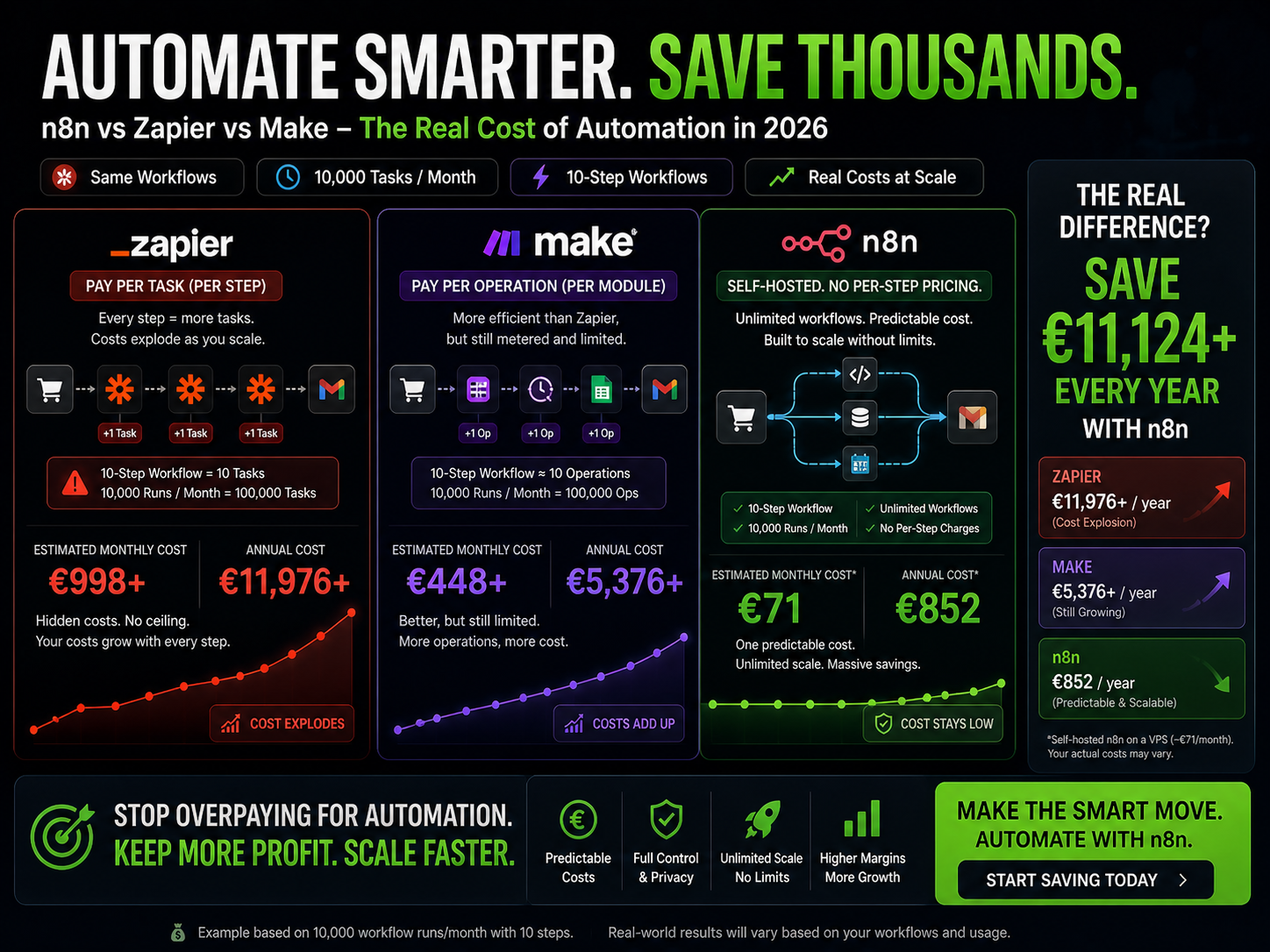
Many automation platforms charge based on "tasks" or "operations", and educational workflows can be task-heavy. A single student enrollment might involve 10-15 individual operations (create account, send email, add to list, etc.). With 1,000 students, those costs multiply fast.
n8n doesn't limit your executions. Whether you have 10 students or 10,000, your costs stay predictable.
400+ Native Integrations
Education tech stacks are notoriously diverse. You might use Canvas for your LMS, Stripe for payments, Mailchimp for email, Slack for team communication, and Google Sheets for tracking. n8n connects to 400+ tools natively, plus offers custom HTTP requests for anything else.
Open Source, No Vendor Lock-In
Your automation workflows represent significant intellectual property, the operational backbone of your educational program. With proprietary platforms, you're dependent on the vendor's pricing, feature roadmap, and business health. n8n is open source, meaning you own your automations completely and can migrate or modify them as needed.
Cost-Effective at Scale
For individual educators and small course creators, n8n's free tier handles substantial volume. For institutions and growing programs, the paid tiers are significantly more affordable than competitors like Zapier or Make, especially when you factor in unlimited executions.
Getting Started
Ready to reclaim your time and focus on what you do best? Visit N8Nme.com to explore how n8n can transform your educational workflows.
Whether you're a solo course creator drowning in administrative tasks or an institution looking to scale without proportional overhead, the right automation strategy, built on the right platform, can give you back the time, energy, and focus that brought you to education in the first place.
Conclusion: Automation Isn't About Replacing Educators, It's About Empowering Them
The goal of workflow automation in education isn't to remove the human element. It's to eliminate the mechanical, repetitive work that prevents educators from being fully present for their students.
When you automate enrollment, you free up time to improve your curriculum. When you automate grading logistics, you create space for meaningful feedback. When you automate engagement tracking, you can intervene earlier and more effectively with struggling students.
The educators and course creators who thrive in the coming years won't be the ones working the longest hours. They'll be the ones who leverage automation to focus their human energy where it matters most: building relationships, creating transformative learning experiences, and helping students succeed.
Your time is your most limited resource. Automation helps you spend it wisely.
Ready to automate your educational workflows? Visit N8Nme.com to get started.