Automating Accounting Software: Cut Manual Work by 70% in 2026
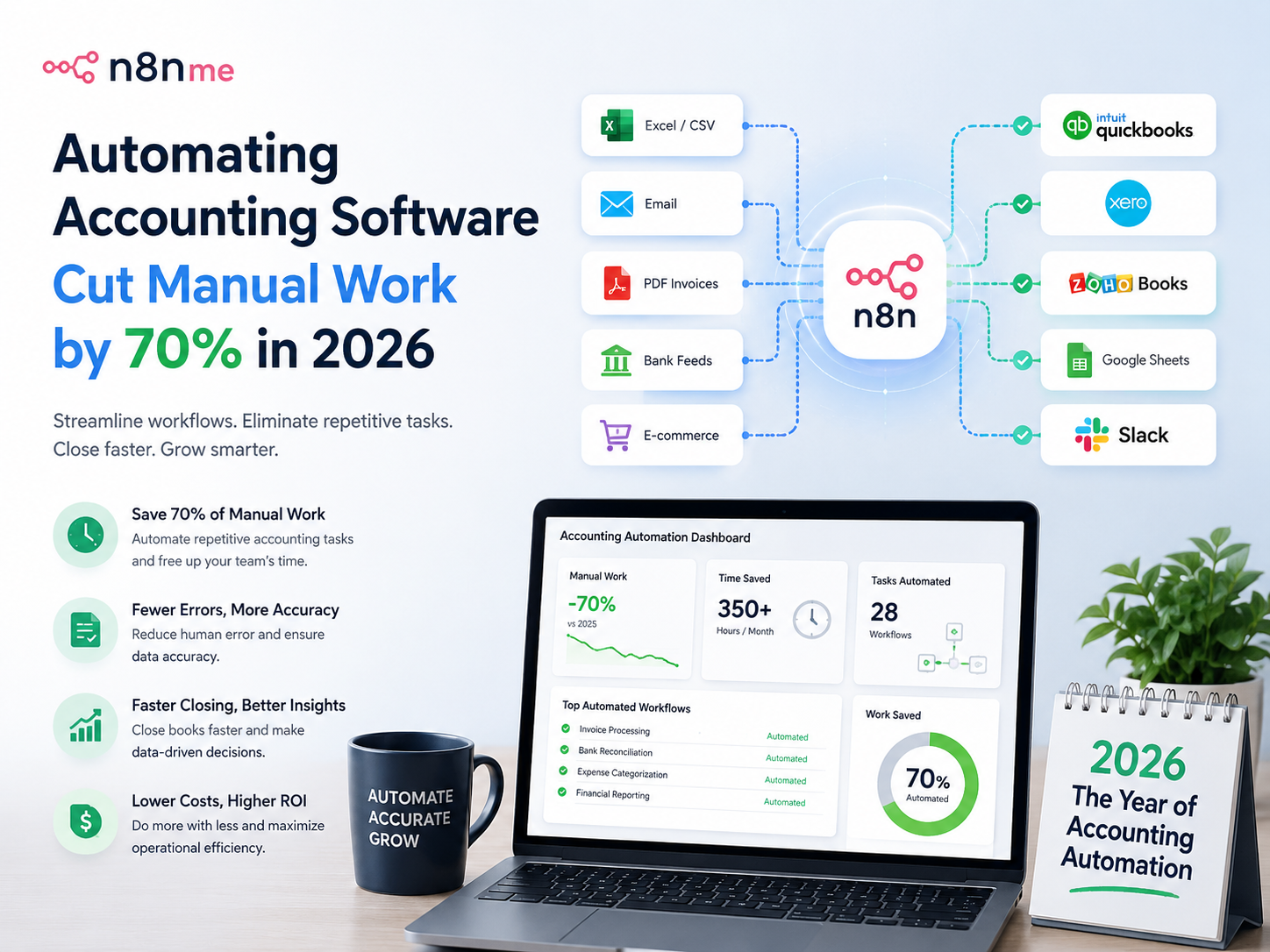
Discover how accounting workflow automation slashes invoice costs from $15 to $3, eliminates manual data entry, and closes your books faster. Built for small businesses.
Accounting Workflow Automation for SMBs: How to Automate Invoice Processing and Finally Fix Your Finance Bottlenecks
It's 9 PM on a Tuesday before month-end close. Someone on your team is still manually re-keying invoice data from a PDF into QuickBooks, chasing an approval that's been sitting in someone's inbox for three days, and trying to track down a $47 difference that's throwing off the bank reconciliation. If this sounds familiar, you're not alone, and you're not failing. You're just running a finance operation the way most small businesses still do.
The numbers are striking. A staggering 97% of accounting firms say they are not using technology efficiently, and 41% cite time-consuming data entry as a top technology pain point. These aren't outliers. They're the norm for SMB finance teams juggling lean staff, multi-vendor tech stacks, and workflows held together by spreadsheets and collective memory.
The cost of staying manual is concrete and measurable. Processing a single invoice by hand costs somewhere between $10 and $15. Automated teams bring that same invoice down to $2-$3, a 70%+ reduction. AP staff spend nearly 22% of their time just answering supplier questions about invoice status and payment timing. That's not strategic finance work; that's an inbox tax.
So what does accounting workflow automation actually mean for a small or mid-sized finance team? It's not about replacing your accountant or buying enterprise software that takes 18 months to implement. It's about removing the repetitive, rule-based tasks that eat hours every week, things like routing invoices for approval, matching receipts to transactions, flagging expense policy violations, or triggering payroll runs, so your team can focus on work that actually requires human judgment.
The tools to do this are more accessible than ever. Platforms like n8n let finance teams and their accounting partners build automated workflows that connect the systems they already use, QuickBooks, Xero, bill payment tools, expense apps, payroll platforms, without needing a development team.
This guide is for SMB owners, controllers, and accounting firm leaders who are tired of the manual grind and want a clear, practical picture of where automation pays off fastest. We'll cover the highest-friction pain points in SMB finance, the workflows with the strongest ROI evidence, what people are actually searching for when they hit their breaking point, and how to build a realistic starting roadmap.
No hype. No generic advice. Just the workflows, benchmarks, and decision frameworks that matter for teams your size.
Accounts Payable Automation: How to Automate Invoice Processing and Cut Costs by 70%
If your finance team is spending hours every week re-keying invoice data, chasing approvals over email, and fielding "when will I be paid?" calls from vendors, you're not alone, and you're not imagining the pain. For most small business finance teams, accounts payable remains one of the most labor-intensive workflows in the entire operation. The good news: it's also one of the highest-ROI workflows to automate, with measurable, proven economics that make the case undeniable.
The Real Cost of Manual Invoice Processing
Before automation, the numbers are sobering. Manual invoice processing typically costs $10-$15 per invoice, with cycle times stretching to 10-20 days in environments where approvals live in email threads and coding decisions happen ad hoc. When you multiply that across hundreds of invoices per month, the cost isn't just financial, it's the constant cognitive load on your team.
Three pain points drive most of that cost:
- Manual data entry: In one 2025 AP-focused survey, manual data entry was cited as the top pain point by 37% of AP professionals. Every PDF invoice that gets re-keyed into your accounting system is a compounding source of errors, delays, and rework.
- Approval bottlenecks: Without a structured workflow, invoices sit in inboxes waiting for context, missing PO numbers, ambiguous GL coding, or an approver who's traveling. Exceptions are more common than most teams realize: 14% of invoices require exception handling due to errors or missing data.
- Supplier inquiry overload: Here's a stat that often surprises finance leaders, AP teams spend 21.8% of their time simply responding to supplier questions about invoice status and payment timing. That's nearly a full day per week consumed by "did you receive my invoice?"
It's worth noting that only 32.6% of invoices are currently processed without any human intervention across typical AP environments. That means more than two-thirds of every invoice still touches a human hand at some point, a significant opportunity hiding in plain sight.
What Automated Invoice Processing Actually Looks Like
An n8n-powered AP automation workflow transforms this process end to end. Here's a practical before/after picture for a small business processing 200 invoices per month:
Before automation:- Staff manually opens email attachments, extracts line-item data, and re-keys it into QuickBooks or Xero
- Approvals are routed via email with no visibility into status or history
- Vendor follows up by phone; someone stops what they're doing to check a spreadsheet
- Month-end close is delayed because AP is still catching up
- Invoices arriving by email are automatically parsed using OCR, with fields mapped to your chart of accounts
- Approval routing triggers instantly based on your defined rules, amount thresholds, department codes, or vendor type, with reminders sent automatically
- Vendors receive real-time status updates through an automated notification workflow, eliminating the bulk of inbound inquiries
- Every invoice is logged with a full audit trail before it ever reaches your accounting system
The result: cost per invoice drops to approximately $2-$3, cycle times compress to 3-5 days, and your AP team shifts from data entry to exception review. That's a 70%+ reduction in per-invoice cost, a figure consistently supported by AP automation benchmarks across SMB environments.
Where n8n Fits Into Your AP Stack
n8n acts as the connective layer between your existing tools, your email inbox, your accounting system, your approval chain, and your vendor communication workflow, without forcing you to replace software you've already invested in. You can build workflows that:
- Trigger on invoice receipt (email, upload portal, or supplier API)
- Extract and validate data fields, flagging mismatches before they become exceptions
- Route approvals to the right person with full invoice context attached
- Post approved invoices directly to QuickBooks, Xero, or your ERP
- Send automated payment confirmations to vendors, cutting that 21.8% inquiry burden significantly
For a lean finance team, the compounding value isn't just cost savings, it's reclaimed capacity. Every hour not spent on manual invoice entry or vendor phone calls is an hour available for cash flow analysis, vendor negotiations, or simply closing the books on time. That's the real ROI of accounts payable automation.
Automate Expense Reports and Bank Reconciliation: Real Savings for SMB Finance Teams
For most SMB finance teams, expense reporting and bank reconciliation aren't just administrative chores, they're recurring time traps that pull skilled staff away from work that actually moves the business forward. The good news: these two workflows are among the highest-ROI automation targets in the entire finance stack, with measurable benchmarks that make the case undeniable.
Expense Reporting Automation: From $60 Per Report to a Fraction of That
If your team is still collecting paper receipts, chasing employees for submissions, and manually keying report data into your accounting system, you're likely spending close to $60 in admin cost per expense report, a figure that includes staff time for data entry, policy review, approval routing, and reimbursement processing. For a business with even 20 employees submitting monthly, that's $14,400 a year in hidden admin overhead before anyone has done anything strategic.
The before/after picture is stark:- Before automation: An employee snaps a photo of a restaurant receipt, emails it to themselves, logs into your expense system three days later, manually types in the amount and merchant, selects a category (often incorrectly), and submits for approval. A manager reviews it in a separate email thread, asks a clarifying question, and approves it five business days later. Finance then manually checks policy compliance, codes it to the GL, and processes reimbursement on the next pay cycle.
- After automation: The employee captures the receipt via a mobile app in real time. OCR extracts the vendor, amount, date, and category automatically. Policy rules flag violations (e.g., meal over the per-diem limit) before submission, not after. The approval routes instantly to the right manager based on amount and department. Reimbursement posts to payroll or directly to the employee's account within 48 hours.
Automated expense workflows consistently deliver roughly a 70% reduction in per-report processing costs, freeing finance staff from low-value data entry and giving managers real-time visibility into spend patterns. The key capabilities driving that savings:
- Mobile receipt capture with OCR, eliminates manual entry at the source
- Automated policy enforcement, flags out-of-policy spend before it becomes a reimbursement dispute
- Rules-based approval routing, no more approvals lost in email threads
- Direct GL coding, mapped to your chart of accounts automatically, not retroactively
For service businesses, field teams, or any organization where employees regularly purchase on behalf of the company, expense automation isn't a nice-to-have, it's a cash flow and compliance lever.
Automate Payroll Processing and Compliance: Stop Dreading Payday
For many small business owners, payroll day is one of the most stressful moments of the month, and the data explains why. 31% of businesses still rely on spreadsheets and manual forms to run payroll, a number that climbs to 44% among the smallest SMEs with 5-19 employees. More troubling still, more than half of these businesses report making payroll errors more than once, each of which carries real financial and legal consequences.
Payroll mistakes aren't just embarrassing, they're expensive. Miscalculated deductions, late tax deposits, and employee misclassifications can trigger IRS penalties, state agency audits, and employee distrust that's hard to rebuild. The root cause is almost always the same: manual processes that were designed for simpler times, now stretched across growing teams, multiple pay types, and increasingly complex compliance requirements.
The Real Cost of Manual Payroll
When payroll lives in spreadsheets, every pay cycle becomes a high-stakes data entry exercise. A single transposed number, a forgotten overtime rule, or a missed state tax update can cascade into hours of rework and costly corrections.
Common pain points for SMB payroll teams include:- Spreadsheet fragility: Manual calculations with no built-in validation, where one formula error affects every employee
- Off-cycle complexity: Handling bonuses, commissions, terminations, or mid-period rate changes requires manual recalculation every time
- Multi-state compliance anxiety: Each state has its own withholding rates, unemployment insurance rules, and deposit deadlines, tracking changes manually is nearly impossible
- IRS e-filing mandates: The IRS now requires mandatory electronic filing for businesses submitting 10 or more information returns (W-2s, 1099s), a threshold most SMBs hit quickly and one that demands accurate, structured data upstream
- Audit trail gaps: Spreadsheets leave no reliable record of who changed what and when, creating serious exposure during any compliance review
Before and After: What Payroll Automation Actually Looks Like
Before automation, a typical SMB payroll run looks like this: the owner or office manager spends 2-4 hours collecting timesheets, manually entering hours, calculating deductions, verifying state withholding rates, and double-checking totals before running payment. Then they spend additional time generating pay stubs, filing tax remittances, and updating employee records, all while hoping nothing was missed. After automation, the picture changes dramatically. According to ADP benchmarking data, 75% of customers spend 15 minutes or less running payroll with automated systems in place. An n8n-powered workflow can connect your time-tracking tool, HR system, and payroll platform, automatically pulling approved hours, applying the correct pay rules, flagging anomalies for review, and triggering payments and filings on schedule. What an automated payroll workflow handles for you:- Syncing approved timesheets directly from your time-tracking tool into payroll calculations
- Applying current federal and multi-state tax rates automatically, with update triggers when rules change
- Generating and distributing digital pay stubs without manual intervention
- Scheduling tax deposits and flagging upcoming deadlines before they become violations
- Producing structured, audit-ready records that satisfy IRS e-filing requirements for 1099s and W-2s
- Sending payroll confirmation alerts to owners and finance staff so everyone has visibility without manual follow-up
Why Compliance Automation Is Non-Negotiable in 2025
The regulatory environment for payroll is tightening, not loosening. The IRS 10-return e-filing threshold means that even modest SMBs with a handful of contractors must now submit structured digital filings, and errors in those filings trigger penalties that dwarf the cost of automation. Multi-state remote work arrangements, which became permanent fixtures after 2020, have added another layer of withholding complexity that spreadsheets simply cannot manage reliably.
Automating payroll compliance isn't about replacing your accountant or payroll specialist. It's about giving them clean, validated data and a reliable process so their expertise is spent on judgment calls, not data entry and deadline chasing. When your payroll workflow runs consistently and correctly, payday stops being a source of dread and becomes exactly what it should be: a routine confirmation that your team is taken care of.
Your 90-Day Finance Automation Roadmap
Implementing finance automation doesn't require a wholesale transformation overnight. The teams that see the most durable results move in deliberate phases, building confidence in each workflow before layering on complexity. Here's a practical roadmap that mirrors what successful small finance teams actually do.
Days 1-30: Audit and Quick WinsStart by mapping where time genuinely disappears. For most teams, two culprits emerge immediately: manual invoice intake and expense capture. In your first sprint, automate AP invoice ingestion from email, parse vendor invoices as they arrive, extract key fields, and push them directly into your accounting system without anyone retyping a line item. Set up a parallel workflow to capture employee expense submissions from a form, email, or Slack message, and route them to the right approval queue automatically. These aren't glamorous wins, but teams consistently report saving 5-8 hours per week in this phase alone.
Days 31-60: Connect and StreamlineWith your foundational data flows running cleanly, shift focus to reconciliation and approval routing. Build workflows that pull bank transaction data on a schedule, match it against your GL entries, and flag discrepancies for human review instead of manual line-by-line comparison. Layer in conditional approval routing, invoices under $500 auto-approve, anything above routes to the appropriate manager via Slack or email with a single-click response. By the end of day 60, your team should be spending significantly less time moving information between systems and far more time acting on it.
Days 61-90: Optimize and ExpandNow you're building leverage. Integrate payroll triggers so headcount changes in your HR system automatically update cost center allocations in your accounting platform. Activate AR automation, send payment reminders on schedule, update invoice status when Stripe or PayPal confirms receipt, and escalate overdue accounts without a single manual follow-up. Close out the sprint by building automated financial dashboards that compile weekly KPIs from multiple sources and deliver them to stakeholders every Monday morning before anyone's had their first coffee.
Why Finance Teams Choose n8n for Workflow Automation
There's a straightforward reason finance and accounting teams increasingly land on n8n after evaluating their options: it's the rational choice for organizations that need genuine control alongside genuine scalability.
Because n8n is self-hosted, your financial data, vendor details, payroll figures, bank transactions, customer invoices, never touches a third-party automation vendor's servers. For teams navigating SOC 2 requirements, client confidentiality obligations, or simply a reasonable data governance policy, that distinction is not minor.
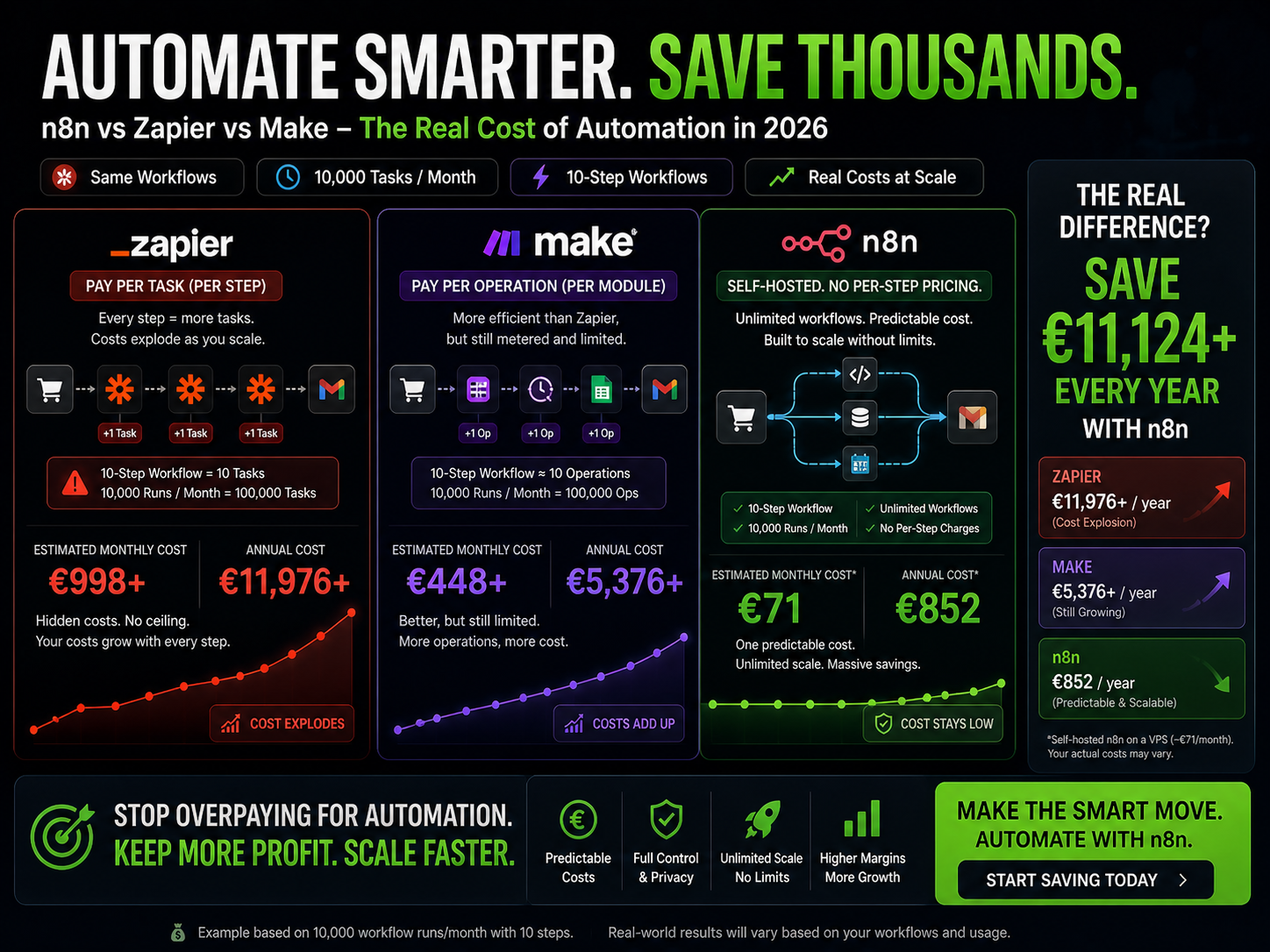
The unlimited executions model matters enormously at scale. Zapier and Make price per task, which means every automated step in a multi-node workflow adds to your bill. A finance team running reconciliation workflows, expense routing, and AR follow-ups across thousands of transactions monthly will face costs that escalate quickly on per-task platforms. n8n's pricing doesn't punish you for automating more.
With 400+ native integrations, including QuickBooks, Xero, Stripe, PayPal, Gmail, Slack, Google Sheets, and most major banking APIs, you're not compromising on connectivity. And because n8n is open source, your team can inspect, customize, and extend any workflow without waiting on a vendor roadmap.
If you're ready to stop losing hours to manual finance processes and start building workflows your team actually controls, explore what's possible by registering for free. The guides, templates, and implementation resources there are built specifically for teams moving from spreadsheet chaos to structured, scalable automation, without the enterprise price tag.