n8n vs Zapier vs Make (2026): The real cost of automation (and the smarter way to scale)
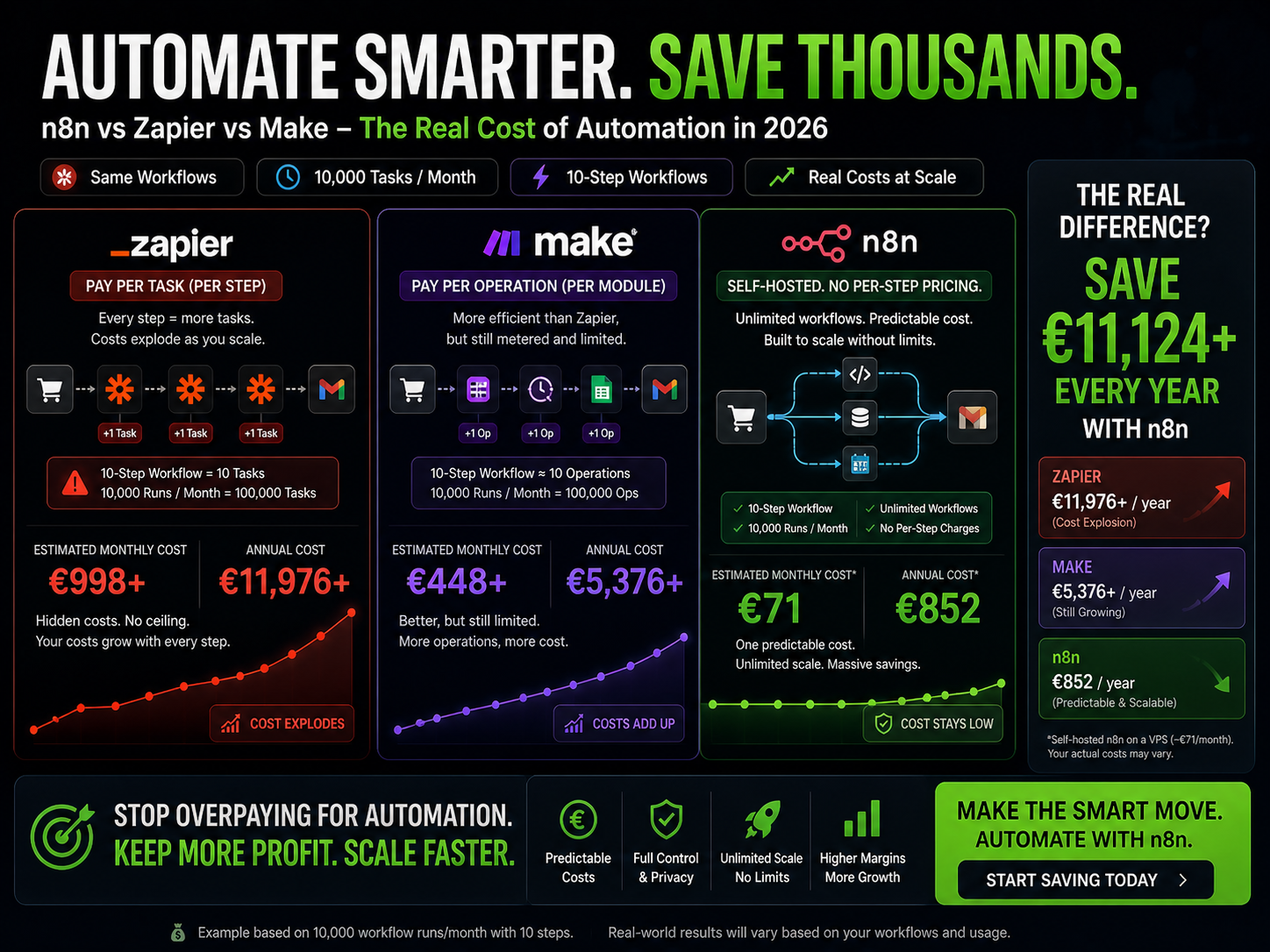
Discover the real cost of the 3 most popular automation tools.
Most teams don’t fail at automation because of bad tools.
They fail because they pick the wrong pricing model.
At first, everything works:
- Workflows save time
- Manual tasks disappear
- Output increases
Then volume grows…
And suddenly your automation tool becomes your biggest bottleneck, financially or technically.
This is where the difference between Zapier, Make, and n8n actually matters.
The Core Problem (that most comparisons ignore)
All three tools automate workflows.
But only one scales without punishing you for success.
| Tool | What Happens When You Scale |
|---|---|
| Zapier | Costs explode per task |
| Make | Costs grow per operation |
| n8n | Costs stay predictable |
That single difference determines whether automation becomes:
- a leverage engine
- or a hidden tax on growth
Zapier: The “Easy Now, Expensive Later” Trap
Zapier is designed for instant gratification.
You can:
- Launch workflows in minutes
- Connect almost any tool
- Avoid technical complexity entirely
But here’s the tradeoff:
Every action = a cost.
As workflows grow:
- Multi-step automations multiply task usage
- High-frequency processes become expensive
- Teams start limiting automation to control cost
That’s the opposite of what automation is supposed to do.
When Zapier makes sense
- You’re validating an idea
- You have low-volume workflows
- You prioritize speed over efficiency
Make: The “Power User Upgrade” (still metered)
Make solves some of Zapier’s limitations.
You get:
- A powerful visual builder
- Better logic handling (routers, filters, loops)
- More efficient execution
But fundamentally?
It still charges you per operation.
So while it’s more efficient, it’s still:
- Usage-based
- Volume-sensitive
- Cost-scaling with growth
When Make makes sense
- You’ve outgrown Zapier
- You need more complex workflows
- You’re okay managing usage carefully
n8n: The Only Option That Actually Scales
n8n flips the model entirely.
Instead of charging per execution:
You control the infrastructure.
That means:
- Unlimited workflows
- No per-task pricing
- Full flexibility (APIs, logic, custom code)
This is why technical teams consistently migrate to n8n after hitting limits elsewhere.
But there’s a catch.
The Real Barrier to n8n (and why most teams don’t wwitch)
n8n is powerful, but not plug-and-play.
Typical friction:
- Hosting setup
- Scaling & performance
- Monitoring & uptime
- Security & updates
So teams get stuck in a loop:
“We know n8n is better long-term… but setup is a headache.”
This is exactly where N8Nme comes in
N8Nme.com removes the only real downside of n8n.
You get:
- Fully managed n8n infrastructure
- Production-ready setup (no DevOps required)
- Scalable execution from day one
- Ongoing reliability without maintenance overhead
- You keep the upside (cost + flexibility)
- Without the operational burden
See what this looks like in practice
Want to run n8n without dealing with setup, hosting, or scaling issues?
→ Get started with a managed setup at N8Nme for free
→ Or request a demo of a real automation workflow tailored to your use case
Pricing Reality (what you’ll actually pay)
Let’s make this concrete.
Zapier / Make
- Pay per task / operation
- Costs increase with every workflow run
- Scaling = higher monthly bills
n8n (self-hosted)
- Fixed infrastructure cost
- Unlimited executions
- Near-zero marginal cost per workflow
N8Nme
- Fixed, predictable pricing
- No setup time
- No maintenance burden
This is why teams moving serious volume switch.
Side-by-Side: what you’re really choosing
| Factor | Zapier | Make | N8Nme |
|---|---|---|---|
| Setup speed | ⭐⭐⭐⭐⭐ | ⭐⭐⭐ | ⭐⭐⭐⭐⭐ |
| Ease of use | ⭐⭐⭐⭐⭐ | ⭐⭐⭐ | ⭐⭐⭐ |
| Flexibility | ⭐⭐ | ⭐⭐⭐⭐ | ⭐⭐⭐⭐⭐ |
| Cost at scale | ❌ Very high | ⚠️ Medium | ✅ Low |
| Technical overhead | None | Low | None |
| Long-term viability | Limited | Moderate | High |
The Strategic Decision (not a tool decision)
This isn’t about which tool is “best.”
It’s about what kind of system you want to build.
Choose Zapier if:
You want speed and simplicity, and accept rising costs.
Choose Make if:
You want more control, but still operate within usage limits.
Choose N8Nme if:
You want automation to become a scalable asset, not a cost center.
When switching to n8n becomes obvious
You’ve likely hit this point if:
- You’re running 10+ active workflows
- You process high volumes (leads, candidates, data)
- You rely on multi-step automations
- Your monthly automation bill keeps increasing
At that stage:
- staying on Zapier/Make is a financial decision, not a technical one
Calculate your hidden automation cost
If you’re currently using Zapier or Make:
- How many tasks/operations do you run monthly?
- What happens if that doubles?
That’s your future cost curve.
Now compare that to:
- fixed-cost infrastructure with N8Nme
Final Take
- Zapier gets you started
- Make gets you further
- n8n is where automation actually scales
The only reason teams don’t switch to n8n earlier?
- Setup friction
And that’s exactly what N8Nme eliminates.
Move from “Automation User” to “Automation Owner”
If you want:
- Lower costs at scale
- More powerful workflows
- Zero infrastructure headaches
N8Nme is the fastest path there.
→ Start with a managed n8n setup for free
→ Or request a custom workflow demo based on your current stack