HR Automation for Small Business: Save 10+ Hours Per Week
Discover practical HR workflow automation strategies that help small business owners streamline recruiting, onboarding, and payroll in less time.
Is your friday afternoon disappearing into a black hole of admin tasks?
It's 3:00 PM on a Friday. You have three interview candidates waiting on scheduling links, a manager who still hasn't approved last week's timesheets, a new hire starting Monday whose IT access hasn't been requested yet, and somewhere in your inbox, a compliance form that was due yesterday. Sound familiar?
If you're an HR manager or small business owner, this isn't an unusual Friday, it's most Fridays. The administrative weight of running HR in a small or mid-sized business can feel relentless, and it has real consequences beyond your stress levels.
The real pressure SMB HR teams are under
Small business HR teams are routinely asked to do the work of departments twice their size. You're managing recruiting, onboarding, payroll coordination, compliance, employee questions, and performance processes, often as a team of one or two people.
The numbers reflect this reality. HR professionals report spending a significant portion of their week on purely administrative tasks: chasing approvals, sending follow-up emails, manually entering data between systems, and answering the same employee questions repeatedly. That's time that isn't going toward hiring better candidates, supporting your people, or building a workplace worth staying in.
Compliance pressure adds another layer. Unlike large enterprises with dedicated legal and HR operations teams, small business HR often means you're personally responsible for ensuring I-9s are completed on time, offer letters go out correctly, and payroll syncs without errors. There's very little margin for things to slip through the cracks.
There's a smarter way to work, without hiring more people
This is where workflow automation comes in, and before you picture a room full of engineers writing code, let's clear that up. In plain English, workflow automation simply means setting up a system where routine, repeatable tasks happen automatically, without you having to trigger them manually every time.
Think of it like a very reliable assistant who never forgets to send the onboarding checklist, always follows up with candidates after an interview, and automatically reminds managers when timesheets are overdue. That's the core idea behind HR workflow automation, not replacing human judgment, but removing the manual coordination work that buries you.
Small business HR automation doesn't require a big budget or a technical background. It requires identifying the tasks that eat your time every week and setting up a smarter path for them.
What this blog will cover
In this guide, we'll walk through four practical ways to automate HR processes that are almost certainly costing your team hours every week:
- Recruiting coordination, automating interview scheduling, candidate follow-ups, and status updates
- Onboarding and compliance, routing forms, e-signatures, and IT setup tasks automatically
- Payroll and time-off workflows, streamlining approvals and reducing payroll errors
- HR self-service, giving employees instant answers to common questions so they stop flooding your inbox
For each one, we'll explain the problem it solves, how the automation actually works in practice, and what kind of time savings you can realistically expect. No jargon, no vendor pitches, just practical guidance you can act on.
How to automate interview scheduling (and win back hours every week)
If you've ever spent three days playing calendar ping-pong with a promising candidate only to have them ghost you the morning of the interview, you already understand why interview scheduling automation matters. It's not a luxury for enterprise HR teams, it's a survival skill for small businesses competing for the same talent.
The reality before automation
Here's a scenario that will feel painfully familiar. A candidate applies on Tuesday. You review their resume Thursday, send an availability email Friday, and wait. They respond Monday with three times, none of which work for the hiring manager. You go back and forth twice more, finally land on Wednesday, send a calendar invite, and then Tuesday night they ask to reschedule.
By the time the interview actually happens, you've exchanged 8-12 emails, burned 45-60 minutes of coordination time, and introduced enough friction that the candidate's enthusiasm has quietly cooled. Multiply that by the fact that hiring teams now conduct an average of 42% more interviews per hire than they did in 2021, up from 14 to 20 screening touchpoints, and you're looking at a serious operational drain.
No-shows compound the problem. Without reminders, candidates forget, life intervenes, and your hiring manager sits in an empty Zoom room. It's demoralizing and wasteful.
What life looks like after interview scheduling automation
With the right automation in place, here's what actually happens instead. A candidate submits their application, triggers an automated workflow, and within minutes receives a personalized email with a self-scheduling link showing real interviewer availability. They pick a slot that works for them, no back-and-forth required.
Twenty-four hours before the interview, an automated reminder fires to both the candidate and the interviewer. Another reminder goes out one hour before, this time including the video conference link. If the candidate needs to reschedule, they can do it themselves through the same link without emailing anyone.
Research consistently shows that automation can reduce interview scheduling time by up to 84%, and automated reminders cut no-show rates by 65%. For a small recruiting team, that's the difference between scrambling and actually having time to prepare thoughtful interview questions.
What this automation looks like in practice
A well-built interview scheduling workflow typically follows these steps:
- Candidate submits application via your ATS or job board form
- Trigger fires, the workflow detects a new qualified applicant based on your screening criteria
- Scheduling link generated, a calendar tool (like Calendly or Cal.com) syncs with the interviewer's live availability and creates a unique booking link
- Personalized email sent to the candidate with the scheduling link, role details, and a warm, human-sounding message
- Candidate self-schedules, they pick a time, the event is added to both calendars automatically
- Confirmation email sent immediately with the video conference link (Zoom, Google Meet, or Teams) already included
- Reminder sequence activates, automated messages go out 24 hours and 1 hour before the interview
- Post-interview follow-up triggered, a thank-you or next-steps email sends automatically after the scheduled time passes
Measuring the ROI of scheduling automation
Before you build anything, establish your baseline so you can actually see the impact. Track these three metrics:
- Scheduling time per interview: How many minutes does coordination currently take from outreach to confirmed booking?
- No-show rate: What percentage of scheduled interviews result in a candidate not appearing?
- Time-to-first-interview: How many calendar days pass between application submission and the first interview?
Even modest improvements across all three metrics translate directly into faster hires, less recruiter burnout, and a better candidate experience, which matters more than most small businesses realize when they're competing against larger employers.
Automate new hire onboarding: from chaos to confidence
For most small businesses, onboarding a new employee looks something like this: someone sends a congratulations email, another person scrambles to find the checklist from last time, IT gets a Slack message three days before the start date (if they're lucky), and the hiring manager spends the new hire's first morning figuring out what to do next. Tasks fall through the cracks, not because anyone is careless, but because onboarding involves a dozen people, a dozen moving parts, and no single source of truth.
The result? New hires arrive to find their laptop isn't set up, their system access isn't provisioned, or their manager seems just as lost as they are. That first impression is hard to undo.
The real cost of manual onboarding
The administrative burden alone is significant. Traditional onboarding processes can consume around 10 hours of HR time per new hire, tracking down paperwork, chasing signatures, coordinating with departments, and following up on incomplete tasks. Research suggests that digital onboarding automation can reduce that time investment by roughly 50%, bringing the per-hire admin burden closer to 3 hours.
That's approximately 7 hours returned to your HR team per hire. For a small business bringing on 10 people a year, that's 70 hours, nearly two full work weeks, spent on coordination that a well-built workflow could handle automatically.
The automated onboarding workflow
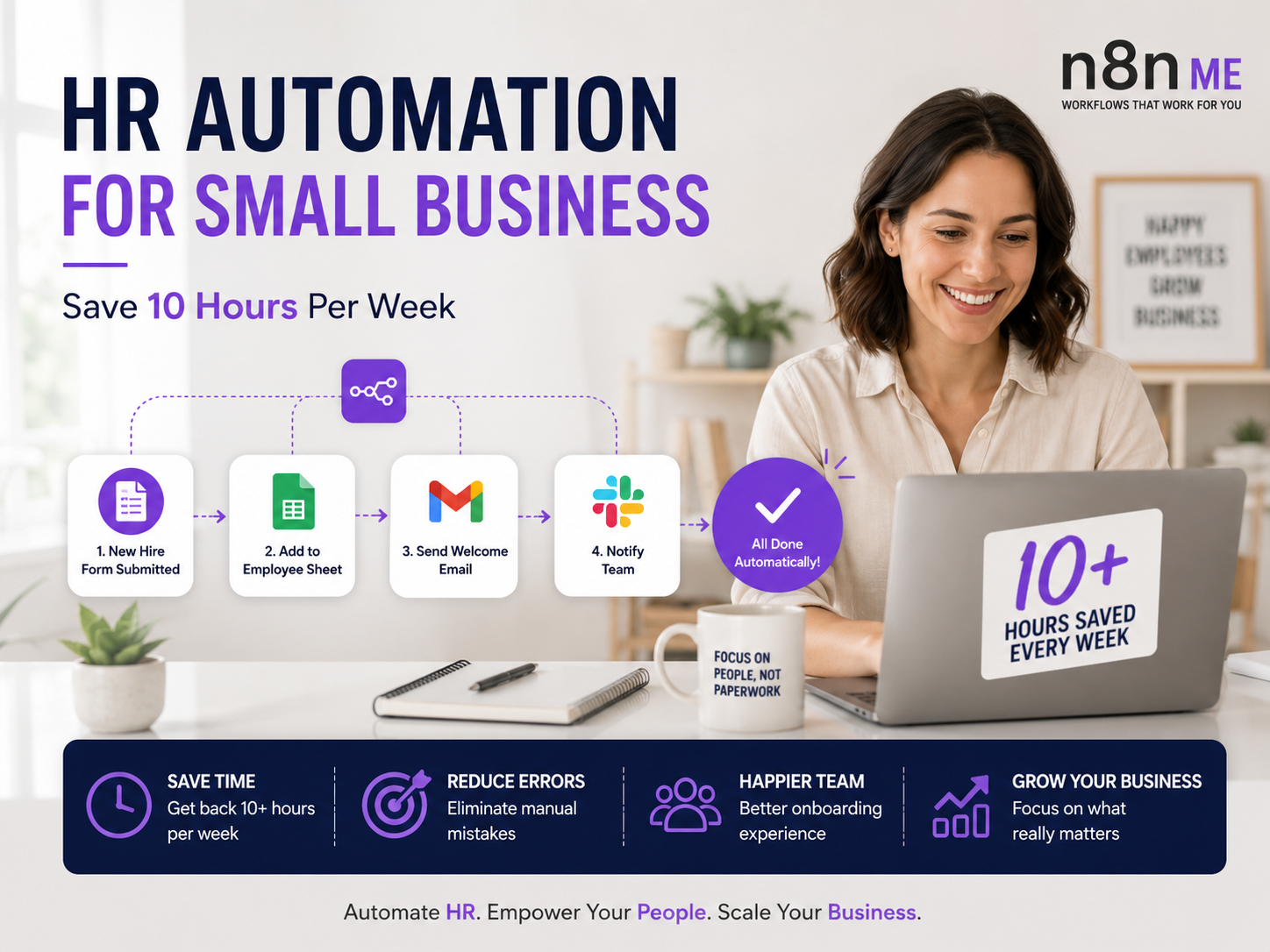
With workflow automation (tools like n8n make this accessible without a developer), the trigger isn't a sticky note or a forwarded email. It's the moment an offer is accepted, and from that point, the workflow takes over.
Here's what an automated onboarding sequence can look like:
- Trigger: Offer accepted, Candidate status updates in your ATS or a form is submitted confirming acceptance.
- HR receives a task list, Contracts, compliance documents, and benefits paperwork are automatically generated and sent for e-signature.
- IT is notified immediately, A ticket is created with the new hire's start date, role, and equipment requirements. No more last-minute laptop scrambles.
- Manager receives a structured checklist, First-week agenda, introduction talking points, and role-specific training resources arrive before Day 1.
- New hire gets a welcome sequence, Automated emails or messages introduce the company culture, explain what to expect, and answer common first-day questions.
- Reminders and escalations run automatically, If a task isn't completed within a set window, the system nudges the responsible party rather than relying on HR to follow up.
- Day 1 readiness confirmed, A pre-start checklist verifies that equipment, access, and introductions are all in place before the new hire walks through the door (or logs in remotely).
Every department gets what they need, when they need it, simultaneously, not sequentially.
A competitive advantage most small businesses haven't taken yet
Here's something worth knowing: only a minority of small businesses currently automate their onboarding processes. Most are still relying on email chains, shared drives, and institutional memory. That means building an automated onboarding workflow isn't just an efficiency gain, it's a genuine differentiator when competing for talent against larger, better-resourced employers.
A smooth, professional onboarding experience signals to new hires that your organization is organized, respectful of their time, and set up for their success. That matters.
How to measure the ROI
Once you've implemented onboarding automation, track these three metrics to understand the real impact:
- HR admin hours per hire, Compare before and after. Even a 50% reduction is meaningful at small-business scale.
- Task completion rate, Are IT provisioning, document signing, and manager check-ins being completed before Day 1? Track how often, and how late.
- First-week readiness score, A simple survey on Day 2 or Day 3 asking new hires whether they felt prepared, welcomed, and equipped gives you qualitative signal alongside the numbers.
Onboarding automation won't replace the human warmth a great manager brings on Day 1. But it removes the friction that prevents that moment from happening the right way.
Automate payroll approvals and end the friday scramble
For most small business HR teams, the days before payroll closes feel like a fire drill. You're chasing down managers for timesheet approvals, texting employees about missing punch-outs, and fielding a steady stream of "did my PTO get updated?" questions, all while trying to hit a hard submission deadline.
One late approval or miscalculated overtime entry can cascade into corrections, off-cycle payments, and frustrated employees. And unlike a one-off project, this happens every single pay period.
The real cost of manual payroll processing
Payroll errors aren't rare exceptions, they're almost inevitable when the process relies on manual handoffs and spreadsheets. Studies show that 69% of SMB HR software users report reduced payroll processing time after implementing automation tools. Yet many small businesses are still running the same manual process they used five years ago.
The cost of correcting a payroll error goes beyond the dollar amount. It erodes employee trust, requires HR time to investigate and reprocess, and sometimes triggers compliance flags depending on your jurisdiction.
What the "before" picture looks like
Here's a typical pre-automation payroll week:
- Monday: Send reminder emails to managers to approve timesheets
- Wednesday: Chase down the three managers who haven't responded
- Thursday: Discover two employees have conflicting hours logged
- Friday morning: Rush to reconcile corrections before the 2 PM cutoff
- Friday afternoon: Answer five separate Slack messages about PTO balances
This pattern repeats 24 to 52 times per year depending on your pay cycle. Even if it only costs you three extra hours per cycle, that's potentially 156 hours of HR time annually consumed by a process that should largely run itself.
What payroll automation looks like step by step
Once you automate payroll approvals and the surrounding workflow, the process becomes predictable and largely self-managing:
- Automated reminder triggers, Five days before the pay period closes, the system sends timesheet completion reminders to all employees via email or Slack.
- Manager approval routing, Once an employee submits hours, the workflow automatically routes to their direct manager for review and approval.
- Escalation if no response, If a manager hasn't approved within 48 hours, a follow-up alert fires automatically, no HR intervention needed.
- Validation before submission, The workflow runs a logic check: are hours within normal range? Does PTO usage match accrual balances? Exceptions get flagged for HR review before anything reaches payroll.
- Payroll data export, Approved, validated data exports directly to your payroll provider in the correct format.
- Paystub distribution, After processing, paystubs publish automatically to an employee self-service portal, reducing inbound questions.
The result is that HR's role shifts from chasing and correcting to reviewing exceptions, which is where your judgment is actually needed.
The compounding ROI of payroll automation
Payroll is unique among HR workflows because of its frequency. Even a modest efficiency gain compounds dramatically over time. Here's what to measure when building your case for payroll workflow automation:
- Payroll processing time per cycle, Track hours spent from timesheet close to submission, before and after automation.
- Correction frequency, How many off-cycle corrections or manual adjustments do you process per quarter?
- Employee payroll inquiries, Count how many questions HR fields each pay period about paystubs, PTO, or discrepancies.
If automation cuts your processing time by just 90 minutes per bi-weekly cycle, that's 39 hours returned to HR annually. Pair that with fewer corrections and fewer employee questions, and the ROI case becomes straightforward, even for a team of one.
Employee self-service HR automation: Reclaim your inbox
If you work in HR at a small business, you know the drill. By 9:15 AM on a Monday, your inbox already has six variations of the same questions: *
Your 90-Day HR automation roadmap
Implementing HR automation doesn't have to mean a massive IT project or a six-month rollout. A phased approach lets you build confidence, demonstrate ROI, and avoid overwhelming your team.
Days 1-30: Automate interview scheduling
Start here because the payoff is immediate and the risk is nearly zero. Automating candidate scheduling eliminates the back-and-forth email chains that eat 5-7 hours per hire, and your team will feel the relief within the first week. This phase builds trust in automation and gives you a quick win to share with leadership.
Days 31-60: Build your onboarding orchestration
Once scheduling is humming, layer in automated onboarding workflows. This is where automation delivers its biggest cross-functional ROI, IT gets notified to provision equipment, Finance gets payroll details, and the new hire receives a structured Day 1 welcome sequence, all without a single manual handoff. Research from the Brandon Hall Group shows organizations with strong onboarding improve new hire retention by 82%, and automation is what makes that consistency possible at scale.
Days 61-90: Add Payroll, Time Tracking, and Self-Service
With your core hiring and onboarding flows stable, connect your time-tracking and payroll systems. Automating timesheet reminders, approval routing, and payroll data syncs reduces errors and frees your HR team from repetitive reconciliation work. Adding employee self-service portals for PTO requests or document access is the final piece, and employees genuinely appreciate not having to email HR for routine requests.
Why n8n is the smart choice for HR automation
There are plenty of automation tools out there, but HR workflows have specific requirements that make the choice more nuanced than it might seem.
Data privacy comes first. Because n8n can be self-hosted, your employee data never has to touch a third-party cloud server. For HR teams handling sensitive compensation, performance, and personal data, keeping everything within your own infrastructure isn't a nice-to-have, it's a compliance necessity.
It connects what you already use. With 400+ pre-built integrations, n8n works with your existing ATS, HRIS, Slack, Google Workspace, DocuSign, and more. You're not rebuilding your tech stack; you're connecting it.
No coding required. The visual workflow builder lets HR managers design and modify automations themselves, without waiting on a developer queue.
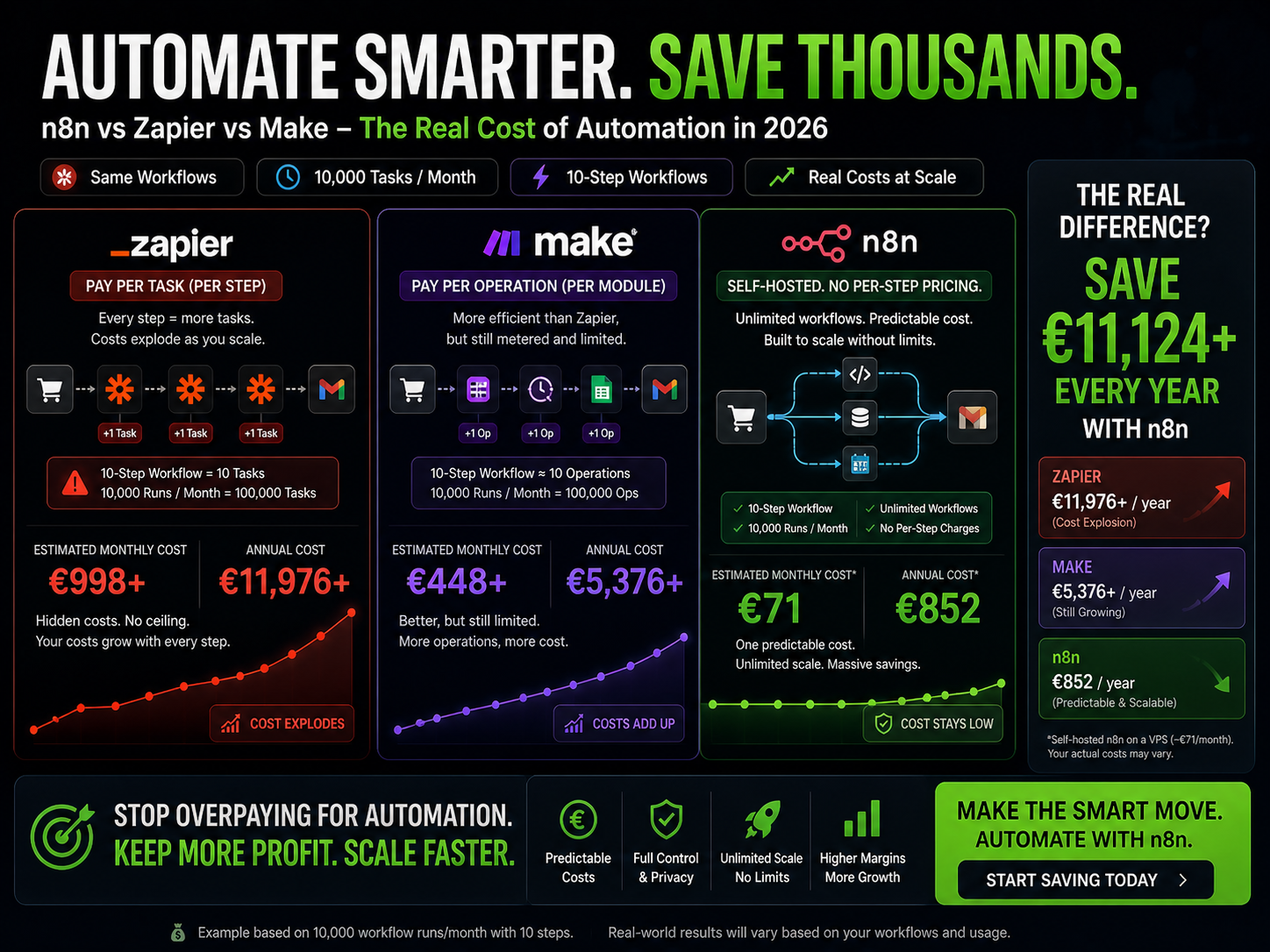
Predictable costs at scale. Unlike Zapier or Make, n8n doesn't charge per automation run. Unlimited executions mean your costs don't spike as your hiring volume grows, a meaningful advantage for scaling businesses.
Open source and cost-effective. At scale, teams switching from Zapier to n8n commonly report savings of 60-80% on automation tooling costs, while gaining more flexibility and control.
If you're ready to stop managing HR by inbox and start building workflows that actually scale, a good first step is seeing what's already been built. Register for free now to browse ready-made HR and recruiting automation templates, from interview scheduling to onboarding to payroll reminders. They're free to use, easy to customize, and designed with small HR teams in mind. No pressure, no demo required; just practical starting points you can adapt to how your team actually works.
The best HR automation isn't the most complex one, it's the one your team will actually use.