Stop Drowning in Tasks: Agency Workflow Automation Guide

Discover the best marketing automation tools for agencies to streamline workflows, automate client reporting, and reclaim 15+ hours weekly. Start saving time today.
Marketing Agency Workflow Automation: How to Stop Running on the Hamster Wheel
You started your agency to do great work. Somewhere between landing your fifth client and your fifteenth, the work you loved got buried under a mountain of status update emails, manual reporting, and the same repetitive tasks that somehow eat your entire Tuesday. Sound familiar?
You are not imagining it. You are not being inefficient. You are simply running a modern agency on processes that were never designed to scale.
Why Your Agency Feels Stuck (And It's Not Your Fault)
The uncomfortable truth about agency life is that growth creates friction before it creates freedom. Every new client means more onboarding documents to prep, more campaigns to report on, more Slack messages asking "can you just pull those numbers real quick?" The workload compounds faster than your team can absorb it.
The numbers back this up. Research shows that nearly 20% of agency staff are so stretched by overallocation and burnout that they would actively consider leaving their roles. Your best people, the ones clients love, the ones who know your processes inside out, are quietly approaching a breaking point.
And yet the admin keeps piling up.
Here is the part that stings most: the tasks consuming your team's time are almost entirely predictable. Campaign performance pulls. Client report generation. Lead handoff emails. Project status updates. These are not creative challenges requiring human judgment. They are repetitive sequences your team executes the same way, every single time, week after week.
Meanwhile, 90% of marketers report they cannot reliably connect their campaign activity to revenue outcomes. Not because the data does not exist, but because the manual process of gathering, formatting, and presenting it consistently is simply too slow and too fragile to sustain.
So What Is Workflow Automation, Really?
Workflow automation is the practice of connecting your apps, data, and processes so that routine work happens automatically, without someone needing to remember to do it, without copy-pasting between tools, without the 3 a.m. panic that you forgot to send that report.
Think of it as building a machine that handles the predictable parts of your business, so your team can focus on the parts that actually require human creativity and judgment.
In this post, we will walk through four specific automation use cases that marketing agencies are implementing right now to reclaim 15+ hours per week, improve client retention, and finally break free from the hamster wheel. These are not futuristic concepts. These are real workflows running at agencies today, delivering measurable ROI.
Let us start with the biggest time sink of all: client reporting.
Use Case #1: Automate Client Reporting (Reclaim 45+ Hours Weekly)
If you manage more than five clients, you know the weekly reporting ritual.
Log into Google Analytics. Export the data. Switch to the ad platform. Screenshot the performance charts. Open the social media dashboard. Copy the engagement numbers. Paste everything into a spreadsheet. Create charts. Write commentary explaining what the numbers mean. Format it all into a presentable PDF. Email it to the client.
Repeat for every single client, every single week.
This process consumes 2-3 hours per client report. For an agency with twenty active clients, that is 40-60 hours of manual work every week. That is more than one full-time employee, doing nothing but copying numbers between systems.
The Automation Solution
Automated reporting replaces this manual grind with dashboards that populate themselves.
Instead of exporting data from five different platforms, you connect those platforms once to a central reporting system. The system pulls fresh data automatically. Pre-built templates format everything into client-ready reports. Scheduled delivery means reports reach clients at the same time every week, without anyone hitting "send."
The time savings are substantial. Agencies using automated reporting systems generate comprehensive client reports in 15-30 minutes instead of 2-3 hours. That represents 85% time reduction per report.
The Business Impact
One agency implementing comprehensive reporting automation calculated the impact across their team: 45+ hours per week recovered through elimination of manual data consolidation and report generation. That is the equivalent of 1-2 full-time staff members worth of capacity, without recruitment, training, or compensation costs.
But the impact goes beyond time savings. Automated reporting delivers consistency that manual processes cannot match. Reports go out on schedule, every time. Data is accurate, pulled directly from source systems rather than transcribed by hand. Clients receive professional, branded reports that build confidence in your agency's capabilities.
Before: Your account manager spends Tuesday morning frantically compiling reports, stressed about accuracy, rushing to meet client deadlines.
After: Reports generate automatically overnight. Your account manager reviews them over coffee, adds strategic insights, and spends the morning on high-value client strategy instead of data entry.
Use Case #2: Social Media Automation at Scale
Managing social media for multiple clients is a volume game that quickly becomes unmanageable. Each client has accounts across three or four platforms. Each platform needs fresh content multiple times per week. Each post needs optimal timing, appropriate hashtags, platform-specific formatting. And clients expect you to monitor engagement, respond to comments, and report on performance.
The manual approach requires logging into dozens of accounts, creating posts individually, guessing at optimal posting times, and manually tracking what went live when. For an agency managing social for ten clients, this easily consumes 15–20 hours per week of pure scheduling work.
The Automation Solution
Social media automation combines three capabilities: content scheduling, cross-platform publishing, and AI-powered content adaptation.
Content scheduling systems allow you to batch-create posts and queue them for automatic publication at optimal times. Instead of logging into Instagram at 9 a.m. every day, you spend two hours on Monday scheduling the entire week's content. The system handles the rest.
Cross-platform publishing means creating content once and distributing it appropriately across Facebook, LinkedIn, Instagram, Twitter, and other channels. The system automatically adapts formatting, adjusting image sizes, optimizing hashtags, tweaking copy length for each platform's constraints.
AI-powered content generation takes this further by automatically creating platform-specific variations from a single source. A blog post becomes a LinkedIn article, three Twitter threads, five Instagram captions, and a Facebook update, all generated automatically with appropriate tone and formatting for each channel.
The Salesforce Case Study
Salesforce's social media team faced exactly this challenge: managing over 150 social channels simultaneously. By implementing automated social listening and management through Sprout Social, they achieved 12,000 hours of time savings in the first year. Their community management efficiency improved 10x.
The system continuously monitors brand mentions, categorizes them by sentiment and urgency, and flags important conversations for human response, allowing the team to focus on strategic engagement rather than manual monitoring.
What This Means for Your Agency
One media company implementing content calendar automation reduced manual scheduling time from 15-20 hours per week to 2-3 hours, a 78% reduction. Simultaneously, they increased content velocity by 40% and improved engagement metrics by 42%.
Before: Your social media manager spends half their week logging into accounts, scheduling posts one by one, struggling to maintain consistent presence across all client channels.
After: Content schedules itself. Your social manager spends their time on community engagement, strategy development, and creative concepting, the work that actually moves the needle for clients.
Use Case #3: Lead Management That Actually Converts
The gap between marketing and sales is where leads go to die. A prospect fills out a form on your client's website. That data sits in a notification email. Someone needs to manually enter it into the CRM. Then create a task for follow-up. Then remember to actually follow up. Then track whether the lead became a customer.
For most agencies, this process is held together with spreadsheets, sticky notes, and hope. The result: leads slip through cracks, follow-up happens inconsistently, and nobody can reliably report on which marketing activities actually generate revenue.
The Automation Solution
Automated lead management creates a closed-loop system where leads flow seamlessly from capture to conversion to revenue attribution.
When a lead submits a form, automation triggers instantly: the lead is scored based on behavior and demographics, routed to the appropriate sales rep based on territory or specialty, enrolled in a nurture email sequence, and created as a task in your project management system.
The sales rep receives an instant Slack notification with full lead context. If the lead is not contacted within 24 hours, the system escalates to management. Meanwhile, the nurture sequence delivers targeted content based on the lead's interests and buying stage. Website behavior triggers additional actions, visiting pricing pages alerts sales, downloading case studies enrolls leads in different content tracks.
The Thomson Reuters Case Study
Thomson Reuters implemented marketing automation to bridge their sales and marketing divide. The results: 72% reduction in lead-to-conversion time, 175% increase in revenue attributed to marketing activities, and 23% increase in high-quality leads passed to sales.
By automating lead scoring and routing, they ensured every lead received appropriate follow-up while giving sales teams better-qualified prospects.
The Revenue Impact
Research across multiple organizations shows that marketing automation delivers 451% increase in qualified leads and 70.5% improvement in email engagement rates. More importantly, agencies can finally connect marketing activities to revenue outcomes, answering the question "what did we actually generate for the client?" with hard numbers rather than vague impressions.
Before: Leads arrive sporadically, get entered into systems inconsistently, and follow-up depends on who remembers to check the spreadsheet.
After: Every lead triggers an immediate, consistent workflow. Sales gets instant notification. Nurture sequences maintain engagement. Management sees real-time pipeline visibility. Nothing falls through cracks.
Use Case #4: Client Onboarding That Sets the Right Tone
New client onboarding is your agency's first impression. It is also, for many agencies, a chaotic scramble of manual tasks: creating client folders, setting up tracking codes, sending welcome emails, scheduling kickoff calls, adding contacts to email lists, configuring project management workspaces.
Each new client requires 4-8 hours of administrative setup. When onboarding is inconsistent, clients notice. Some get comprehensive welcome packets. Others get a single email and radio silence. This inconsistency undermines the professional image you are trying to project.
The Automation Solution
Automated onboarding transforms client intake from a chaotic manual process into a standardized, professional experience.
When a prospect signs, automation triggers a complete onboarding sequence: welcome emails send automatically with appropriate attachments and next steps, project management workspaces create themselves with pre-configured task templates, tracking codes generate and install automatically, team notifications route to appropriate specialists, and calendar invites schedule kickoff calls at optimal times.
The client receives consistent, professional communication from day one. Your team receives clear task assignments without manual coordination. Nothing gets forgotten because the system handles every step.
First Impressions Matter
Agencies implementing automated onboarding reduce setup time from 4-8 hours to 1-2 hours per client. For an agency onboarding two clients per week, that saves 6-12 hours weekly, nearly a full day of administrative work.
More importantly, automated onboarding creates consistent client experiences that build confidence. Every client receives the same comprehensive welcome, the same clear next steps, the same professional communication. This consistency translates directly to retention: agencies report 10-15% improvement in client retention when onboarding is systematized and professional.
Before: New client setup is a scramble. Things get forgotten. Clients receive inconsistent communication. Your team spends the first week playing catch-up instead of delivering value.
After: Onboarding runs like clockwork. Clients feel professionally managed from day one. Your team focuses on strategy and execution rather than administrative setup.
Your 90-Day Agency Automation Roadmap
Implementing automation is not an all-or-nothing proposition. The agencies seeing the best results take a phased approach, building momentum with quick wins before tackling more complex workflows.
Week 1-30: Audit and Quick Wins
Start by mapping your current workflows. Where does your team spend the most time on repetitive tasks? Where do errors and delays consistently occur? Where are the bottlenecks that frustrate both your team and your clients?
Target your first automations for maximum impact with minimum complexity:
- Automate client reporting, Connect your analytics and ad platforms to automated dashboards
- Schedule social media content, Implement batch scheduling to reclaim 10+ hours weekly
- Standardize email sequences, Create templates for common client communications
These three automations alone can recover 15-20 hours per week, giving you immediate ROI and building organizational confidence in automation.
Week 31-60: Core Workflows
With quick wins delivering value, tackle the workflows that directly impact revenue:
- Lead management automation, Connect forms to CRM, implement lead scoring and routing
- Client onboarding sequences, Build standardized intake and setup workflows
- Invoice and billing automation, Eliminate manual invoicing and payment tracking
These automations improve client experience and cash flow while further reducing administrative overhead.
Week 61-90: Optimization and Advanced Integrations
- Cross-platform orchestration, Coordinate marketing activities across email, social, ads, and website
- Predictive analytics, Implement systems that identify at-risk clients and optimization opportunities
- Advanced reporting, Build closed-loop attribution connecting all marketing activities to revenue
Why Smart Agencies Choose n8n
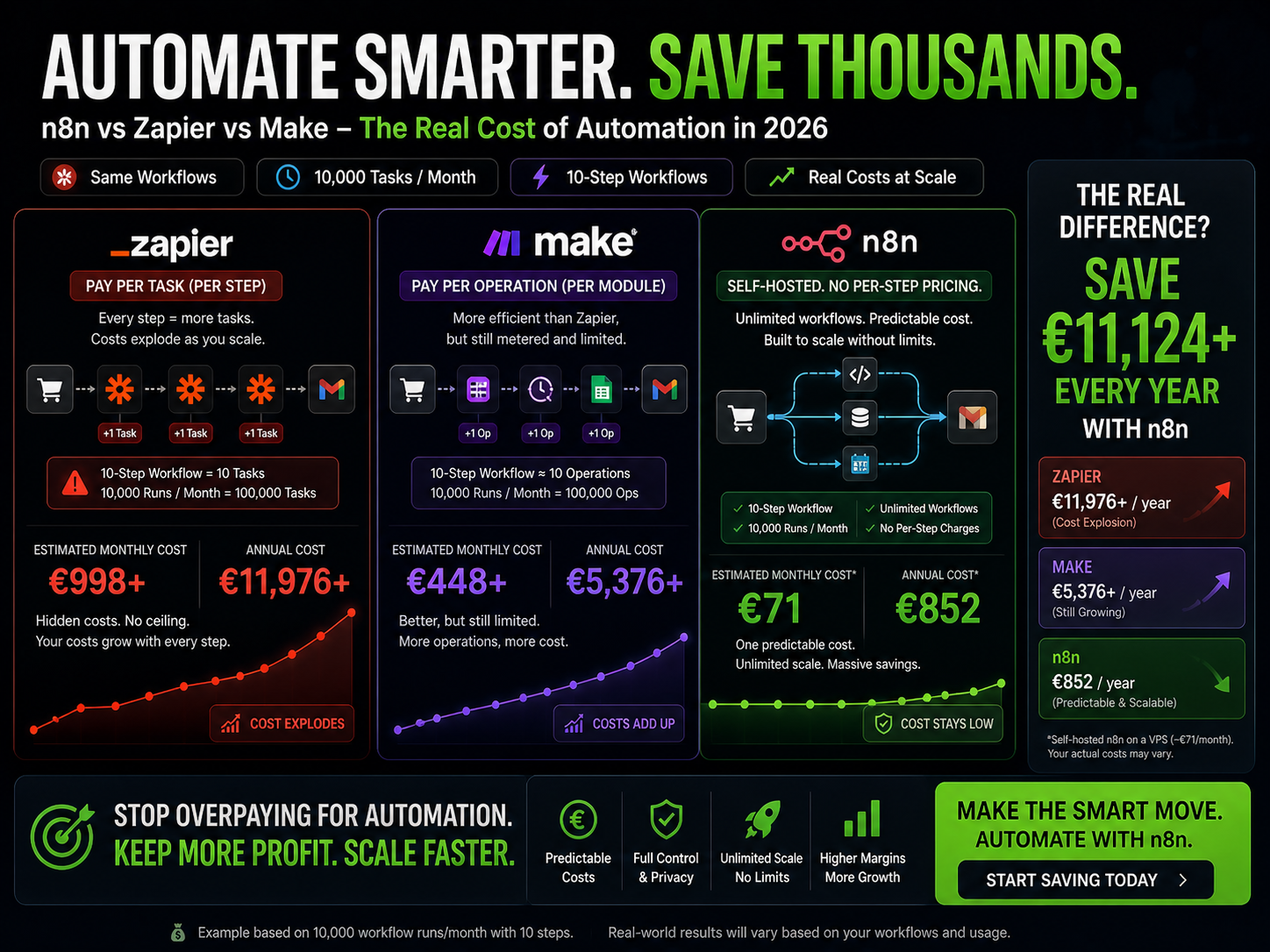
As you evaluate automation platforms, you will encounter the usual suspects: Zapier, Make, and various point solutions. These tools work, but they come with limitations that become expensive at scale.
n8n offers a different approach. As an open-source workflow automation platform, n8n gives you:
- Self-hosted option, Keep sensitive client data on your own infrastructure rather than routing it through third-party servers.
- Unlimited executions, Unlike per-task platforms, n8n does not penalize you for running workflows frequently.
- 400+ integrations, Connect virtually any tool your clients use, from mainstream platforms to niche industry solutions.
- Open source, No vendor lock-in. Customize workflows to your exact requirements.
- Cost-effective at scale, Predictable pricing for agencies running high-volume workflows.
The bottom line: n8n gives you enterprise-grade automation capabilities without enterprise-grade pricing or complexity.
Ready to Stop Drowning in Tasks?
Your agency does not have a talent problem. It does not have a strategy problem. It has a workflow problem, and workflow problems have technical solutions.
The agencies winning in 2026 are not working harder. They are working smarter, using automation to handle the repetitive work that consumes their competitors' time and energy.
Start with one workflow. Prove the concept. Build from there. Within 90 days, you can transform how your agency operates, and finally get off the hamster wheel.
Ready to explore what is possible? Visit n8nme.com to see how n8n can power your agency's automation transformation.
This post was researched using current industry data and real case studies from agencies implementing workflow automation. The ROI figures and time savings cited are based on published research and documented implementations.