SaaS Workflow Automation: Why Your Startup's Manual Processes Are Costing More Than You Think

Startups waste 4.5+ hours per person weekly on manual workflows. Learn how to automate SaaS processes across Stripe, HubSpot, Jira, and Slack with n8n. If you need help with anything, get in touch with jeroen[at]clsystems[dot]nl as he has deep knowledge of n8n workflows.
You've built a respectable stack. Stripe for billing, HubSpot for the CRM, Jira for engineering, Intercom for support, Slack for everything else. You're paying for 40, maybe 60 tools. According to Okta's 2025 data, the average company now runs on 101 apps. Somewhere between app number 30 and app number 101, the connections between those tools stopped being someone's job and became everyone's problem.
The result is a specific kind of operational drag that's hard to quantify but impossible to ignore. Knowledge workers spend roughly 25% of their workweek just searching for information that already exists somewhere in their stack. Asana's research puts the cost of repetitive manual work at about 4.5 hours per person per week, with 83% of workers reporting they feel inefficient because of it. At a 15-person startup, that's not a productivity footnote. That's a full-time employee's worth of capacity evaporating every single week.
The painful part is that most founders already know this. They've tried to fix it. They built a few Zapier automations, set up some Slack alerts, maybe hired an ops lead to own the chaos. But the automations broke quietly. No one knew. A lead routing rule stopped firing three weeks ago and nobody noticed until a sales rep asked why their pipeline had gone cold. This is the real problem: it's not that SaaS workflow automation is hard to start. It's that the current tools make it hard to trust.
Where the Manual Work Is Actually Hiding
Before you can fix workflow problems, you need to name them precisely. In most early-stage SaaS companies, the manual work clusters around four areas.
Revenue Operations. Lead routing sounds like a solved problem until your sales team scales past four reps and your territory logic has three exceptions baked into someone's memory. Failed payment recovery is still being handled by a customer success manager who gets a Stripe webhook email, checks the account in HubSpot, and sends a manually-written follow-up. Billing edge cases, like plan changes mid-cycle or churned accounts requesting data exports, are tracked in a shared Google Sheet that three people have edit access to and nobody fully trusts.
Customer Support. When a bug report comes in through Intercom, your support rep has to copy the conversation context, open Jira, create a ticket, paste the context, tag the engineer, and then manually follow up when the ticket closes to tell the customer. That process takes 12 minutes every single time. Multiply by 30 tickets a week. SLA monitoring is a spreadsheet or a color-coded Notion board that someone updates when they remember to.
Engineering and DevOps. Release coordination is a Slack thread. Incident response starts with someone @channel-ing and hoping the right person sees it. PR descriptions rarely become release notes automatically. Developers are spending non-trivial time on coordination tasks that could be structured and automated, and the work is invisible because it happens in DMs and ad hoc Slack messages.
Internal Operations. New hire onboarding is a Google Doc with 47 steps, most of which require a human to initiate something in another tool. IT provisioning requests are Slack DMs. Software procurement approvals are email chains. None of this is tracked, which means nothing is optimized.
The "We Have Automations But We Don't Trust Them" Problem
Here's something that rarely gets discussed in automation content: the trust problem is worse than the tooling problem.
Most startups do have automations. They just don't have observable automations. A Zapier zap failing silently is arguably worse than no automation at all, because it creates false confidence. The team assumes the process is running. It isn't. Weeks pass. By the time someone notices, the damage is already done: missed follow-ups, lost leads, unpaid invoices that aged past the recovery window.
Slack becomes what one operator described as a "chaos engine." Instead of structured intake, you get a river of untagged requests that require human triage. Someone pastes a Stripe payment failure notification in #billing. Three people see it. None of them know if someone else is handling it. One person follows up. The customer gets two emails. Or nobody follows up and the customer churns.
The fix isn't adding more automations. It's building automations with structure, error handling, retry logic, and a clear owner. That's a different kind of tool requirement than what most low-code automation platforms were designed for.
Real Numbers From Companies Who Fixed This
This isn't theoretical. The operational improvements from properly-built workflow automation are measurable and significant.
HubSpot documented saving 68 hours per month on customer onboarding workflows by automating the handoffs between contract signing, account provisioning, and the first onboarding touchpoint. That's not 68 hours of busywork. That's 68 hours of a skilled customer success team's capacity redirected toward work that actually requires human judgment.
Aglet, a mobile gaming company, saved over 2,000 support hours by automating repetitive support workflows, specifically the classification, routing, and initial response layer that doesn't require a human but was eating human time anyway.
Casetext built 317 distinct sales workflows to manage the complexity of their sales process at scale. Workato reported a 20% reduction in Jira ticket resolution time after automating the routing and escalation logic that previously lived in people's heads.
These aren't edge cases. They're what happens when workflow automation is treated as infrastructure rather than a side project.
Where n8n Fits Into This Picture
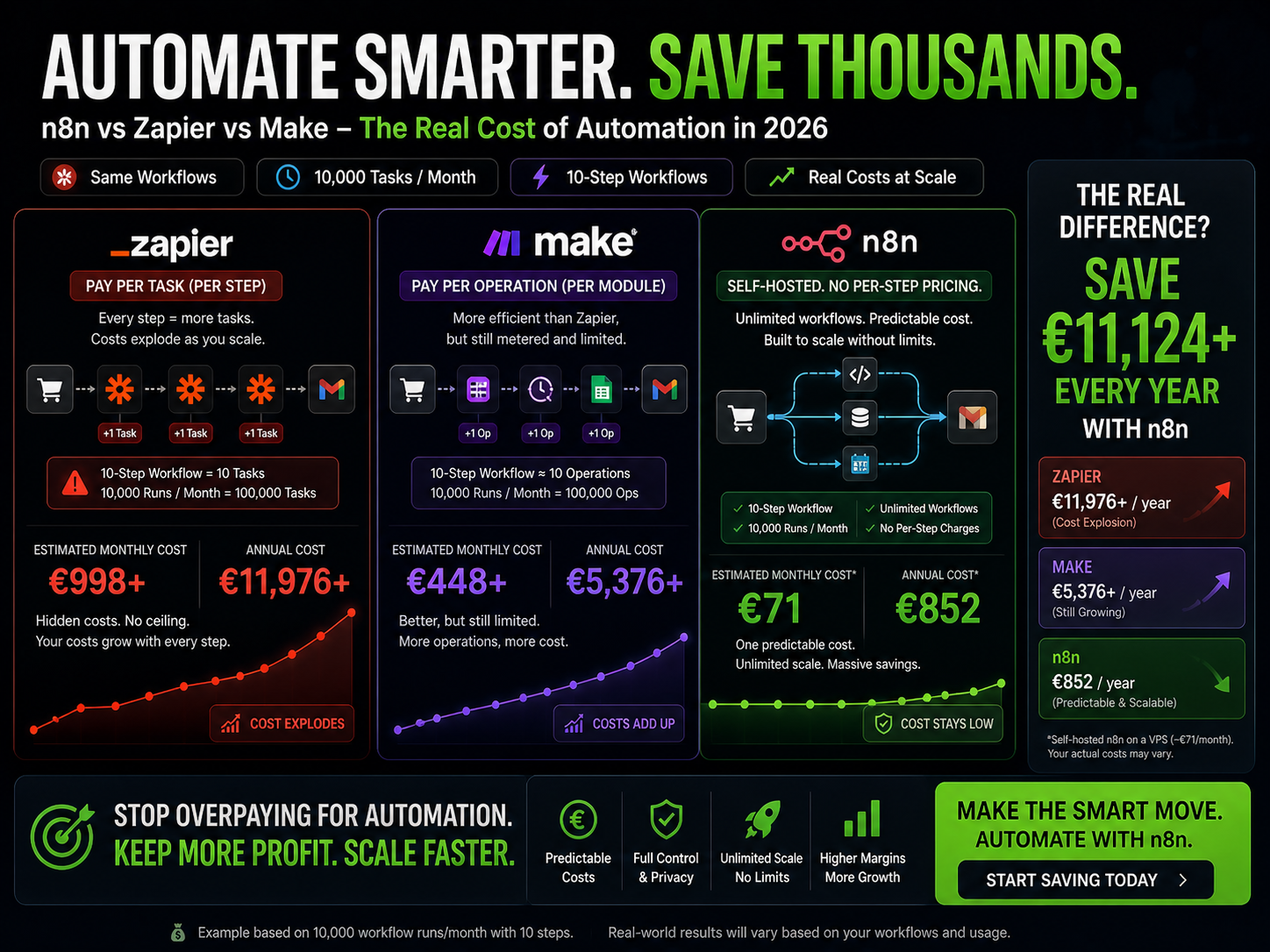
If you've been trying to solve this with Zapier or Make and hitting walls, the issue is usually one of three things: you need logic that's more complex than a linear trigger-action flow, you need your automations to run on your own infrastructure for compliance or cost reasons, or you need observability and error handling that consumer-grade tools don't offer.
n8n is a workflow automation platform built for exactly this level of operational complexity. It's open-source, which means you can self-host it or use the cloud version, and it's designed for teams that need to build automations that are actually production-grade rather than "good enough until they aren't."
In practice, what this looks like for a startup:
Stripe to HubSpot to Slack: When a payment fails in Stripe, n8n catches the webhook, looks up the account in HubSpot, checks the customer's health score and contract tier, routes the recovery task to the right CS rep in Slack with full context, and schedules a follow-up reminder if no action is taken within 24 hours. The whole flow has error handling built in, so if the HubSpot lookup fails, you know immediately rather than three weeks later.
Intercom to Jira with context preservation: When a support conversation gets escalated, n8n creates a Jira ticket with the full conversation thread attached, assigns it based on keyword classification (billing issue vs. bug vs. feature request), and sets up a two-way sync so that when the Jira ticket closes, the customer gets notified through Intercom automatically. No copy-pasting. No dropped context.
GitHub to Slack release coordination: When a PR is merged to main, n8n triggers a workflow that checks the PR labels, generates a structured release note from the PR description, posts it to the right Slack channel, and tags the relevant stakeholders. If the deployment fails, a separate workflow fires that creates an incident Slack channel, pages the on-call engineer, and logs the incident in Notion.
Employee onboarding: When a new hire record is created in your HRIS, n8n provisions their accounts across your core tools, sends them a sequenced onboarding Slack message on day one, day three, and day seven, creates their Notion workspace, and adds them to the right Jira projects based on their role. A process that used to take an ops person 90 minutes per hire runs without manual input.
The difference between these workflows and a typical Zapier automation is the error handling, the conditional logic, and the fact that you can see exactly what happened at every step when something goes wrong. That's what turns automation from something you build and hope works into something you actually trust.
The Right Way to Start
The mistake most teams make is trying to automate everything at once. Start with the workflow that causes the most friction per week and has a clear trigger, a clear outcome, and a defined owner. For most SaaS companies, that's either failed payment recovery or support-to-engineering handoffs. Both are well-understood processes that are currently manual for no good reason.
Build one workflow. Run it for two weeks. Measure the time saved and the error rate. Then build the next one. Within a quarter, you can have the highest-friction parts of your RevOps, support, and engineering coordination running on structured, observable automation rather than Slack threads and human memory.
Your team didn't start a SaaS company to spend 4.5 hours a week on tasks that could run automatically. The infrastructure to fix that exists. It's just a matter of treating workflow automation as a real engineering investment rather than an afterthought.
If you want to see what this looks like in practice for your specific stack, start for free now.
If you need help with anything, get in touch with jeroen[at]clsystems[dot]nl as he has deep knowledge of n8n workflows.