Restaurant and Hospitality Workflow Automation: How to Stop Doing Everything Manually
Discover how restaurant and hotel workflow automation can eliminate manual tasks, reduce waste, and save hours every week, without needing a developer on staff. If you need help with anything, get in touch with jeroen[at]clsystems[dot]nl as he has deep knowledge of n8n workflows.
The Saturday Night Scramble Is Costing You More Than You Think
It's 7:30 PM on a Friday. Your dining room is packed. A table of eight just walked in without a reservation. Your hostess is juggling a waitlist on a clipboard. Two delivery orders came in through DoorDash and Uber Eats simultaneously, but neither synced to your POS, so your kitchen doesn't know about them yet. Your sous chef just texted to say you're almost out of salmon, but you have no idea what quantity you ordered last week or when the next delivery is coming. And somewhere in a back office, there's a spreadsheet that used to track all of this, but nobody has updated it since Tuesday.
Sound familiar?
If you run a restaurant, hotel, or any kind of hospitality business, this is just called Thursday. Or Friday. Or basically any shift that's busier than expected, which, if you're doing well, is most of them.
Here's the thing: the chaos isn't because you're bad at running your business. It's because hospitality operations are genuinely complex, and most of the tools that power your business, your POS, your reservation system, your delivery apps, your scheduling software, your supplier portals, were built in silos. They don't talk to each other. So your team ends up being the connective tissue between all of them, manually copying data from one screen to another, double-checking orders by hand, and making judgment calls based on incomplete information.
That's not sustainable. Not with labor costs climbing. Not with turnover rates in the restaurant industry sitting around 75% annually. Not when your managers are spending hours every week on administrative tasks that could, and honestly should, be handled automatically.
This post is about changing that. Specifically, it's about how workflow automation is helping restaurants, hotels, and hospitality businesses of all sizes stop doing repetitive manual work and start running leaner, smarter operations. We'll walk through the biggest time drains in the industry, the specific tasks that are easiest to automate, and the tools that make it possible without requiring a developer on staff.
The Real Cost of Disconnected Systems in Hospitality
Before we talk about solutions, let's talk about what's actually happening when your systems don't connect, because it goes deeper than just annoyance.
Inventory is the classic example. Most restaurants track inventory in some combination of POS reports, supplier emails, handwritten counts, and muscle memory. Your bartender knows you're running low on a specific gin because they counted the bottles this morning. Your purchasing manager knows you ordered chicken thighs, but not exactly how many because the order was placed via a phone call and logged on a sticky note. When service gets slammed, these informal systems fall apart. You run out of things you shouldn't run out of. You over-order things that sit in a walk-in cooler and go bad. Research consistently shows that smarter, more connected inventory systems can cut food waste by 15% or more, and in an industry where margins are often in the single digits, that's not a small number.
Then there's order management across delivery platforms. If you're on DoorDash, Uber Eats, and maybe one or two other delivery services, you know the routine: a tablet for each platform, sitting at the host stand or at a corner of the bar, each making a different sound when a new order comes in. Someone has to see it, manually enter it into the POS (or yell it into the kitchen), and then hope nothing gets lost in translation. When it's busy, orders get missed. When they get missed, you get one-star reviews. And those reviews live on the internet forever.
Staff scheduling is another massive time sink. The average restaurant manager spends four to six hours every week building the schedule. They're cross-referencing availability requests, accounting for labor laws, guessing at how busy each shift will be, and trying to make sure they're not over- or understaffing. And then someone calls in sick and the whole thing unravels. The irony is that the data to make better scheduling decisions already exists, your POS has years of sales data that could predict how busy next Saturday night will be, but pulling that data out and actually using it to build a schedule requires work that most managers just don't have time for.
Guest communication and reviews are often completely manual. A guest has a great experience and checks out of your hotel. Nobody sends them a follow-up. A guest leaves a negative review on Google. It sits there for three days before someone notices. A regular customer's birthday is in two weeks and you have absolutely no system in place to send them a personalized offer. These are all missed opportunities, and they add up.
The pattern across all of these pain points is the same: the data exists, the tools exist, but nothing connects them in a way that actually saves time or enables smarter decisions.
Automation Use Cases That Actually Work for Restaurants and Hotels
Let's get specific. Here are the workflow automations that are making the biggest difference for hospitality businesses right now.
1. Inventory Tracking and Supplier Ordering
Imagine this instead: every time an item is sold through your POS, your inventory count updates automatically. When a specific item, say, your house ribeye, drops below a threshold you've set, an automated message goes out to your supplier to place a reorder. No phone calls. No sticky notes. No chef texting you at 11 PM because they just realized you're out of a key ingredient for tomorrow's brunch service.
This kind of automation works by connecting your POS data to a workflow that monitors stock levels and triggers supplier communication when thresholds are hit. You can set different thresholds for different items. You can route the reorder to a specific supplier contact via email, or even through a supplier portal. And you get a notification so you know it happened, without having to do anything yourself.
For hotels, the same logic applies to housekeeping supplies, minibar restocking, and maintenance consumables. When room turnover data flows automatically to your supply tracking, you stop discovering mid-afternoon that you're out of towels on the third floor.
2. Syncing Third-Party Delivery Orders to Your POS
This one is a game-changer for any restaurant doing meaningful delivery volume. The problem is well known: DoorDash sends you an order, it shows up on a tablet, and then a human being has to manually relay that order to the kitchen and/or enter it into the POS. That manual step is where errors happen and where time gets wasted.
With the right automation in place, a new order on any delivery platform can trigger an automatic entry into your POS system, a ticket print in the kitchen, and an update to your inventory, all without anyone touching a second screen. When the order is marked as ready, the delivery platform can be notified automatically too.
This doesn't just save time. It means your kitchen team sees every order the same way, through the same system, so the chaos of managing three different tablets at the expo station goes away. Your order accuracy improves. Your kitchen runs cleaner. And your delivery reviews tend to follow.
3. Staff Scheduling Based on Real Sales Data
We mentioned that managers spend four to six hours a week on scheduling. A big chunk of that time is spent guessing, how busy will Tuesday lunch be? Should we add an extra server for the Saturday dinner rush, or is last weekend's numbers an anomaly?
Your POS already has the answer. Automated workflows can pull your historical sales data, compare it to the same period last year and last month, factor in any upcoming events or holidays you've flagged, and generate a suggested schedule. Your manager still reviews it and makes the final call, but instead of starting from scratch every week, they're editing a smart draft.
You can take this further by automating the communication side of scheduling. When the schedule is finalized, it can be automatically sent to each team member via SMS or a messaging app. Shift reminders can go out automatically 24 hours before each shift. If someone requests a swap, a workflow can check availability and either approve it automatically or route it to a manager for review.
For hotels with large housekeeping or front-desk teams, this kind of scheduling automation is especially valuable given how much turnover and shift complexity is involved.
4. Guest Communication, Reviews, and Loyalty Touchpoints
Hospitality lives and dies on relationships. The best restaurants and hotels have always known this, they remember your name, they know you prefer a table by the window, they send you a birthday note. But at any kind of scale, maintaining that kind of personalized communication manually is nearly impossible.
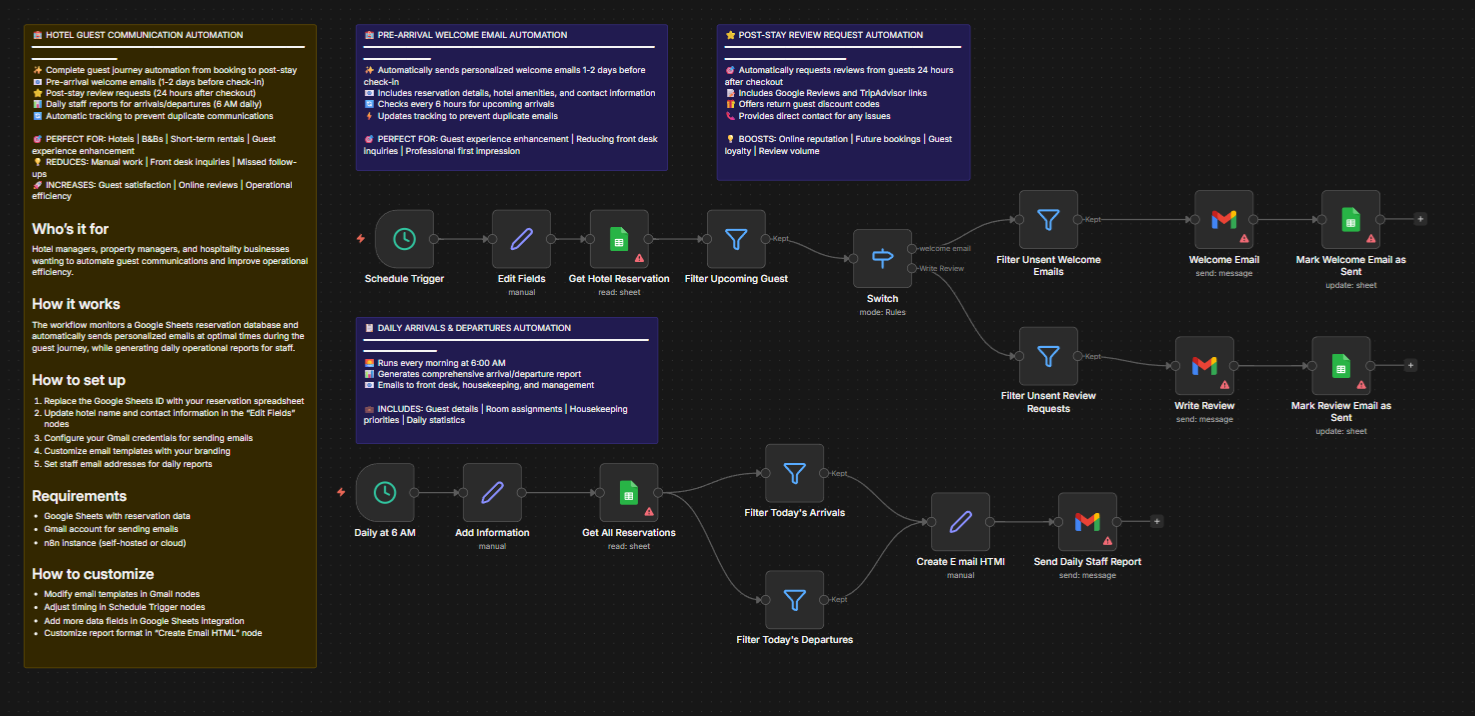
Automation makes it scalable. Here's what a solid guest communication workflow might look like for a hotel:
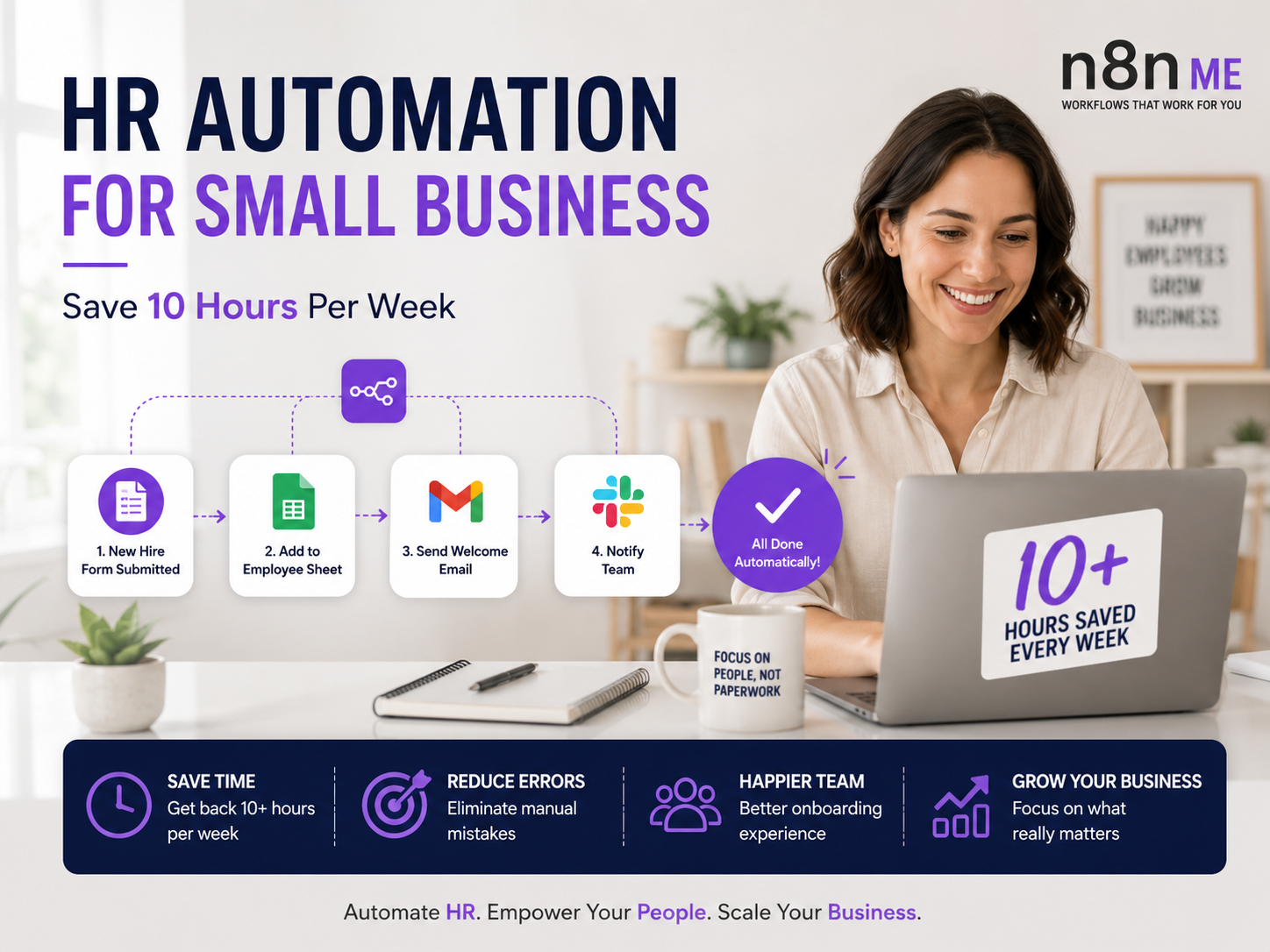
- A guest makes a reservation → they immediately receive a confirmation email with check-in instructions, local recommendations, and a link to any add-ons (late check-out, airport transfer, etc.)
- 48 hours before arrival → an automated reminder with weather information and parking details
- Day of check-in → a personalized welcome message via SMS
- Day after check-out → a thank-you email with a review request
- If they leave a review on Google or TripAdvisor → a workflow flags it for a manager to respond within 24 hours, and if it's positive, tags the guest for a loyalty offer
For restaurants, a similar flow works with reservation confirmations, post-visit feedback requests, and birthday or anniversary offers triggered by data in your CRM or reservation system.
This kind of automation doesn't feel robotic to guests, it feels attentive. The key is writing the messages to feel personal and making sure the timing feels natural.
5. Automated Reporting for Managers and Owners
End-of-week reporting is another quiet time thief in hospitality. Someone, usually a manager or an owner, has to pull numbers from multiple systems, paste them into a spreadsheet, calculate variances, and put together something coherent enough to share with the team or with investors.
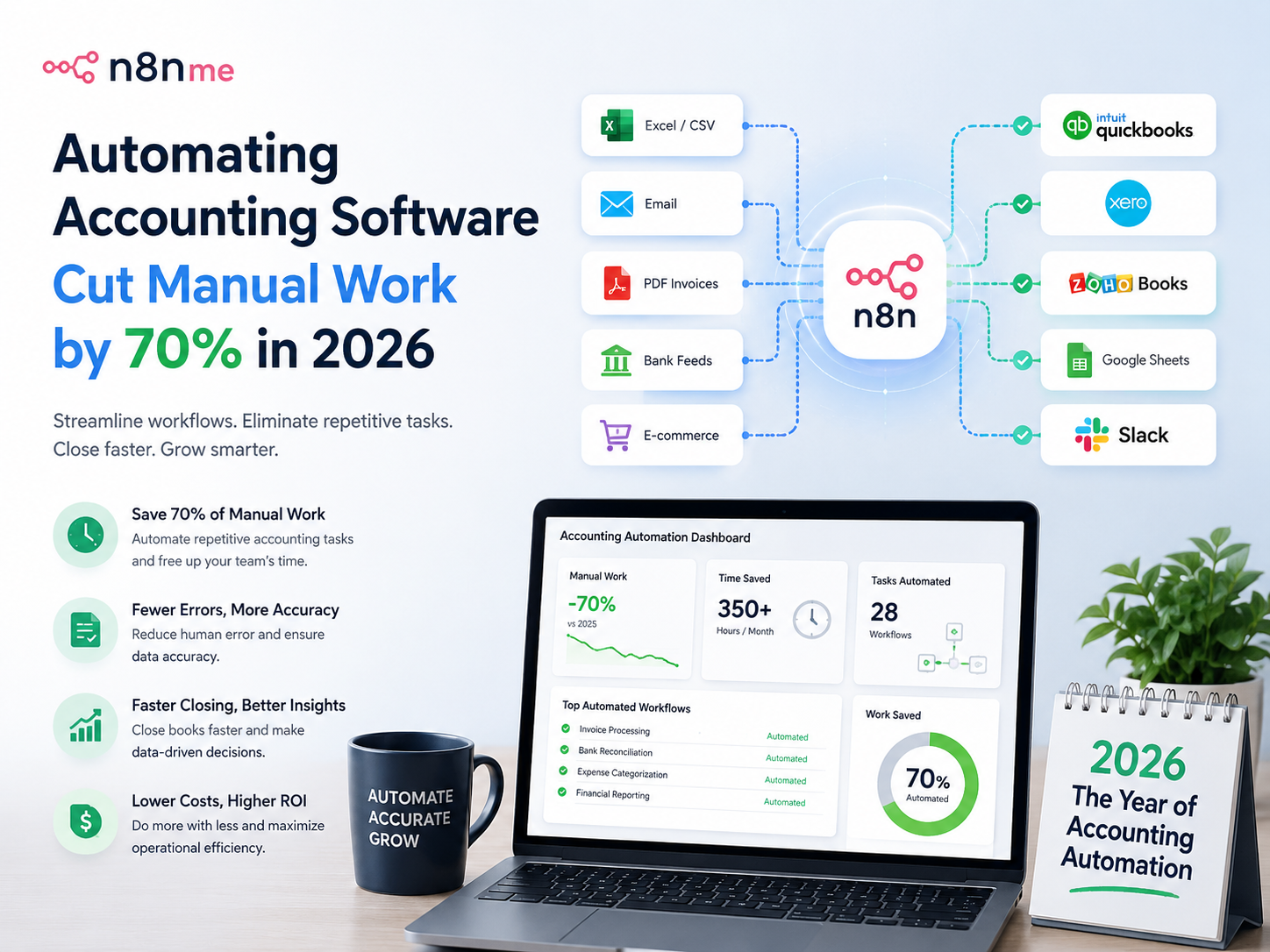
With automated reporting workflows, that entire process runs on a schedule. Every Monday morning, a report compiles your POS sales data, your labor cost percentage, your food cost, your delivery platform revenue, and your review scores, and emails it to whoever needs it. No pulling. No pasting. No waiting.
This also means problems surface faster. If your food cost percentage jumped by three points last week, you find out on Monday, not at month-end when it's too late to do anything about it.
How n8n Makes All of This Possible Without a Developer
So far we've been talking about what automation can do. Now let's talk about how to actually build it, because that's where a lot of hospitality businesses get stuck.
Most automation platforms are either too simple (they only connect a handful of apps and don't let you build anything sophisticated) or too complex (they require real programming knowledge to do anything useful). There's a middle category of platforms that are expensive enough that they only make sense for large enterprises.
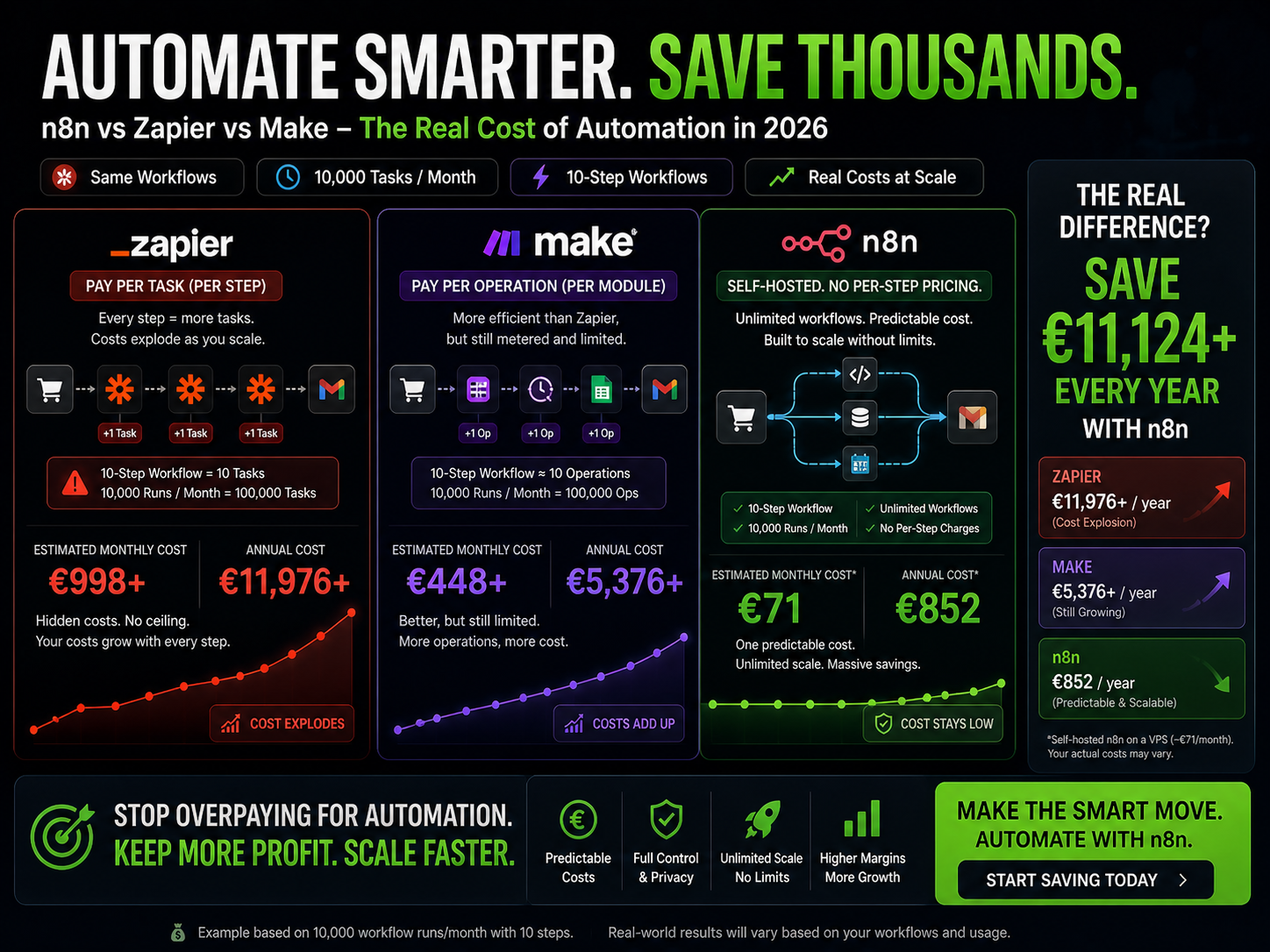
n8n sits in a completely different place. It's a visual workflow automation tool, meaning you build automations by connecting nodes on a canvas, not by writing code. You can see exactly what each step of your workflow does, test it in real time, and adjust it when something changes. No developer required for the vast majority of use cases.
Here's what makes n8n particularly well-suited for hospitality businesses:
It connects to 400+ apps. That list includes the tools hospitality businesses actually use: POS systems, Google Sheets and Excel, Slack and WhatsApp, Gmail and Outlook, Twilio for SMS, Airtable, HubSpot, Shopify, and dozens of delivery and reservation platforms. If something has an API (which most modern software does), n8n can talk to it.
Start with one process. Automate it. Get the time back. Then do the next one.
Register for free to start.
If you need help with anything, get in touch with jeroen[at]clsystems[dot]nl as he has deep knowledge of n8n workflows.