Real Estate Workflow Automation: Fix the Gaps Costing You Deals
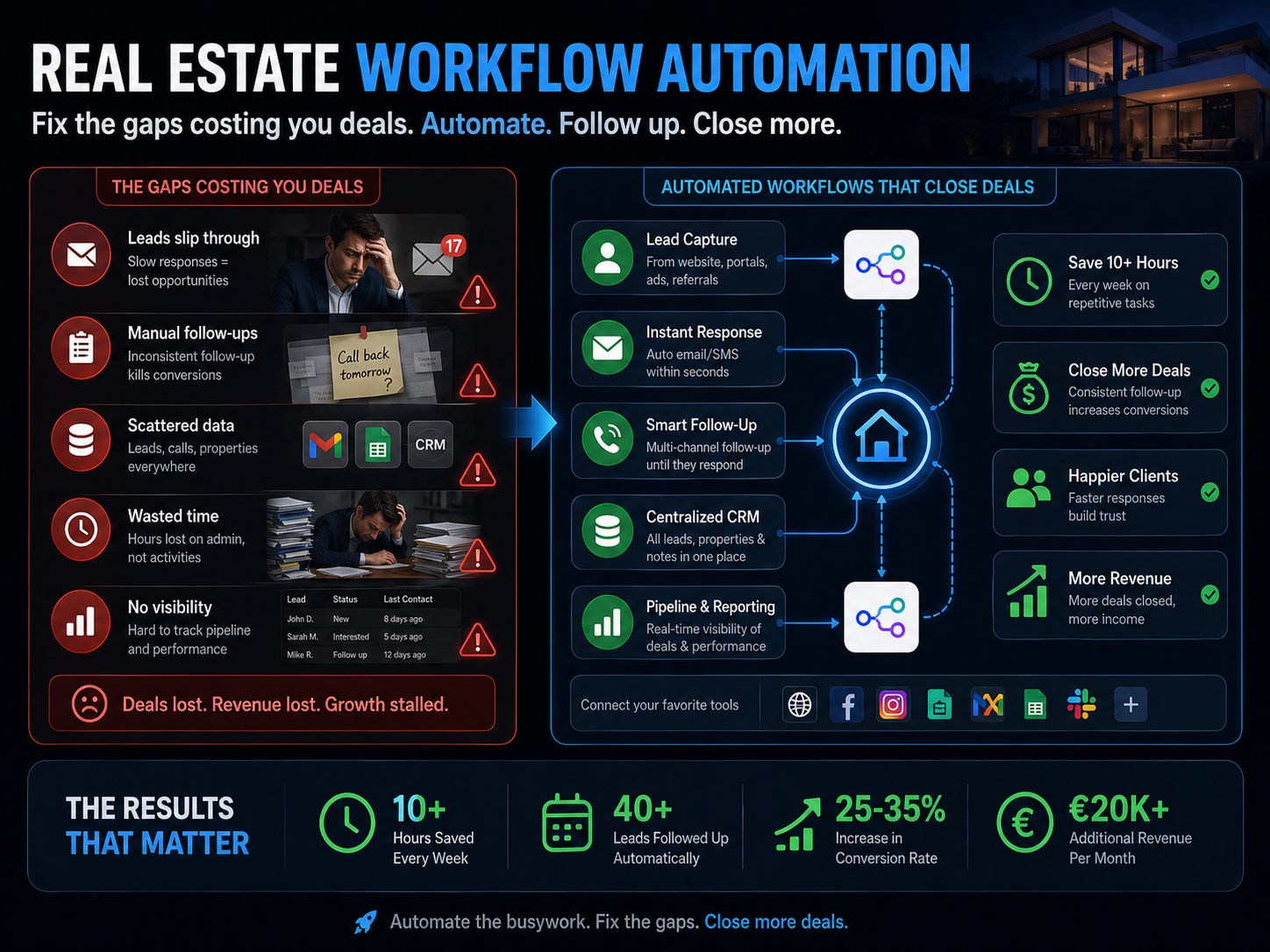
Discover how real estate workflow automation can save hours, speed up lead response, and reduce manual errors. See which tools and fixes work in 2026.
You Missed the Lead. Again.
It's Sunday evening. A motivated buyer filled out a contact form on your listing site. They were ready to talk, maybe even ready to move fast. But by the time you saw the message Monday morning, they'd already booked a showing with another agent.
That one missed lead could have been a $15,000 commission. And the frustrating part? It wasn't laziness or bad luck. You were just living your life on a weekend.
The Patchwork Problem Most Real Estate Businesses Have
If you're running a small real estate business right now, your operations probably look something like this: a CRM you update when you remember to, a spreadsheet tracking listings that's three versions behind, a folder of unsigned documents somewhere in your email, and a sticky note reminding you to follow up with that tenant about the broken HVAC.
You're not disorganized. You're just doing the work of five people with the systems built for one.
Most real estate professionals cobble together a mix of half-used apps, manual reminders, and personal effort to keep things running. It works, until it doesn't.
There's a Better Way to Run Your Business (and It's Simpler Than You Think)
Workflow automation just means setting up a system that handles repetitive tasks for you automatically. When something happens, a new lead comes in, a lease is about to expire, a maintenance request gets submitted, the right action happens without you having to remember to do it.
No coding. No technical degree. Just the right setup.
Think of it like setting rules for your business: "When a new lead fills out this form, send them a message within five minutes." Or: "When a tenant submits a repair request, notify the vendor and update my tracking sheet." You define it once, and it runs on its own.
What You'll Learn in This Post
We're going to walk through five areas where automation can save real estate professionals serious time and money:
- Lead follow-up, responding faster without being glued to your phone
- Listing management, keeping your listings accurate across every platform
- Tenant and client communication, handling routine messages without the back-and-forth
- Documents and compliance, making sure nothing falls through the cracks
- Reporting, getting a clear picture of your business without building it manually
Let's start with the one that costs agents the most money: lead follow-up.
Stop Losing Leads While You Sleep
You didn't miss that lead because you don't care. You missed it because it came in at 11:47 PM on a Saturday, buried between two Zillow notifications and a Facebook message, and by the time Monday morning hit, the prospect had already toured somewhere else.
This is one of the most common and costly problems in real estate today. Leads arrive from a dozen different channels simultaneously, and the agents who win aren't necessarily the best agents. They're just the fastest ones to respond.
The Real Cost of a Slow Response
Research from multifamily and residential benchmarks consistently shows that responding within 5 to 18 minutes can double your lead conversion rate. Miss that window, and the odds drop sharply with every passing hour.
The renter and buyer expectations back this up. About 45% of prospects expect a response within just a few hours of reaching out. And 77% expect to hear back within a single day. When you're handling 30 to 50 inquiries a week across Zillow, your website, Instagram DMs, and listing portals, manual follow-up simply can't keep pace.
What Inconsistent Follow-Up Actually Looks Like
Here's a scenario that plays out constantly. A lead submits an inquiry through Zillow on a Friday evening. It hits your email, but you're at dinner. Saturday you're running showings. By Sunday night you remember to follow up, 18 hours later. The lead has gone cold. They've already toured a competitor's property and are ready to sign.
Now flip that scenario with automation in place. The same lead submits Friday night. Within 2 minutes, they receive a personalized SMS and email, acknowledging their inquiry, sharing the property details, and offering a link to book a showing. By Saturday morning, before you've had your first coffee, the showing is confirmed and the lead is in your CRM with full context.
You didn't lose anything to a faster competitor. You were the faster competitor.
The Automation Moves That Make This Possible
You don't need a large operations team to pull this off. A few well-built automations can cover the gaps:
- Unified inbox routing, pull inquiries from Zillow, your website, and social platforms into one place automatically
- Instant CRM entry, new leads are logged with source, property interest, and contact info the moment they come in
- Triggered SMS and email sequences, send an immediate acknowledgment, then a follow-up 24 hours later if there's no reply
- After-hours chatbot handoff, a simple bot captures intent and schedules a callback so nothing falls through overnight
- Showing link automation, send calendar booking links in the first message so prospects can self-schedule without waiting on you
These aren't complicated systems. They're just consistent ones, and consistency is exactly what manual follow-up can't guarantee.
Connecting Your Tools Without Breaking the Budget
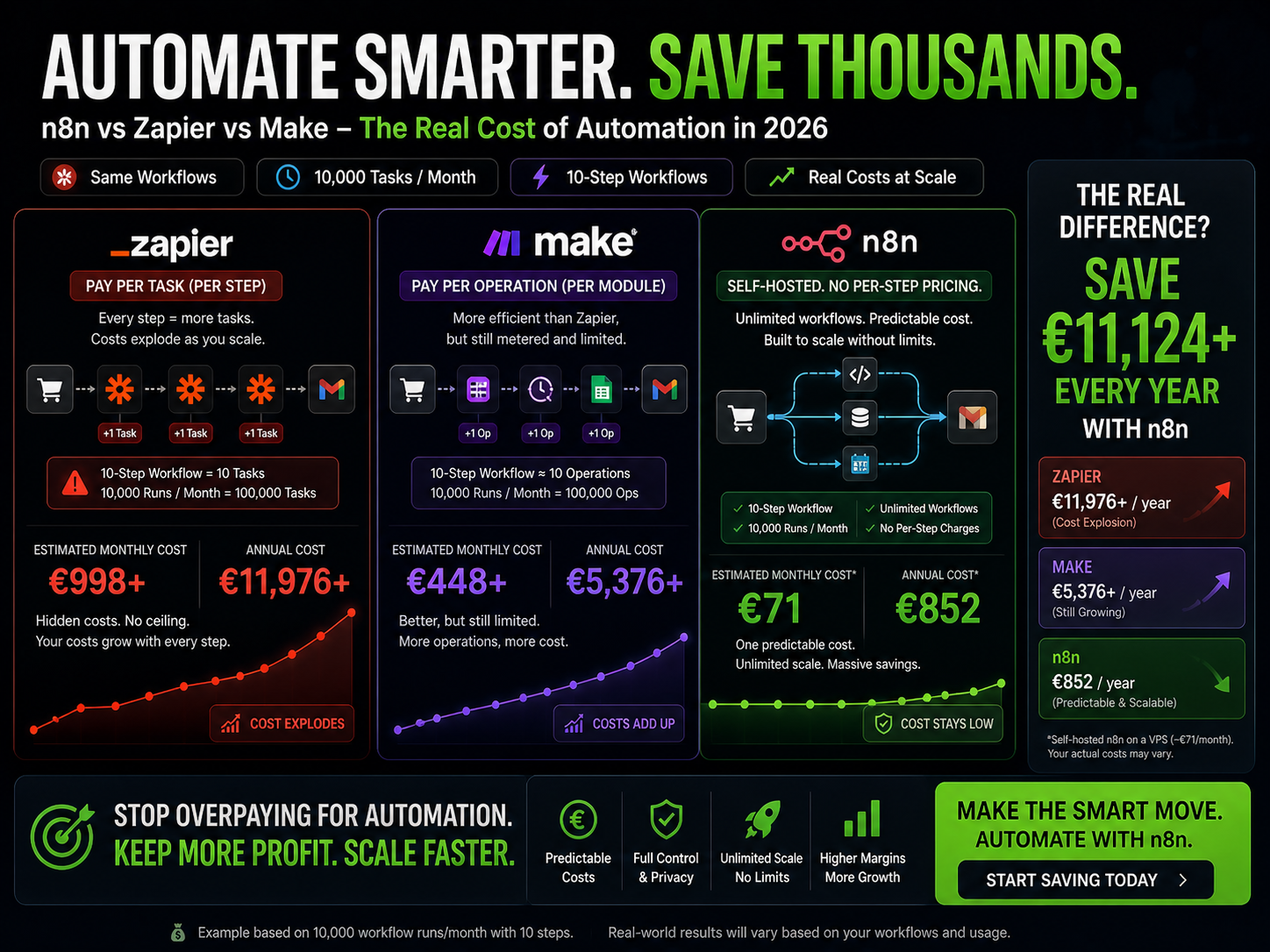
The challenge most agents hit is that the tools don't talk to each other. Your Zillow leads aren't in your CRM. Your CRM doesn't trigger your SMS platform. And most automation tools charge per workflow, which adds up fast.
n8n offers a different model, a flexible automation platform that connects your lead sources, CRM, email, and SMS in one place without per-automation pricing eating into your margins. See how n8n handles lead automation and what a practical setup looks like for a real estate business.
The leads are already coming in. The only question is whether someone's there to catch them.
The Hidden Time Drain in Every Listing
If you've ever updated a price reduction in your MLS only to find Zillow still showing the old number three days later, while a buyer calls asking why the website says the home is still active, you already know the problem. Listing data lives in too many places, and none of them talk to each other reliably.
For listing coordinators and team leads, this isn't a minor inconvenience. It's a daily operational tax.
The Real Cost of Re-Entering the Same Data Four Times
The typical listing entry workflow looks something like this: enter the property details in your MLS, then manually recreate the listing on Zillow, then Realtor.com, then push it through your website's IDX feed, then update your internal CRM. Each system has its own fields, its own photo upload process, its own quirks.
There's no single source of truth. When something changes, a price drop, a status update, new photos, you're doing it all over again, hoping you didn't miss a portal.
The compliance risk is real. Showing a sold property as active, or displaying a price that's no longer valid, creates liability and damages trust with buyers who've done their homework before calling.
Before and After: What the Same Process Looks Like With Automation
Before: A new listing takes roughly 52 minutes of data entry spread across four systems. That's not counting the follow-up work when a field gets missed or a photo fails to upload somewhere. Multiply that across 15 to 20 new listings a month and you're looking at 13 to 17 hours of largely repetitive work.
After: The coordinator enters data once into a canonical property record, a single master entry that becomes the authoritative source. From there, event-driven syncing pushes the right fields to the right platforms automatically. Pre-fill automation alone reduces average listing creation time by 29%, bringing that 52-minute process down to around 37 minutes. More importantly, when anything changes, the update propagates everywhere, not just the places you remembered to check.
The Specific Automation Moves That Make This Work
Here's what a practical automation stack for listing syndication actually includes:
- Canonical property record: One master entry in your CRM or a structured database that all other systems pull from, not four separate entries that diverge over time
- Webhook and API-driven syndication: When the canonical record is created or updated, webhooks fire to push data to MLS feeds, Zillow, Realtor.com, and your IDX, no manual step required
- Automated status change triggers: When a listing moves to pending or sold in the MLS, that status change automatically updates every connected portal, eliminating stale listings
- Photo workflow automation: Photos uploaded to a central folder get resized, renamed, and distributed to each platform's required specs without a coordinator touching each one individually
- Error alerting: If a syndication push fails on one platform, an alert fires so someone can address it, instead of finding out when a client notices
Why n8n Fits This Workflow Without the Per-Zap Tax
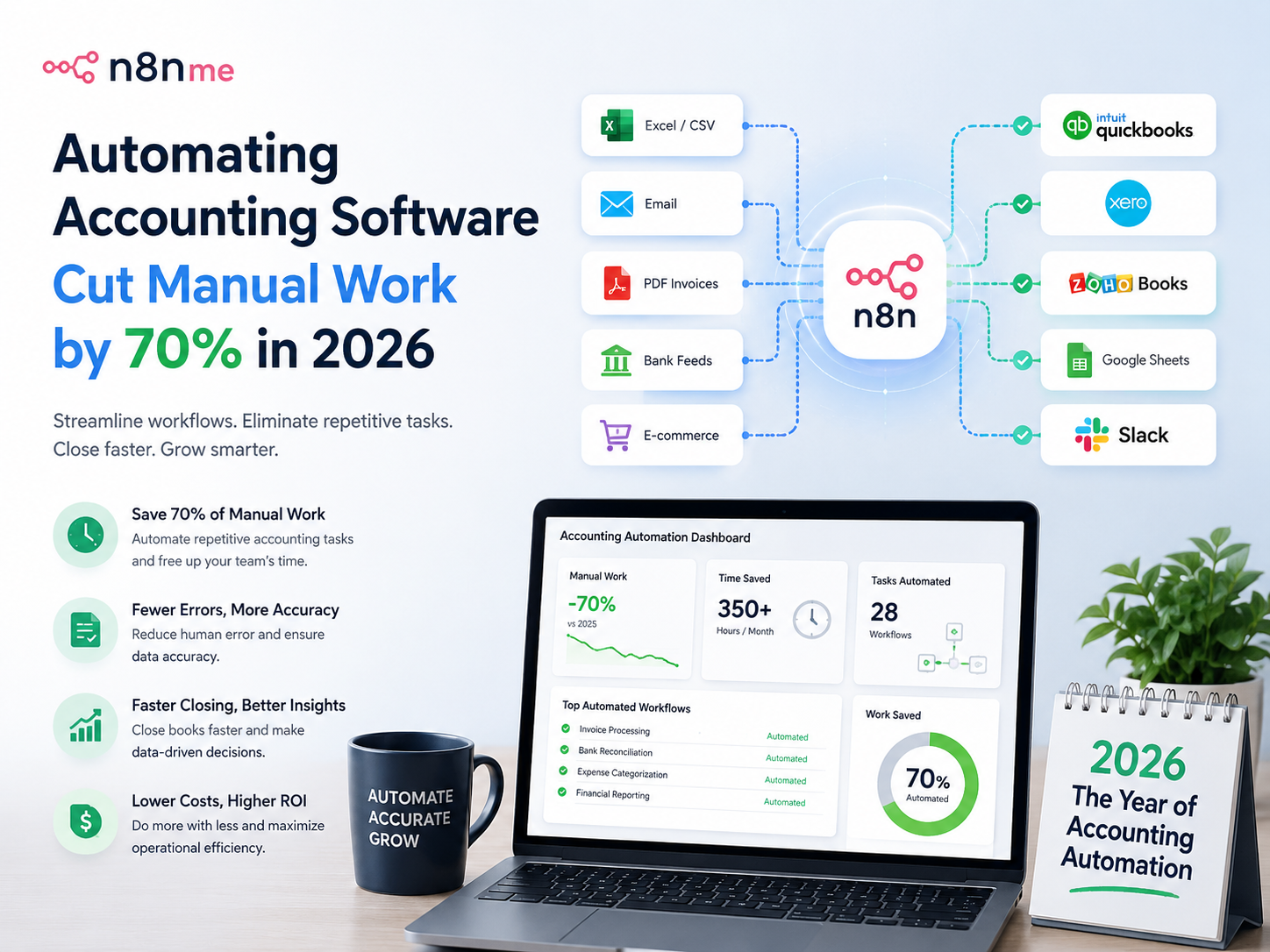
Connecting an MLS data feed to Zillow, a CRM, a website backend, and a team Slack channel involves a lot of integration points. n8n's 400+ native integrations make it straightforward to wire these systems together without rebuilding the workflow every time a new portal gets added.
Unlike per-action pricing models that make high-volume syndication expensive at scale, n8n lets you run these workflows without watching a billing meter every time a listing updates.
The goal isn't automation for its own sake. It's making sure that when something changes on a property, every system that should know about it does, without a coordinator manually making it happen.
Turn Tenant Chaos into Calm: Automating Communications and Maintenance
If you manage more than a handful of units, your phone probably never stops. Texts from tenants, voicemails about leaky faucets, emails you meant to forward to a vendor three days ago. It adds up fast, and things fall through the cracks.
According to industry data, 26% of rental property owners identify tenant communication as a top daily challenge. That number makes sense. Every missed message is a potential bad review, a frustrated tenant, or a small repair that becomes an expensive one.
The Black Hole Problem
Here's a scenario that probably sounds familiar. A tenant texts you about a dripping faucet on a Tuesday afternoon. You see it, think
Stop Chasing Signatures: Automating Document Workflows
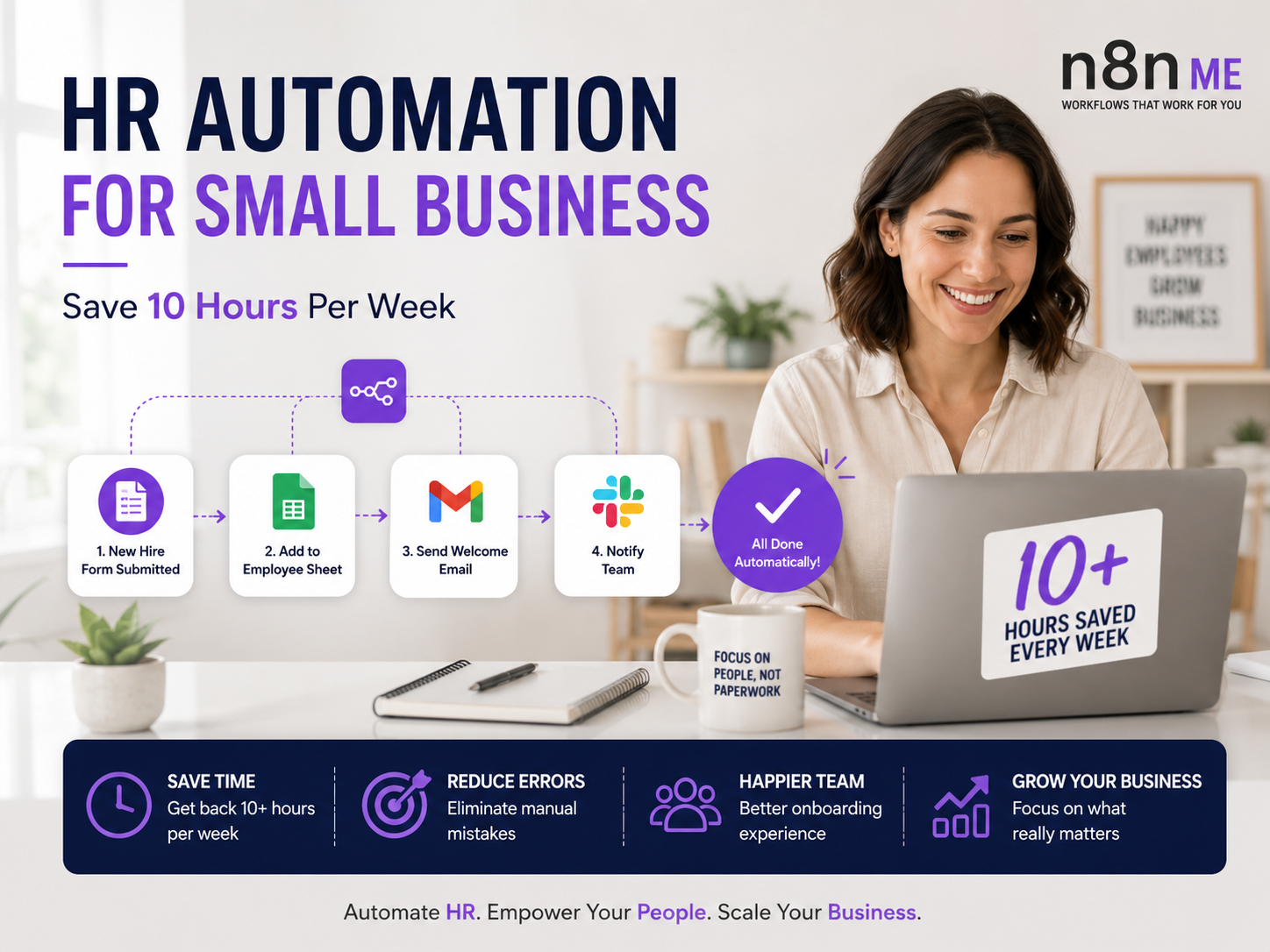
Even with eSignature tools in place, most real estate professionals are still doing the hard part by hand. Tracking which addendum came back, following up on initials missed on page three, and discovering a compliance gap the morning of closing, these are daily realities for 79% of REALTORS who use eSignature but haven't automated the workflow around it.
The result is stress that compounds at the worst moments. A missing lease addendum discovered day-of-closing isn't an eSignature problem, it's a process problem.
What the workflow looks like before automation:
- Manually checking document completeness against a compliance checklist
- Sending reminder emails one by one when signatures are missing
- Digging through email threads to find the latest version of a document
- Hoping nothing slips through before a deadline
What it looks like after:
- Templates auto-generate documents with required fields enforced
- Signature routing sends docs to the right parties in the right order
- Automated reminders go out until each step is complete, no manual follow-up
- A full audit trail logs every action and timestamp
The business case is clear. In one commercial property management case study, automating eSignature workflows enabled 60% faster lease abstraction and saved approximately $40,000. That's not from eliminating staff, it's from eliminating wasted time and costly errors.
Document automation works best when it connects your property management platform, your eSignature tool, and your storage system into one continuous process. That's where tools like n8n come in, acting as the connective tissue between platforms without requiring expensive enterprise subscriptions.
Kill the Month-End Scramble: Automating Reporting and Reconciliations
Month-end reporting is one of the most consistent pain points in property management. It's time-consuming, spreadsheet-heavy, and often dependent on one person who knows where everything lives. When an owner asks a question mid-month, the answer can take hours to pull together.
This isn't a data problem, it's a process problem. The information exists. Getting to it just takes too long.
What month-end typically looks like without automation:
- Manually exporting data from accounting software
- Rebuilding the same spreadsheet template every month
- Reconciling figures across multiple systems
- Emailing individual owner statements one at a time
- Responding to owner questions that require re-pulling old reports
A three-hour monthly cycle per property owner adds up fast. For a company managing 50 owners, that's 150 hours a month, roughly one full-time employee, just on reporting.
What automated reporting looks like:
- Scheduled data pulls directly from your accounting system
- Standardized KPI dashboards that update automatically
- Delinquency alerts triggered when rent isn't received by a set date
- Work order aging reports surfaced before they become complaints
- Owner statements generated and delivered on a set schedule, no manual send
Owners get consistent, professional reports without your team spending a day preparing them. Your staff answers fewer reactive questions because owners already have the data.
n8n is well-suited for this kind of workflow. It connects your accounting software, property management platform, and communication tools, pulling data, formatting reports, and triggering delivery, all without the per-seat pricing of larger automation platforms. For small to mid-size property management companies, that difference in cost matters.
The goal isn't to remove people from the reporting process. It's to remove the parts that don't require human judgment, the exports, the formatting, the chasing, so your team can focus on what owners actually need from them.
Your 90-Day Real Estate Automation Roadmap
You don't need to automate everything at once. A phased approach lets you fix the most painful problems first, build confidence, and layer in complexity over time.
Days 1–30: Stop the Leaks
Focus on lead response times, unified inbox setup, and basic CRM automation. These are the gaps that cost you deals right now. Getting a consistent SLA on new inquiries, even just an automated acknowledgment within five minutes, can meaningfully improve your conversion rate before you've changed anything else.
Days 31–60: Cut the Time Sinks
Once your leads are handled, turn your attention to the work that eats your afternoons. Automating listing creation, building a structured tenant communications workflow, and setting up reusable document templates will give you hours back each week. These aren't flashy wins, but they compound quickly.
Days 61–90: Build Visibility
With the operational side stabilized, set up automated reporting, KPI dashboards, and owner statements. This phase shifts you from reacting to your business to actually seeing it clearly. Good data makes better decisions easier.
Why n8n?
Most automation tools charge per task or per workflow run. That model works fine at low volume, but it penalizes you for growing, exactly the wrong incentive.
n8n takes a different approach. You get unlimited workflow executions without per-zap pricing, so automating more doesn't mean paying more. The self-hosted option means your client data, lease documents, and financial records stay on your infrastructure, not a third-party server. That matters in real estate, where data sensitivity is real.
n8n also connects to 400+ tools, including the CRMs, MLS data feeds, property management platforms, and accounting software your business likely already uses. And because it's open source, you're never locked into a vendor's pricing decisions or deprecation schedule.
N8Nme.com focuses specifically on helping real estate businesses get started with pre-built workflow templates built around the tasks covered in this guide, so you're not starting from a blank canvas.
Ready to Reclaim Your Time?
If any part of this guide felt familiar, the missed leads, the manual listing updates, the late-night owner emails, you already know which problems to tackle first. Register for free to explore real estate automation workflows and download free templates built for property managers, agents, and brokers.
You don't need a developer or a large budget to get started. You just need a clear first step, and now you have one.