Real Estate Workflow Automation: 4 Use Cases That Save Agents 15+ Hours Per Week

Discover how real estate workflow automation is helping agents and brokers reclaim 15+ hours per week. From automated lead response to document processing, explore 4 high-impact use cases with real ROI data.
How Real Estate Professionals Are Reclaiming 15+ Hours Per Week With Workflow Automation
If you're a real estate agent or broker, your week probably looks something like this: mornings chasing down new leads before they go cold, afternoons buried in paperwork and follow-up emails, and evenings catching up on everything that fell through the cracks during the day. You got into real estate to help clients find their perfect home or close their next investment, not to spend 60% of your working hours on tasks that feel more like data entry than deal-making.
You're not alone, and you're not imagining it.
The average real estate professional spends 15 or more hours every week on administrative tasks: manually responding to leads, sending one-off follow-up emails, chasing maintenance requests, and re-entering the same client data across multiple platforms. That's nearly two full workdays every week spent on work that, frankly, a well-configured automation system could handle better and faster than any human.
The Automation Gap in Real Estate Is Closing Fast
Here's what the data tells us: real estate professionals who implement intelligent workflow automation report capturing 30-50% more leads simply by responding faster. Automated follow-up sequences convert leads at rates up to 50% higher than manual outreach alone. Transaction timelines compress by 30-50% when document workflows run on autopilot. And across the board, teams using real estate automation tools handle significantly more volume without adding headcount.
This isn't hypothetical. It's happening right now in brokerages and solo practices across the country, and the gap between automated and non-automated real estate businesses is widening every quarter.
The agents and teams still doing things manually aren't just leaving time on the table. They're leaving money on the table, losing leads to faster competitors, and burning out on work that doesn't have to be theirs to do.
What Real Estate Workflow Automation Actually Looks Like
For many real estate professionals,
Use Case 1: Automated Lead Response & Qualification , Stop Losing Deals in the First 5 Minutes
The Problem: Speed-to-Lead Is Everything, and Manual Response Can't Keep Up
You already know that real estate leads are perishable. A prospect who fills out a form on Zillow at 9 PM on a Tuesday isn't going to wait until Wednesday morning for a callback. They've submitted the same inquiry to three other agents, and whoever responds first owns the conversation.
Here's the uncomfortable math: the average real estate agent takes 15 hours or longer to respond to a new lead. Meanwhile, research consistently shows that leads contacted within the first five minutes are 100 times more likely to convert than those reached after 30 minutes. Every hour you delay, the probability of connection drops dramatically.
For solo agents and small teams, the problem isn't effort, it's capacity. You can't monitor every lead source simultaneously, craft personalized responses at midnight, and still show up sharp for your 9 AM buyer consultation. Manual lead response doesn't scale, and the leads that fall through the cracks represent real, quantifiable revenue loss.
The Automation Solution: Instant, Intelligent Response at Every Hour
Real estate lead response automation eliminates the speed-to-lead problem entirely. When a prospect submits a form, whether through your website, Zillow, Realtor.com, or a Facebook ad, an automated workflow fires within seconds, not hours.
Here's what a well-configured automated lead response system does immediately:
- Sends a personalized acknowledgment via email and SMS, using the lead's name and referencing the specific property or search criteria they submitted
- Asks qualifying questions to gather budget range, timeline, pre-approval status, and buying intent, without requiring any agent involvement
- Scores and segments the lead based on their responses, routing hot leads directly to your phone and placing longer-term prospects into appropriate nurture sequences
- Logs everything in your CRM automatically, so no lead data lives in an email inbox or sticky note
The lead receives a response that feels personal and immediate. You receive a qualified, pre-screened contact with context already gathered, ready for a meaningful conversation when you call.
Before vs. After: What Changes When You Automate Lead Response
| Before Automation | After Automation | |
| Response time | 15+ hours average | Under 5 minutes, 24/7 |
| Lead qualification | Happens (or doesn't) on first call | Completed automatically before agent contact |
| After-hours leads | Missed or stale by morning | Engaged immediately, flagged for follow-up |
| Data entry | Manual CRM updates | Automatic, real-time logging |
The ROI You Can Expect
Real estate professionals who implement automated lead response systems consistently report 30-50% increases in lead capture rates, not because they're getting more leads, but because they're actually converting the ones they were already paying for.
Consider what this means in practice. If your current marketing spend generates 40 leads per month and your team converts 10% of them, that's 4 clients. A 30% improvement in lead capture from faster response and better qualification brings that to roughly 5 or 6 clients, without spending an additional dollar on advertising.
Beyond conversion rates, the time savings are equally significant. Agents report recovering five to eight hours per week previously spent on manual lead follow-up and data entry. For a team of three agents, that's up to 24 hours per week redirected toward showings, negotiations, and relationship-building.
Automated lead qualification also means your agents spend their limited calling time on prospects who are actually ready to move, not cold contacts who just clicked an ad out of curiosity. That focus alone dramatically improves close rates and agent morale.
The leads you're paying to generate deserve a response that matches their urgency. Automation ensures they always get one.
Use Case 2: Automated Follow-Up & Client Nurture Sequences, Convert More Leads Without More Outreach
The Problem: Most Leads Aren't Ready Today, And Most Agents Forget About Them Tomorrow
Here's a reality that stings a little: the majority of real estate leads in your pipeline right now are not ready to buy or sell this month. Industry research suggests that only about 3% of your market is actively transacting at any given time. The other 97% are in various stages of awareness, consideration, and preparation, some six months out, some two years out, some just beginning to wonder whether now is the right time to make a move.
This creates a fundamental problem for real estate professionals relying on manual follow-up.
You respond to a new lead, have a promising initial conversation, and they tell you they're "thinking about selling in the spring." You make a note. Life gets busy. Three weeks pass. You mean to follow up but the note gets buried under newer, more urgent leads. Six months later, that prospect lists their home, with the agent who stayed in touch.
This isn't a discipline problem. It's a systems problem. The average real estate agent follows up with a new lead just 1.5 times before moving on, despite research showing it takes an average of 8 to 12 touchpoints to convert a prospect into a client. The gap between those two numbers is where deals go to die, and where your competitors quietly win the business you generated.
The Automation Solution: Nurture Sequences That Never Forget, Never Stop
Automated follow-up sequences solve the consistency problem permanently. Instead of relying on memory, calendar reminders, or willpower, you build the follow-up logic once and let it run indefinitely, staying in front of every lead in your pipeline with the right message at the right time, whether they're ready to transact today or eighteen months from now.
Here's what a well-structured real estate nurture system looks like in practice:
Immediate response sequence (Days 1-7): The moment a new lead enters your CRM, an automated workflow begins. Day one delivers your personalized acknowledgment and qualifying questions. Day three sends a relevant market update or neighbourhood guide based on their area of interest. Day seven follows up with a low-pressure check-in. All of it feels personal because it's triggered by their specific behaviour and responses, not a generic blast to your entire list.
Short-term nurture (Weeks 2-8): For leads who haven't converted in the first week, the sequence shifts cadence and content. Bi-weekly touchpoints deliver genuine value, local market reports, recently sold comparables in their target area, buyer or seller guides relevant to their stated timeline. The goal isn't to push for a meeting. It's to be the most helpful, most present agent in their inbox so that when they're ready, you're the obvious call.
Long-term drip sequences (Month 3 onwards): For prospects with longer timelines, automated monthly or quarterly touchpoints keep the relationship warm for as long as needed, six months, a year, two years. Market updates, anniversary messages, and seasonal check-ins maintain presence without requiring a single manual action from you. These long-cycle nurture sequences are where most agents fail completely and where automation delivers its most disproportionate return.
Behavioural triggers: The most sophisticated layer of follow-up automation responds to what leads do, not just the passage of time. If a prospect opens your email three times in one day, that's a buying signal, an automated workflow flags them as re-engaged and nudges you to call within the hour. If someone who went quiet for two months suddenly clicks a listing link, the system reactivates their sequence and alerts you immediately. You stay focused on the hottest prospects while the system watches everyone else.
Before vs. After: What Changes When Nurture Runs on Autopilot
| Before Automation | After Automation | |
|---|---|---|
| Follow-up consistency | 1-2 attempts before leads go cold | 8-12 touchpoints, automatically sequenced |
| Long-term lead management | Forgotten after initial contact | Nurtured indefinitely until ready to transact |
| Personalisation | Generic, when it happens at all | Triggered by lead behaviour and stated timeline |
| Agent time required | Hours per week of manual outreach | Minutes, reviewing flagged re-engaged leads |
| Pipeline visibility | Unclear, based on memory | Every lead tracked, scored, and sequenced |
The ROI: The Leads You Already Have Are Worth More Than You Think
The return on follow-up automation isn't theoretical, it shows up directly in conversion rates and commission income.
Real estate professionals who implement structured nurture sequences report converting leads at rates up to 50% higher than those relying on manual outreach alone. That improvement doesn't come from getting better leads. It comes from actually staying in front of the ones they already have.
Consider what this means for a typical pipeline. If you're generating 50 new leads per month and currently converting 8% of them into clients, that's 4 transactions. A 50% improvement in conversion through consistent, automated follow-up brings that to 6 transactions, two additional closings per month from the same marketing spend.
At an average commission of €8,000 per transaction, that's €16,000 in additional monthly revenue from a system you build once and run indefinitely.
The time impact is equally significant. Agents using automated nurture sequences report recovering four to six hours per week previously spent on manual follow-up, time that previously went to composing individual emails, updating CRM notes by hand, and trying to remember who needed a call. That time goes back into showings, relationship-building, and the high-value activities that actually require a human.
Perhaps most importantly, follow-up automation changes the psychology of lead generation. When you know that every lead entering your pipeline will be nurtured systematically, regardless of their timeline, you stop feeling the pressure to convert immediately or lose the lead forever. That patience, backed by a system that stays in touch for you, is what separates agents who chase transactions from those who build a sustainable referral business over time.
The leads you're generating are more valuable than your current follow-up process suggests. Automation is simply the mechanism for realising that value.
Use Case 3: Property Management & Maintenance Coordination , Eliminate the Chaos of Manual Communication
The Problem: Property Management Without Automation Is a Full-Time Job Within a Full-Time Job
For real estate agents who also manage rental properties, or who work closely with investor clients, the operational complexity compounds quickly. Every maintenance request is a multi-step coordination challenge: receive the request, assess urgency, contact the right vendor, confirm scheduling, notify the tenant, follow up on completion, and document everything for the owner's records.
Do that manually across 10, 20, or 50 units and you've effectively added a part-time administrative job to your already full plate. Tenant satisfaction scores drop significantly when response times exceed 24 hours, and poor maintenance communication is consistently cited as one of the top reasons tenants choose not to renew leases, directly impacting your investor clients' returns and your reputation as a trusted advisor.
The coordination overhead isn't just time-consuming. It's error-prone. Requests get missed when they arrive by text. Vendor confirmations slip through email threads. Owners ask for updates and agents have to manually reconstruct timelines from a scattered mix of messages and memory.
The Automation Solution: Intelligent Maintenance Workflows That Run Themselves
Property management workflow automation creates a structured, trackable system around every maintenance request and routine coordination task, without requiring constant manual intervention.
A modern real estate back office automation setup for property management typically works like this:
- Tenants submit requests through a standardized form (web-based, text, or email), which immediately creates a tracked ticket in your system
- The system categorizes urgency automatically, emergency plumbing issues route differently than routine appliance requests, and sends the tenant an immediate confirmation with an estimated response timeline
- Vendor matching and notification happens automatically based on issue type, vendor availability, and location, with outreach sent via the vendor's preferred communication channel
- Scheduling confirmations are sent to both the tenant and vendor, with automated reminders 24 hours before the appointment
- Completion verification triggers a follow-up message to the tenant confirming resolution, and the entire timeline is logged and attached to the property record
- Owner reporting is generated automatically on a weekly or monthly cadence, giving investor clients full visibility without a single manual update from you
Before vs. After: The Maintenance Coordination Transformation
| Before Automation | After Automation | |
| Request tracking | Text messages, emails, memory | Centralized, timestamped ticket system |
| Vendor coordination | Manual calls and texts | Automated outreach and confirmation |
| Tenant communication | Reactive, inconsistent | Proactive, standardized, and timely |
| Owner reporting | Manual compilation | Auto-generated on schedule |
| Response time | Hours to days | Acknowledgment within minutes |
The ROI: Fewer Hours, Happier Tenants, Better Client Retention
The numbers behind property management automation are compelling for any real estate professional managing units or serving investor clients at scale.
Real estate teams that implement automated maintenance workflows report reducing coordination time by 40-60% per request. For a portfolio of 30 units averaging two maintenance requests per unit per year, that translates to dozens of hours recovered annually, hours that previously went to phone tag and status update emails.
Tenant satisfaction improvements are equally significant. Automated acknowledgment within minutes of a request submission, even when no human has reviewed the ticket yet, dramatically improves the perceived responsiveness of your operation. Studies in property management consistently show that fast acknowledgment matters as much as fast resolution to tenant satisfaction scores.
For real estate agents serving investor clients, the reporting automation alone changes the relationship. Investors who receive consistent, professional property performance summaries without having to chase you for updates are more likely to refer you to other investors and more likely to bring you additional properties to manage.
In a competitive market where investor clients have choices, operational excellence is the differentiator. Automation makes that excellence sustainable.
Use Case 4: Real Estate Document Automation & Transaction Workflow Management , Close Faster With Zero Data Entry
The Problem: Transactions Are Document-Heavy, Error-Prone, and Time-Consuming by Default
A single real estate transaction involves an extraordinary volume of paperwork. Purchase agreements, addenda, disclosure packages, inspection reports, appraisal documents, title commitments, HOA certifications, loan commitments, closing disclosures, the list can exceed 30 to 40 individual documents before a deal crosses the finish line. Each one requires accurate data, proper sequencing, and timely delivery to the right parties.
For most real estate professionals still operating without real estate document automation, this means hours of manual drafting, copy-pasting client information from one form to the next, and hoping that a transposed address or misspelled name doesn't cause a delay at closing. It means chasing signatures through text messages, tracking contingency deadlines on spreadsheets, and manually calculating commission splits at the end of each month.
The consequences of this manual approach are measurable and painful. Data entry errors create rework. Missed deadlines threaten transactions. Delayed closings frustrate clients and erode the referral relationships you've worked years to build. And for high-volume agents and teams, the administrative burden doesn't just slow you down, it caps how many transactions you can realistically handle without burning out or hiring additional staff.
The Automation Solution: Intelligent Document Processing From Contract to Close
Transaction workflow automation transforms the back office from a bottleneck into a competitive advantage. Here's what a fully automated transaction management system looks like in practice:
Template-Based Contract Generation: Rather than drafting agreements from scratch or manually populating standard forms, automation pulls client information, property details, purchase price, and contingency dates directly from your CRM and populates the appropriate templates instantly. The moment a new transaction is created, the core document package is ready for review, without a single keystroke of data entry.
Intelligent Document Processing: For documents received externally, inspection reports, appraisals, title commitments, intelligent extraction technology reads and categorizes key data points automatically. This capability alone is why 66% of commercial real estate firms have already adopted automation for document processing. Modern systems achieve accuracy rates above 95% while processing hundreds of files per hour, compared to the slow, error-prone pace of manual review.
Automated Transaction Checklists: Every deal follows a defined sequence of tasks, contingency deadlines, and required documents. Automation enforces that sequence without relying on anyone's memory. When an inspection is completed, the system automatically triggers the repair negotiation window, sends deadline alerts to all parties, and updates the transaction timeline in real time.
Commission Tracking and Calculation: At the close of a transaction, commission tracking automation calculates splits, referral fees, and brokerage percentages based on pre-configured rules, eliminating the weeks of manual calculation that typically follow a busy closing month.
Before vs. After: The Transaction Management Transformation
| Before Automation | After Automation | |
| Contract preparation | 45-90 minutes of manual drafting | Auto-populated templates in minutes |
| Data entry errors | Common, costly, and time-consuming to correct | Virtually eliminated with 95%+ accuracy |
| Deadline tracking | Spreadsheets and manual reminders | Automated alerts for all parties |
| Document processing | Manual review, file by file | Hundreds of files processed per hour |
| Commission calculation | Weeks of manual reconciliation | Instant, rule-based automation |
The ROI: Faster Closings, Higher Accuracy, More Transactions Per Agent
The business case for real estate back office automation is straightforward. Manual data entry time drops 50-60% with intelligent document processing, freeing transaction coordinators and agents to focus on client communication and problem-solving rather than paperwork.
More importantly, closing timelines compress by 30-50% when automated checklist execution removes the delays caused by missed deadlines, slow document turnaround, and communication gaps between parties. For clients, a faster, smoother close is a direct measure of your professionalism. For your business, faster closings mean faster commission collection and more capacity for the next transaction.
With the administrative ceiling removed, high-performing agents and teams can handle significantly more transactions per year without proportionally increasing overhead, which is precisely the kind of scalable growth that defines a sustainable real estate business.
Your 90-Day Roadmap to a Fully Automated Real Estate Business
If you've made it this far, you already know that automation isn't a luxury for high-volume teams, it's a competitive necessity for any agent or brokerage serious about scaling. The real estate professionals winning in today's market aren't working harder. They're working smarter, letting intelligent systems handle the repetitive work while they focus on relationships, negotiations, and growth.
The good news? You don't have to automate everything at once. A phased approach lets you capture quick wins, build confidence, and expand systematically without disrupting your existing operations.
Days 1-30: Foundation and Quick Wins
Start where the pain is loudest. For most real estate professionals, that means lead response and follow-up. In your first 30 days, focus on:
- Deploying automated lead response across your top two or three lead sources (Zillow, Realtor.com, website forms)
- Building your first nurture sequence for new buyer and seller leads with five to seven touchpoints
- Setting up your CRM triggers so every new contact enters the right workflow automatically
Most agents who implement these two systems in month one report saving eight to twelve hours per week almost immediately, time that goes directly back into income-generating activities.
Days 31-60: Deepen the Automation Stack
Once your lead systems are running smoothly, turn your attention to transaction and property management workflows. In this phase, you'll:
- Activate document automation templates for your most common contract types and disclosure packages
- Build your transaction coordination checklist with automated deadline alerts and milestone notifications
- Set up maintenance request workflows if you manage rental properties or work with investor clients
This is typically where the ROI becomes undeniable. Teams that complete this phase report closing timelines compressing by 30-50% and administrative hours dropping dramatically across the board.
Days 61-90: Optimize, Integrate, and Scale
With your core systems in place, the final 30 days are about refinement and expansion. Review your automation performance data, identify bottlenecks, and layer in more advanced capabilities:
- Commission tracking and reporting automation to eliminate end-of-month calculation marathons
- Client review and referral sequences triggered automatically at closing
- Performance dashboards that give you real-time visibility into pipeline, conversion rates, and revenue
By day 90, you'll have a business that runs with the efficiency of a team twice your size, without the overhead.
Why Real Estate Professionals Choose N8Nme to Power Their Automation
By now the case for automation is clear. The question most agents and brokers arrive at next is a practical one: which tool do I actually use to build all of this?
There's no shortage of options. Zapier is well-known. Make is popular in tech circles. You could hire a developer to build custom integrations. You could invest in an all-in-one real estate platform that promises to do everything and usually does most things adequately. Or you could self-host n8n on your own server and manage the infrastructure yourself.
Each of those paths works, with trade-offs. Here's why a growing number of real estate professionals who've evaluated the landscape land on N8Nme.
Your Client Data Belongs to You, And Should Stay That Way
Real estate is a relationship business built on trust. Your clients share sensitive financial information, personal timelines, family situations, and location data with you because they trust you to handle it responsibly. The last thing you want is that data flowing through a third-party automation platform's shared infrastructure, subject to their security practices, their data policies, and their pricing decisions.
With n8nme, your automation runs on a dedicated VPS assigned exclusively to you. Your lead data, your client communications, your CRM integrations, your transaction documents, none of it passes through shared servers. It stays on your instance, under your control, in a jurisdiction you choose.
For real estate professionals operating under GDPR obligations or serving clients who ask where their data lives, and increasingly they do, this isn't a minor technical detail. It's the right way to handle client information, full stop.
One Flat Fee. Unlimited Workflows. No Surprises.
Task-based automation pricing sounds reasonable until your systems are actually working. Then the bills start climbing.
Think about what a fully automated real estate operation actually runs: lead response triggers firing on every new enquiry, nurture sequences touching hundreds of prospects simultaneously, maintenance request workflows handling dozens of properties, document automation processing every new transaction, commission calculations running at close. At any meaningful volume, that's tens of thousands of automated tasks per month.
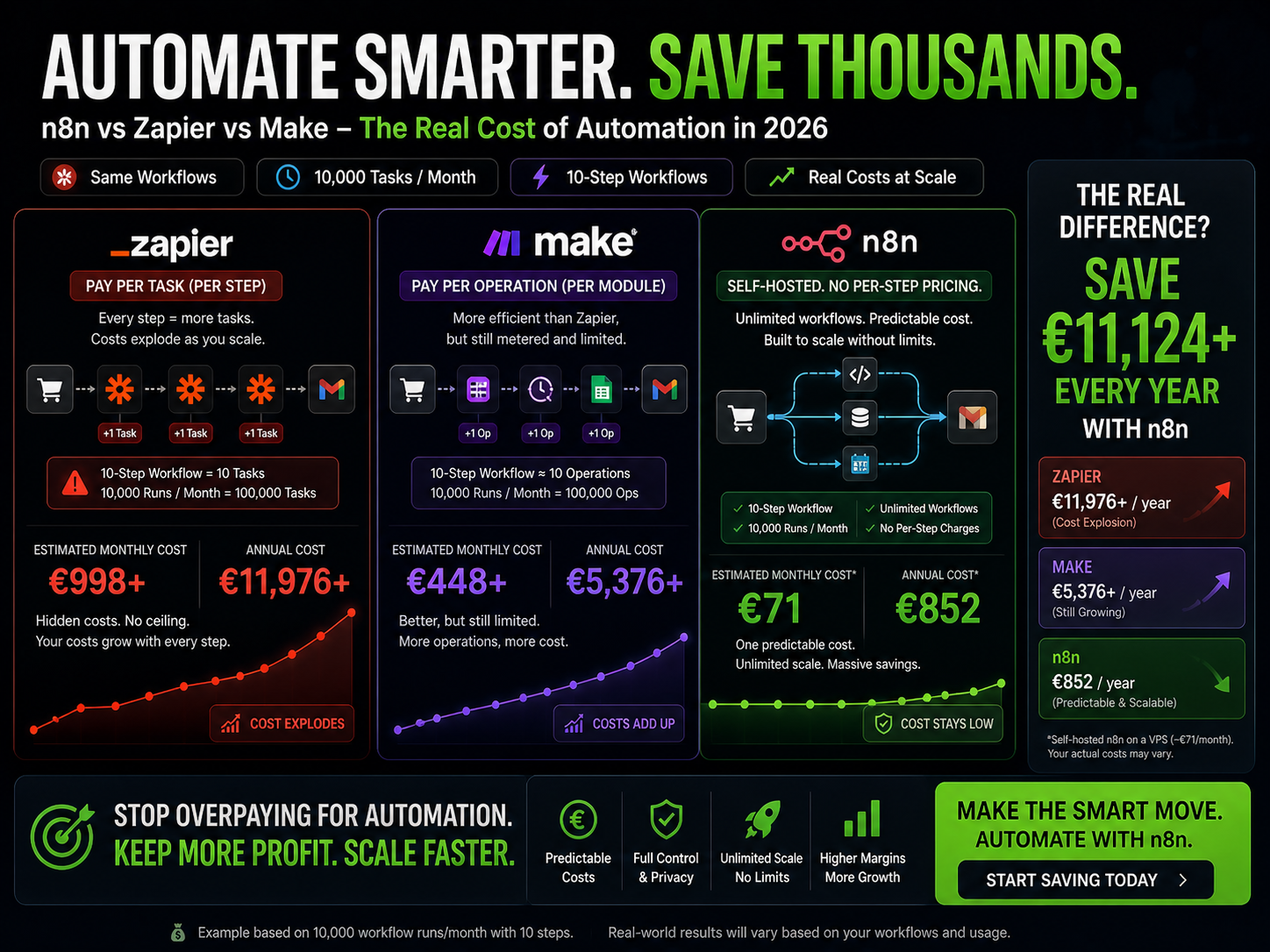
On Zapier, every one of those tasks costs you. At scale, Zapier bills for active real estate operations routinely reach €500, €800, even more, and they grow directly with your success, penalising you for the very thing automation is supposed to deliver.
N8Nme charges a single flat monthly fee. Run your workflows a hundred times a day or ten thousand times, your bill doesn't change. For agents and brokers building automation that's genuinely meant to scale, this pricing model isn't just more affordable. It's more honest.
Connect Every Tool You Already Use
Real estate professionals don't run on one platform. You have a CRM, HubSpot, Follow Up Boss, Salesforce, or something purpose-built for real estate. You have a transaction management system. A property management platform. Google Workspace for communication. DocuSign or a similar e-signature tool. Possibly Zillow, Realtor.com, or Facebook lead forms feeding your pipeline from multiple directions simultaneously.
N8n connects to 400+ tools natively, including the platforms most common in real estate operations, and if something you use isn't on the native list, its API capabilities mean you can connect it anyway. If a tool has an API, n8n can reach it.
This matters because the value of automation compounds when your tools talk to each other seamlessly. A lead that arrives from Zillow should flow automatically into your CRM, trigger your nurture sequence, and update your pipeline dashboard, without anyone manually bridging three platforms. That kind of end-to-end integration is what separates a genuinely automated business from one that's just added another tool to the stack.
The Power of Self-Hosting, Without the Pain of Managing It
N8n is open source and self-hostable, which means for technical users, you can run it entirely on your own infrastructure with full control over every configuration detail. That flexibility is one of n8n's most compelling attributes.
The reality for most real estate professionals, however, is that "spin up a VPS, install Docker, configure a reverse proxy, manage SSL certificates, and handle your own updates and backups" is not how they want to spend their time. Nor should it be.
N8Nme gives you everything that makes self-hosted n8n valuable, dedicated infrastructure, data ownership, unlimited executions, full customisation, without requiring you to touch a server. Your instance is provisioned in under 5 minutes. Updates, backups, uptime monitoring, and infrastructure management are handled for you. You get the control of self-hosting with none of the operational overhead.
For a real estate professional whose time is worth far more spent on client relationships and deal-making than on server administration, that trade-off is a straightforward one.
A Workflow Library Built for Getting Started Fast
One of the most common barriers to automation adoption isn't willingness, it's the blank canvas problem. You know automation would help, but staring at an empty workflow builder wondering where to start is enough to make anyone put it off until next quarter.
N8Nme's library of 9,000+ pre-built workflows means you're rarely starting from scratch. Templates for lead response automation, CRM integrations, follow-up sequences, document workflows, and notification systems are available to install with a single click and customise to your specific setup. What would otherwise take days of configuration takes hours, sometimes less.
For the four use cases covered in this guide, the foundational workflows already exist in the library. Your job is to adapt them to your business, not build them from the ground up.
The Bottom Line for Real Estate Professionals
The agents and brokers pulling ahead in today's market share a common characteristic: they've stopped doing manually what software can do automatically, and they've redirected that time toward the activities that actually build a business, client relationships, negotiations, market expertise, and referral cultivation.
N8Nme is the infrastructure that makes that shift possible. Dedicated hosting, flat-rate pricing, 400+ integrations, a 5-minute setup, and a workflow library that gets you to your first automation fast, without a DevOps background, a developer on retainer, or a bill that scales against you.
The 15 hours a week you're currently losing to admin work are recoverable. The question is simply when you decide to start.