Marketing Agency Automation: Save Time on Repetitive Tasks

Discover how marketing agency automation saves 10+ hours weekly. Explore 4 workflows to automate client reporting, lead response, and more. Start today.
Why Smart Marketing Agencies Are Automating Everything They Can
If you've ever spent a Sunday evening manually compiling client reports, copying campaign metrics from five different platforms into a spreadsheet, and wondering why you started an agency in the first place, you're not alone.
Marketing agency life is supposed to be about strategy, creativity, and building real results for clients. But for most agency owners and their teams, a startling portion of every week disappears into repetitive, administrative work that adds no strategic value. Sending status updates. Reformatting data. Following up on approvals. Onboarding new clients with the same documents you've sent dozens of times before.
This isn't just frustrating. It's expensive.
When your senior strategist spends three hours every Friday assembling a client report that could be automated, you're not just losing three hours. You're losing the opportunity cost of what that strategist could be doing instead, developing new campaign ideas, deepening client relationships, or helping close that proposal sitting in the pipeline.
The automation gap in marketing agencies is real, and it's widening.
Agencies that have invested in workflow automation for agencies are operating with significantly leaner teams while maintaining or growing their client rosters. They're responding to leads faster, delivering work more consistently, and spending more time on the high-value thinking that actually moves the needle for clients.
So what exactly is marketing agency automation? At its core, it's using technology to handle repetitive, rule-based tasks that don't require human judgment. It's connecting your tools so data flows automatically instead of being copied and pasted. It's setting up triggers that move work forward without someone having to remember to send an email or update a status.
The agencies winning in 2025 aren't working harder. They're automating smarter.
In this guide, we'll explore four specific automation use cases that are transforming how marketing agencies operate: automated client reporting that eliminates Friday night spreadsheet marathons, lead response systems that capture prospects while your competitors are still checking their email, content production workflows that let small teams publish at scale, and project management automation that keeps scope creep and missed deadlines at bay.
How to Automate Client Reporting and Reclaim 5+ Hours Every Week
Let's start with the task that probably consumes more of your team's time than anything else: client reporting.
If you're like most agencies, your reporting process looks something like this: Log into Google Ads. Export the campaign data. Log into Meta Ads Manager. Export those numbers. Open Google Analytics 4. Navigate to the right views. Export more data. Open your CRM. Check lead numbers. Copy everything into a spreadsheet. Reconcile the discrepancies. Format it nicely. Create charts. Paste into a slide deck. Write the narrative. Send to the client. Repeat for every client. Every week or month.
This is the reality of data silos, information trapped in separate platforms that refuse to talk to each other. Your advertising platforms, analytics systems, CRM, email marketing tools, and social media dashboards all generate valuable data, but they do it in different formats, on different schedules, and with different organizational structures.
The before scenario: A typical account manager spends 3-5 hours per client per month on manual reporting. For an agency with 15 clients, that's 45-75 hours of senior-level time spent copying and formatting data instead of analyzing it or developing strategy.
The after scenario: Automated reporting systems pull data from all your platforms automatically, populate pre-built templates, and deliver branded reports to clients on a schedule you define. The account manager spends 15 minutes reviewing insights and adding strategic commentary before the report sends.
The impact goes beyond time savings. When you automate client reporting, you can:
- Deliver reports more frequently (weekly instead of monthly) without increasing workload
- Provide real-time dashboards clients can access anytime instead of static PDFs
- Eliminate human error from data copying and calculations
- Free your team to focus on insights and recommendations instead of data assembly
Agencies that implement automated reporting typically save multiple hours per week per project. More importantly, they shift their team's energy from mechanical data compilation to strategic analysis, the work clients actually value and pay premium rates for.
Lead Response Automation: Capture Prospects While Competitors Sleep
Here's a statistic that should keep every agency owner awake at night: If a lead is called within 5 minutes versus 30 minutes after submission, that lead is 100 times more likely to be contacted and 21 times more likely to enter your sales cycle.
Let that sink in. A 100x difference based on response time alone.
Now consider this: The average lead response time across industries is 42 hours. Some research suggests half of companies take up to 5 days to respond to inquiries. And only 27% of leads ever get contacted at all, even though with proper systems, companies can contact around 92% of leads.
The before scenario: A prospect fills out your contact form. The submission sits in an inbox until someone checks it. Maybe that's an hour later. Maybe it's the next morning. Maybe it's Monday if they submitted Friday evening. When someone finally responds, they have to craft a reply, look up the prospect's information, and figure out the next steps. Meanwhile, the prospect has already contacted three other agencies.
The after scenario: The moment a prospect submits your form, automation triggers an immediate personalized acknowledgment email. The lead is scored based on their responses and routed to the appropriate team member. A task is created in your CRM with all context pre-populated. If the lead meets certain criteria, they receive a calendar link to book a call immediately. Your team is notified via Slack or email with full context. Response time: under 5 minutes, 24/7.
This isn't just about speed, though speed matters enormously. It's about consistency. Manual lead management depends on people remembering to check systems, following up promptly, and maintaining detailed records. Automation ensures every lead receives the same high-quality experience regardless of when they inquire or how busy your team is.
For agencies doing their own business development, LinkedIn automation can reduce time spent switching between accounts by up to 80%. Instead of manually visiting profiles and composing individual messages, teams configure personalized outreach sequences once and let automation handle the execution while they focus on conversations with qualified prospects.
The agencies winning new business aren't necessarily the ones with the best creative work (though that helps). They're the ones that respond first, follow up consistently, and make it effortless for prospects to take the next step.
Content Production Automation: Publish at Scale Without Burning Out Your Team
Content marketing is essential for agency growth, but it's also one of the biggest time sinks in your operation. A single blog post needs to become a LinkedIn article, an Instagram carousel, a Twitter thread, an email newsletter piece, and maybe a YouTube video. Each format requires different copy, different visuals, and different optimization.
Video content is particularly brutal, even a simple two-minute video can consume 20-30 hours when you account for scripting, recording, editing, and platform-specific formatting.
The before scenario: Your content team operates reactively. Someone realizes you haven't posted in three days, so they scramble to create something. Each piece of content is built from scratch. Videos require expensive freelancers or dedicated staff. Quality is inconsistent because there's no systematic process. Your senior strategist spends half their week on content logistics instead of strategy.
The after scenario: Content is created in batches. One core piece of content (a blog post or video) is automatically reformatted for each platform. AI-assisted tools generate variations of copy and visuals. Everything is scheduled weeks in advance. Your team reviews and refines rather than creating from scratch.
The results speak for themselves:
- Teams using batching reduce content production time by 30-40%
- A mid-sized B2B company automated their content calendar and reduced time from 20 hours weekly to 6 hours on review and strategy
- An e-commerce brand generated 100 product showcase videos in one day using AI automation, work that would have taken months traditionally
- A marketing agency managing 15 client accounts implemented content automation and increased capacity to 30 clients without hiring additional staff
Content automation doesn't mean sacrificing quality. It means eliminating repetitive formatting, resizing, and scheduling work so your creative team can focus on the ideas and messaging that actually matter.
Project Management Automation: Eliminate Scope Creep and Missed Deadlines
Scope creep is the silent killer of agency profitability. That "one small change" the client requested via email turns into three days of unbilled work. The project that was supposed to take two weeks stretches to six. Your team is overworked, margins evaporate, and nobody's happy.
Research shows scope creep is the leading barrier to completing projects on budget, cited by 31% of agencies. Meanwhile, 32% of agencies describe their teams as somewhat overworked, and 13% say teams are frequently overworked. The connection is clear: unclear boundaries lead to extra work, which leads to burned-out teams.
Add to this the #1 productivity barrier agencies face: client delays in providing assets, feedback, or approvals. A full 55% of agencies cite this as their biggest challenge. One delayed client approval cascades through your entire project schedule, pushing other work and creating chaos.
The before scenario: Projects are tracked in spreadsheets or scattered across email threads. Nobody knows the real status without asking. Change requests come in via Slack, email, and phone calls with no documentation. Clients forget deadlines until you chase them. Your team wastes hours every week on status update meetings and "where are we on this?" conversations.
The after scenario: Every project lives in a centralized workspace with real-time status visible to all stakeholders. New client requests automatically create properly structured projects from templates. Tasks are assigned based on availability and skills. Automated reminders notify clients when their input is needed by specific dates. Approval workflows ensure nothing moves forward without proper sign-off. Budget tracking alerts you when projects are at risk of going over.
The impact is transformative:
- Formalized change management workflows make scope creep visible and manageable
- Automated client reminders keep projects moving without manual follow-up
- Real-time budget visibility protects profitability
- Documented approval trails prevent "I never approved that" disputes
When time tracking integrates with project management, you gain unprecedented visibility into actual versus estimated hours. This data helps you price future projects more accurately and identify which service offerings consistently deliver strong margins.
Your 90-Day Roadmap to Agency Automation Success
The business case for marketing automation is compelling: Businesses see an average return of $5.44 for every $1 spent, representing a 544% ROI. Most companies see positive returns within the first year, with significant results appearing after six months.
But where do you start? The agencies that succeed don't try to automate everything at once. They build systematically, one workflow at a time.
Month 1: Foundation and Quick Wins
Start with your most painful, repetitive task. For most agencies, that's client reporting. Set up your first automated reporting workflow, connecting your data sources and building templates. This single win will save hours every month and demonstrate the value of automation to your team.
During this first month, audit every recurring task your team performs. Document how long each takes, how often it repeats, and how rule-based the work is. This becomes your automation backlog.
Month 2: Core Workflows
With reporting automated, turn your attention to lead response and project kickoff workflows. Set up CRM-based lead nurture sequences so no prospect falls through the cracks. Automate your onboarding process from signed contract to first deliverable.
Standardize your content production pipeline with briefing templates, approval workflows, and asset management systems.
Month 3: Optimization and Scale
By month three, you'll have real data on what's working. Identify which automations are saving the most time and expand those approaches to other areas. Add advanced workflows like client health scoring, automated upsell triggers, and sophisticated reporting.
This is also when you should measure your ROI. Compare time spent on manual tasks before and after automation. Calculate the value of faster lead response. Document the revenue impact of more consistent follow-up.
Why n8n Is the Smart Choice for Agency Automation
As you evaluate automation platforms, consider what matters for agencies: flexibility, cost-effectiveness at scale, and data control.
n8n offers a unique combination of capabilities that make it ideal for marketing agencies:
- 400+ integrations connecting all your agency tools, from Google Ads and Meta to Slack, HubSpot, and beyond
- Self-hosted option for agencies that need complete data control and privacy
- Unlimited executions without per-task pricing that penalizes you for running more workflows
- Open source with an active community constantly adding new integrations and capabilities
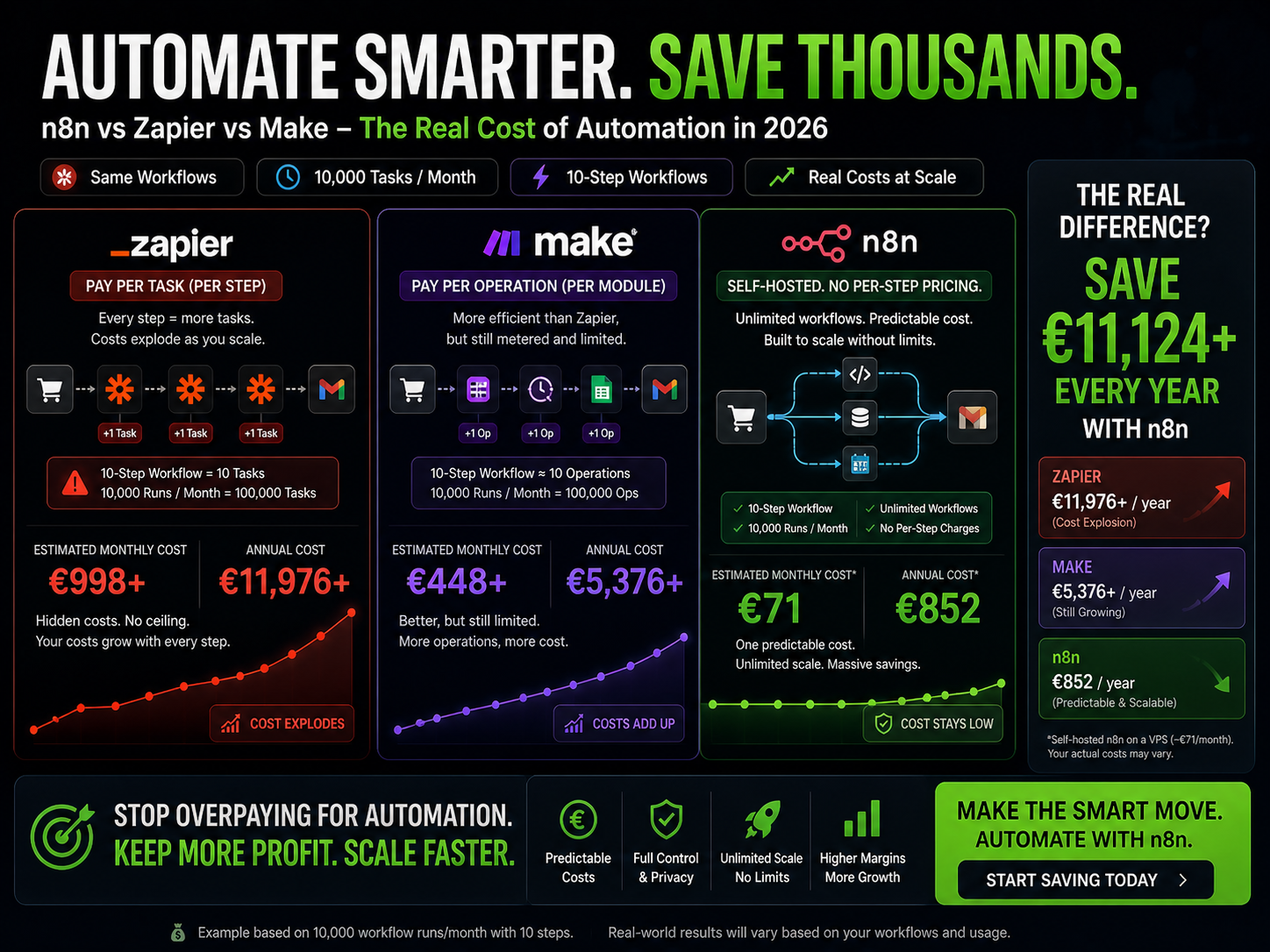
- Cost-effective at scale, as you grow and run more workflows, your costs don't scale proportionally like they do with Zapier or Make
The agencies that will thrive in the coming years aren't the ones working the hardest. They're the ones that recognize repetitive work belongs to machines, freeing their people to focus on strategy, creativity, and client relationships.
Ready to see what's possible? Start free, no credit card required → to explore how workflow automation can transform your agency's operations.