Logistics & Supply Chain Automation: A Small Business Guide

Stop losing money to manual logistics errors. Discover how warehouse and supply chain automation cuts costs, reduces mistakes, and speeds up operations.
Why Manual Logistics Processes Are Costing Your Business More Than You Think
If your team is still copying tracking numbers into spreadsheets, sending manual purchase orders by email, or reconciling inventory counts by hand, you're not just losing time, you're losing money and competitive ground every single day.
The average logistics employee spends 15-20 hours per week on manual data entry and process coordination, according to supply chain research from McKinsey. For a small business, that's often the difference between scaling confidently and being perpetually stuck firefighting operational problems.
Logistics and supply chain automation isn't a luxury reserved for Amazon-scale enterprises anymore. Modern workflow automation tools have made it possible for businesses with 5 employees or 500 to eliminate repetitive manual tasks, reduce costly errors, and move faster than competitors still relying on human-powered processes.
The Hidden Costs of Manual Supply Chain Management
The direct labor cost of manual processes is easy to see. The indirect costs are harder to quantify, but they're often larger.
A miskeyed inventory count leads to a stockout. A stockout leads to a lost sale. A lost sale leads to a customer who doesn't come back. That chain reaction, triggered by a single data entry error, can cost a small business thousands of dollars in revenue and customer lifetime value.
Research from Gartner estimates that poor data quality costs organizations an average of $12.9 million per year. Even at a fraction of that scale, the math for small logistics operations is sobering.
What Workflow Automation Actually Looks Like in Logistics
Logistics automation doesn't mean replacing your team with robots. It means eliminating the tedious, error-prone tasks that consume your team's time and divert attention from higher-value work.
In practice, it looks like this: a shipment arrives at your warehouse, triggering an automatic inventory update in your ERP, a notification to your sales team, and a reorder request to your vendor, all without anyone touching a keyboard. That sequence, which might take a skilled employee 20 minutes to complete manually, happens in seconds, automatically, every time.
This guide covers four of the highest-impact automation opportunities available to small logistics and supply chain businesses today: warehouse operations, inventory synchronization, shipment tracking, and vendor management. Each section includes specific workflow examples, realistic ROI figures, and practical implementation advice.
Whether you're running a regional distribution operation, managing a product-based e-commerce business, or overseeing fulfillment for a manufacturing company, at least two or three of these use cases will apply directly to your situation.
The businesses that are winning in logistics right now aren't necessarily bigger or better-funded than their competitors. They're faster, more accurate, and more responsive, and workflow automation is the engine powering that advantage.
Warehouse Automation: Eliminate the Manual Work Slowing Down Your Operations
The warehouse floor is where manual inefficiency does the most damage. Receiving errors, mispicks, misrouted inventory, and delayed put-away processes create a cascade of downstream problems that are expensive to untangle and easy to prevent with the right automation.
For small businesses running lean warehouse teams, every manual touchpoint is a potential failure point. Automation doesn't just speed things up, it makes your processes more consistent and reliable at scale.
The Most Common Warehouse Bottlenecks Automation Solves
Three processes cause the majority of warehouse inefficiency for small operations:
Receiving and put-away. When goods arrive, someone manually counts items, compares them to a purchase order, logs discrepancies, updates inventory records, and assigns storage locations. This process is slow, error-prone, and completely automatable.
Pick-and-pack coordination. Matching open orders to available inventory, generating pick lists, and notifying packers still happens via email or printed sheets in many small warehouses, an approach that creates lag time and communication gaps.
Inventory reconciliation. End-of-day or end-of-week inventory counts are time-consuming, and discrepancies found days after the fact are nearly impossible to trace back to their source.
What an Automated Warehouse Receiving Workflow Looks Like
Here's a concrete example of how workflow automation transforms the receiving process:
When a shipment arrives, your team scans a barcode. That scan triggers an automated workflow: the system retrieves the corresponding purchase order, compares received quantities to expected quantities, flags any discrepancies in your inventory management system, updates stock levels in real time, notifies the purchasing team of variances, and logs the receiving event with a timestamp. The entire sequence takes seconds.
Without automation, that same process requires manual cross-referencing of documents, data entry into multiple systems, and follow-up emails, easily 15-30 minutes per receiving event, multiplied across every shipment your warehouse handles.
ROI You Can Actually Measure
- 70-80% reduction in receiving processing time
- Near-elimination of data entry errors that cause inventory discrepancies
- Same-day inventory availability for newly received stock (versus 1-2 day lag with manual processes)
For a warehouse handling 20 receiving events per week, cutting processing time from 20 minutes to 4 minutes per event saves roughly 5.3 hours weekly. At a burdened labor cost of $25/hour, that's $6,760 saved annually, from one automated workflow.
Building Your First Warehouse Automation Workflow
The practical starting point for most small warehouses is connecting three systems: your barcode scanning or WMS platform, your inventory management system, and your communication tool (Slack, email, or SMS).
A tool like n8n can serve as the central hub, pulling data from your WMS when a scan event occurs, looking up the relevant purchase order, performing the comparison logic, updating your inventory system via API, and firing off the appropriate notifications, all in a single automated workflow you build once and run indefinitely.
Start With High-Frequency, High-Error Processes
If you're deciding where to begin, prioritize the warehouse processes that happen most frequently and carry the highest error rates. Receiving is the most common starting point, but put-away confirmation, cycle count triggers, and low-stock alerts are close seconds.
The key principle: automate the handoffs between systems first. Every time a human has to move data from one platform to another, that's a failure point you can eliminate.
Inventory Synchronization: Stop Selling What You Don't Have
Inventory sync failures are one of the most expensive problems in small business logistics. You sell a product on your e-commerce store. The order goes to your fulfillment team. Your fulfillment team discovers the item is out of stock, but your online inventory showed it as available. Now you have an angry customer, a canceled order, and a damaged reputation.
This scenario plays out thousands of times daily across small businesses that rely on manual inventory updates or poorly integrated systems. Automated inventory synchronization eliminates it entirely.
Why Inventory Gets Out of Sync
Inventory discrepancies don't usually happen because of negligence. They happen because inventory data lives in multiple places, your e-commerce platform, your ERP, your warehouse management system, your physical count records, and keeping those sources aligned manually is practically impossible at any meaningful volume.
A sale on your Shopify store needs to decrement inventory in your WMS. A return needs to increment it. A warehouse receiving event needs to update your e-commerce platform. A damaged-goods write-off needs to adjust every connected system. When humans perform these updates, delays and errors are inevitable.
The Real Cost of Inventory Inaccuracy
IBM research suggests inventory inaccuracy costs retailers 3-5% of annual revenue in overstocks, stockouts, and fulfillment errors. For a business doing $2 million in annual sales, that's $60,000-$100,000 in preventable losses.
The costs break down across three categories:
Stockouts lead to lost sales and customer churn. Research from Harvard Business Review found that 21-43% of customers who encounter a stockout don't come back.
Overstock ties up working capital in slow-moving inventory, increases carrying costs, and can lead to markdowns that compress margins.
Fulfillment errors from inaccurate inventory data create return processing costs, customer service overhead, and shipping expenses for replacements.
What Automated Inventory Sync Looks Like in Practice
An effective inventory synchronization workflow operates in near real time. Here's a common architecture for a small e-commerce and fulfillment operation:
When a sale occurs on any connected channel, Shopify, Amazon, a B2B portal, an automated workflow immediately updates inventory quantities across all other channels and your internal systems. When a warehouse team member completes a receiving scan, that quantity flows instantly to your storefront. When inventory drops below a configured threshold, a reorder workflow triggers automatically.
The entire loop, from sale to inventory update to reorder trigger, can happen in under 60 seconds with no human involvement.
Building a Multi-Channel Inventory Sync Workflow
- Trigger: A webhook or API event from your sales channel or WMS when inventory changes
- Logic layer: Rules that determine how inventory should be allocated across channels (buffer stock, channel priorities, location-based rules)
- Update actions: API calls to each connected system to push updated quantities
- Notification layer: Alerts for low stock, sync errors, or discrepancies that require human review
n8n connects natively to Shopify, WooCommerce, NetSuite, QuickBooks, and dozens of other platforms that small logistics businesses use, making it well-suited for building multi-channel sync workflows without custom development.
The Accuracy Baseline You Should Target
Industry benchmarks suggest best-in-class inventory accuracy sits at 95-99%. Most small businesses running manual sync processes operate at 80-90% accuracy, a gap that translates directly to customer experience failures and financial loss.
Automated synchronization typically brings accuracy into the 97-99% range within the first 30 days of implementation, with ongoing improvement as edge cases are identified and handled in workflow logic.
Shipment Tracking Automation: Give Customers Answers Before They Ask
Shipment tracking is one of the highest-volume, lowest-value manual tasks in small business logistics. Your customer service team answers the same question, "Where is my order?", dozens or hundreds of times per week. Your operations team manually checks carrier portals, updates internal records, and sends status emails. None of this creates value. All of it can be automated.
Beyond customer-facing tracking updates, automated shipment monitoring also gives your operations team real-time visibility into delays, exceptions, and delivery failures, so you can intervene proactively instead of reacting to customer complaints.
The Scope of the Problem
Zendesk research consistently shows that order status inquiries represent 20-30% of all customer service tickets for e-commerce and logistics businesses. For a team handling 50 support tickets per day, that's 10-15 tickets daily that could be eliminated with proactive, automated tracking communication.
At an average cost of $5-$8 per customer service interaction, eliminating 10 daily tickets saves $18,000-$29,000 annually. That's before accounting for the time your operations team spends manually monitoring carrier portals.
Proactive vs. Reactive Tracking: The Automation Difference
Manual tracking processes are inherently reactive. A customer contacts you asking where their order is. Someone checks the carrier portal, retrieves the status, and responds. If there's a delay, the customer is already frustrated before you knew there was a problem.
Automated tracking flips this dynamic. Your system continuously monitors shipment status via carrier APIs. When a status change occurs, shipment picked up, out for delivery, delivered, or exception flagged, an automated workflow fires the appropriate response without anyone checking anything.
Customers receive proactive updates. Your team receives exception alerts only when something requires human attention. The volume of inbound "where is my order?" questions drops dramatically.
Building a Shipment Tracking Automation Workflow
A complete shipment tracking automation workflow typically handles three scenarios:
Normal status updates: When a shipment status changes (label created, picked up, in transit, out for delivery, delivered), an automated email or SMS goes to the customer with the current status and estimated delivery date.
Delivery confirmation: When a shipment is marked delivered, the workflow triggers a delivery confirmation to the customer, optionally triggers a review request, and updates your order management system to close the order.
Exception handling: When a carrier flags an exception, failed delivery attempt, address issue, weather delay, lost package, the workflow immediately alerts your customer service team with the order details, customer contact information, and carrier exception code, enabling fast human intervention.
Carrier API Integration: What You Need to Know
Major carriers including UPS, FedEx, USPS, and DHL offer tracking APIs that allow your systems to retrieve real-time shipment status programmatically. Aggregator platforms like EasyPost, ShipStation, and Shippo provide unified APIs that cover multiple carriers through a single integration point.
n8n can connect to these carrier APIs or aggregator platforms, triggering workflows on status changes and routing information to the appropriate downstream systems and communication channels.
The Customer Experience Impact
Beyond operational savings, proactive shipment communication has measurable customer experience benefits. Research from Convey (now Project44) found that 83% of online shoppers expect regular updates about their orders, and 98% say shipping experiences affect their loyalty decisions.
Businesses that implement automated proactive tracking communication typically see 15-25% reductions in support ticket volume within the first 60 days, and measurable improvements in post-purchase satisfaction scores.
Vendor Management Automation: Build Stronger Supplier Relationships With Less Manual Work
Vendor management is one of the most time-intensive and least-automated processes in small business supply chain operations. Purchase orders, delivery confirmations, invoice reconciliation, performance tracking, and compliance documentation all create significant administrative burden, and most of it is still handled through email threads, shared spreadsheets, and manual follow-ups.
Automating vendor management workflows doesn't just save time. It creates the kind of consistent, data-driven vendor relationships that reduce supply chain risk and improve purchasing leverage.
Where Vendor Management Breaks Down
Small businesses typically struggle with three specific vendor management challenges:
Purchase order lifecycle management. Creating POs, sending them to vendors, tracking acknowledgment, following up on delivery confirmations, and reconciling received quantities against ordered quantities is a multi-step manual process that can span days or weeks.
Invoice reconciliation. Matching vendor invoices to purchase orders and receiving records, three-way matching, is tedious and error-prone when done manually. Discrepancies often go unnoticed until they're difficult to resolve.
Vendor performance visibility. Most small businesses don't have systematic data on vendor on-time delivery rates, fill rates, or quality metrics. Without this data, it's hard to negotiate from a position of strength or identify which supplier relationships need attention.
Automating the Purchase Order Workflow
An automated PO workflow eliminates most of the manual touchpoints in the procurement cycle:
When inventory drops below a reorder threshold, an automated workflow generates a draft purchase order with the correct vendor, SKUs, and quantities based on your reorder rules. The PO is sent to the vendor via email or EDI. When the vendor acknowledges receipt, that confirmation is logged automatically. When goods arrive and are scanned into your WMS, the received quantities are matched against the PO and any discrepancies trigger an alert for human review.
The net result: your team reviews exceptions, not routine transactions. The 80% of POs that go exactly as planned require zero manual intervention.
Vendor Scorecarding With Automated Data Collection
One of the highest-value vendor management automations for small businesses is automated performance tracking. Here's how it works in practice:
For every purchase order, your automated workflow captures: promised delivery date, actual delivery date, ordered quantity, received quantity, and any quality flags from receiving. Over time, this data accumulates into a vendor performance record without anyone manually updating a spreadsheet.
Monthly or quarterly, an automated report generates a vendor scorecard for each supplier, showing on-time delivery rate, fill rate, and order accuracy, and can be automatically emailed to the relevant stakeholders or used as the basis for vendor review conversations.
This kind of systematic performance data transforms vendor negotiations. Instead of general impressions, you have specific metrics. Instead of "we've had some issues with late deliveries," you can say "your on-time delivery rate was 73% last quarter, which cost us X in expediting fees."
Invoice Matching and Discrepancy Resolution
Three-way matching, comparing a vendor invoice against the original PO and the receiving record, is one of the most valuable automations for accounts payable accuracy. When all three documents align, the invoice is automatically approved for payment. When there's a discrepancy, it's flagged for human review with all relevant context surfaced automatically.
Businesses implementing automated three-way matching typically see 50-60% reductions in accounts payable processing time and near-elimination of duplicate payments or overbilling that goes undetected.
The Compound Effect of Vendor Automation
The strategic value of vendor management automation compounds over time. As your data improves, your purchasing decisions improve. Better purchasing decisions lead to fewer stockouts, lower carrying costs, and stronger vendor relationships. Stronger vendor relationships often yield better pricing, priority allocation during supply crunches, and more flexible payment terms, all of which improve your competitive position.
For small businesses competing against larger operators with dedicated procurement teams, automated vendor management is one of the most effective ways to close the capability gap.
The Future of Logistics Automation Is Already Here
The logistics and supply chain landscape is changing faster than most small businesses can adapt manually. Companies that cling to spreadsheets, phone-based vendor updates, and manual inventory checks are already falling behind competitors who've embraced workflow automation, and the gap is widening every quarter.
The good news? You don't need an enterprise budget or a dedicated IT department to get started.
Your 90-Day Automation Roadmap
The most successful small business operators don't try to automate everything at once. They start with one high-pain, high-frequency process and build from there.
Days 1-30: Audit and Prioritize
Map out every manual task your team performs weekly in your logistics workflow. Count how many times each task happens and estimate the time cost. Your biggest time sinks, probably inventory updates, shipment status checks, or vendor follow-ups, become your first automation targets.
Days 31-60: Build Your First Workflow
Choose one process and automate it end-to-end. Connect your existing tools, your WMS, your carrier APIs, your ERP, and let data flow automatically between them. Measure the time saved and the error rate reduction. These numbers will justify your next automation project.
Days 61-90: Expand and Optimize
With one proven automation running, replicate the approach across other pain points. Warehouse receiving, vendor scorecards, shipment exception alerts, each workflow compounds your efficiency gains. By day 90, most businesses see 15-25% reduction in manual labor hours across their logistics operations.
Where n8n Fits Into Your Logistics Stack
n8n is a workflow automation platform built for exactly this kind of operational complexity. Unlike rigid, out-of-the-box tools, n8n lets you connect virtually any system in your logistics stack, whether that's a major platform like SAP or NetSuite, or a niche warehouse management system your industry relies on.
What makes n8n particularly well-suited for small businesses in logistics:
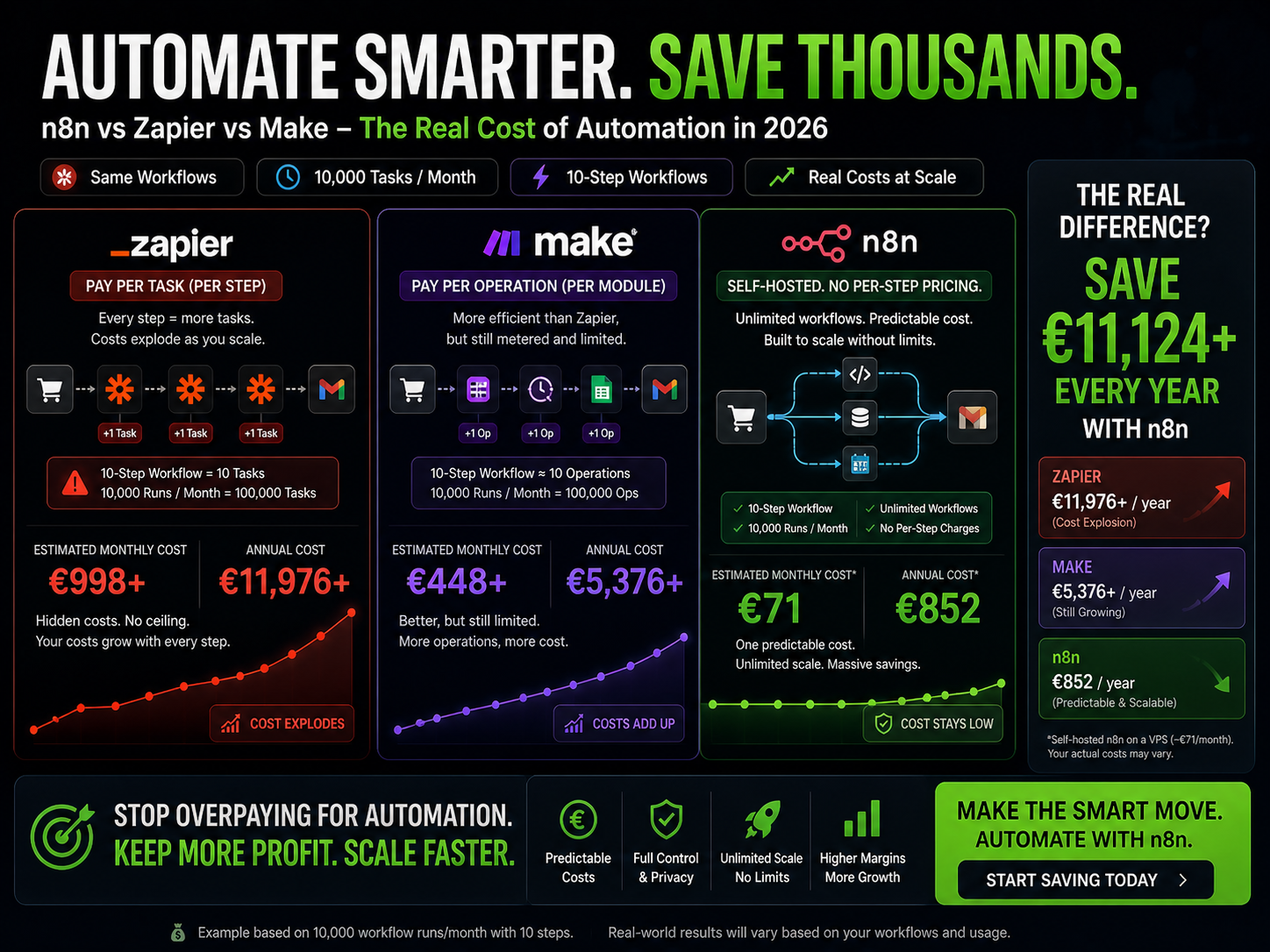
- No per-task pricing. Most automation platforms charge based on how many times your workflows run. When you're processing thousands of inventory updates or shipment events daily, those costs add up fast. n8n's self-hosted model means your automation costs don't scale with your volume.
- Visual workflow building. You don't need a developer to build most logistics workflows. n8n's drag-and-drop interface lets operations managers build and modify automations without writing code, though developers can extend functionality with custom JavaScript when needed.
- 400+ pre-built integrations. From major shipping carriers to ERP systems to communication tools like Slack and email, n8n connects your entire logistics ecosystem out of the box.
- Full data control. For businesses handling sensitive vendor contracts, pricing data, or customer information, self-hosting means your operational data never touches a third-party server.
The ROI Case Is Clear
- 60-80% reduction in time spent on manual data entry
- 90%+ decrease in human errors affecting order accuracy
- 2-4 hour faster response times to supply chain disruptions
- Full ROI recovery within 3-6 months of implementation
These aren't projections. They're outcomes reported by operations teams who made the switch from manual processes to automated workflows.
Start Small, Scale Fast
The biggest mistake logistics operators make is waiting for the perfect moment to automate, when the new WMS is implemented, when the team is bigger, when things slow down. That moment rarely comes.
Pick your most painful manual process. Build one workflow. Measure the results. Then build the next one.
n8n offers a free tier to get started, with full workflow functionality so you can validate your automation approach before committing to any cost. Your competitors aren't waiting. The question is whether you will.
Ready to stop drowning in logistics busywork? Visit N8Nme.com to explore how workflow automation can transform your supply chain operations.