Legal Workflow Automation: Save 15+ Hours a Week at Your Firm

Discover how legal workflow automation helps solo attorneys and small firms cut admin time, reduce errors, and serve more clients, without hiring extra staff.
It's 9 PM on a Tuesday, and you're still at your desk. Not reviewing strategy for tomorrow's hearing, you're chasing down a missing intake form, copying client details from an email into your case management system for the third time this week, and mentally calculating how many billable hours slipped through your fingers today. Sound familiar?
You didn't go to law school to spend half your working life on administrative tasks. But for most solo practitioners and small firm owners, that's exactly what happens. Research from the American Bar Association consistently shows that lawyers in small practices bill only 60-65% of their working hours, meaning nearly two full days every week are lost to work that doesn't pay.
The good news? That's a solvable problem. It's called workflow automation, and it's already transforming how thousands of small law firms operate.
So what exactly is workflow automation? In plain English, it simply means setting up systems that handle repetitive tasks automatically, without you lifting a finger every single time. Think of it like a series of dominoes you arrange once and then tip over whenever you need them. A new client fills out an intake form, and your system automatically creates their file, sends a welcome email, schedules a consultation, and reminds you to follow up. No manual data entry. No dropped balls. No 9 PM catch-up sessions.
For law firms specifically, automation isn't just a productivity perk, it's a competitive necessity. Your clients expect fast responses, airtight organization, and clear communication. Meanwhile, you're competing with larger firms that have entire support staffs handling the administrative load you currently shoulder alone.
In this guide, you'll discover four high-impact automation opportunities that can save you 15+ hours per week, recover thousands in lost billable time, and let you focus on what you actually trained to do: practicing law.
How to Automate Your Law Firm's Client Intake Process (And Stop Losing Leads to Faster Competitors)
Every new client relationship starts with intake, and for most firms, that's where the friction begins. Manual PDF forms. Back-and-forth emails to schedule consultations. Data entry into three different systems. By the time you've onboarded one client, you've lost two more to competitors who responded faster.
The Pain Point: Traditional intake processes are slow, error-prone, and expensive. A lead who submits a form on Friday evening might not hear back until Monday morning. In that gap, they've already contacted three other firms. Research from the legal technology sector shows that firms responding to inquiries within 5 minutes are 21 times more likely to convert that lead than firms waiting 30 minutes.
Before Automation: A potential client emails your firm. You reply 4 hours later asking them to download a PDF form, fill it out, and email it back. They do so the next day. You manually transcribe their information into your practice management system, then send three more emails to coordinate a consultation time. Total time invested: 45 minutes of your staff's time, spread across 2-3 days.
After Automation: A potential client submits a form on your website. Within 60 seconds, they receive a personalized email confirming receipt and linking to your calendar to book immediately. Their information flows directly into your CRM, tagged by practice area and urgency. A consultation slot is reserved. A reminder is scheduled. Total time invested: Zero.
The Automation Workflow:
- Web form (Typeform, JotForm, or embedded form) captures client details
- Data automatically creates or updates contact record in your CRM/practice management system
- Conditional logic routes urgent matters (criminal defense, emergency family law) to immediate attorney notification
- Calendar integration lets prospects self-schedule consultations based on your real availability
- Automated email sequence delivers intake packet, firm brochure, and pre-consultation questionnaire
- Reminder sequence reduces no-shows by 40-60%
ROI Calculation: If your firm receives 20 inquiries per week and automated intake saves 30 minutes per inquiry while improving conversion by just 15%, that's 10 hours saved plus 3 additional clients. At $300/hour average billing rate, that's $3,000 in recovered time plus new revenue, every single week.
How Law Firms Cut Document Preparation Time by 80% With Automation
If you've ever spent three hours drafting a fee agreement that differs from your template by only a few fields, you understand the document preparation burden. Every matter type has its documents: engagement letters, retainer agreements, discovery requests, motions, contracts. Drafting them from scratch, or even copy-pasting from old files, is billable time you're giving away.
The Pain Point: Manual document creation is slow, inconsistent, and risky. A missed clause in an engagement letter. An outdated address block. A fee schedule from last year's rates. These errors don't just waste time, they create malpractice exposure and client confusion.
Before Automation: You open a previous client's file, copy their engagement letter, spend 20 minutes carefully replacing all the personal details, then review it three times to make sure you didn't miss anything. Then you repeat this process for the retainer agreement, the scope of work document, and the initial correspondence. For a typical matter, that's 60-90 minutes of attorney or paralegal time before you've done any actual legal work.
After Automation: You enter matter details once, client name, matter type, fee structure, key dates. Your system generates a complete document package in under 2 minutes: engagement letter, retainer agreement, initial correspondence, and calendar entries. Every document is current, accurate, and consistent with your firm's latest templates.
The Automation Workflow:
- Centralized template library with version control ensures everyone uses current documents
- Dynamic fields (client name, matter number, fee amount, court jurisdiction) auto-populate from your CRM
- Conditional logic generates different clauses based on matter type (contingency vs. hourly, litigation vs. transactional)
- Automatic conversion to PDF with digital signature fields
- E-signature integration (DocuSign, HelloSign) routes documents for signature and tracks completion
- Executed documents automatically file to the correct matter folder
ROI Calculation: A 5-attorney firm handling 50 new matters monthly can recover 40-50 hours of attorney/paralegal time. At blended rates of $200/hour, that's $8,000-10,000 in recovered capacity monthly, capacity you can redirect to billable work or business development.
How Law Firms Automate Billing to Recover Lost Revenue and Get Paid Faster
If you have ever reached the end of a long day unable to remember exactly what you worked on, or worse, realized you forgot to log two hours of billable time, you are experiencing the silent revenue killer that affects nearly every small firm.
The Pain Point: Manual time tracking and billing processes leak revenue. Industry studies consistently show that attorneys fail to record 10-30% of their billable time. For a solo practitioner billing $300,000 annually, that's $30,000-90,000 in lost revenue. Add delayed invoicing (the longer you wait to bill, the less likely you are to collect) and the cost of manual invoice preparation, and the financial impact is staggering.
Before Automation: You try to reconstruct your time at day's end from memory and scattered notes. At month-end, you spend 3-4 hours compiling invoices, cross-referencing time entries with matter numbers, and formatting documents. Invoices go out 2-3 weeks after work is completed. Payment arrives 30-60 days later, if at all. Your effective realization rate hovers around 80%.
After Automation: Time is captured automatically as you work, via calendar integration, activity tracking, or simple timers. Invoices generate automatically at matter milestones or on scheduled cycles. Payment reminders deploy without your involvement. Online payment options reduce collection time. Your realization rate climbs toward 95%.
The Automation Workflow:
- Time tracking integrates with calendar, email, and document systems to capture billable activity
- Automated timers start when you open matter files and pause during inactive periods
- Invoice generation triggers automatically at configurable intervals or matter stages
- Payment reminders deploy at 15, 30, and 45 days past due, escalating in tone
- Online payment portals accept credit cards and ACH, reducing collection cycles by 50%
- Trust account reconciliation happens automatically with bank feed integration
ROI Calculation: For a solo practitioner billing $300,000 annually, capturing just 10% more billable time adds $30,000 in revenue. Reducing collection cycles from 60 to 30 days improves cash flow by $25,000-50,000. Automated invoicing saves 5-8 hours monthly. Combined annual impact: $35,000-45,000 in improved revenue and efficiency.
How Law Firms Use Automated Case Management to Eliminate Missed Deadlines and Malpractice Risk
If you've ever woken up at 3 AM panicking about whether you filed that motion on time, you understand the psychological toll of manual deadline management. For lawyers, missed deadlines aren't just embarrassing, they're malpractice claims waiting to happen.
The Pain Point: Manual deadline tracking relies on memory, sticky notes, and calendar entries that may or may not account for court rules, service requirements, and jurisdictional variations. The American Bar Association reports that missed deadlines are among the most common causes of malpractice claims against small firms.
Before Automation: You receive a scheduling order and manually calculate 15 different deadlines based on local rules. You enter them in your calendar, hoping you interpreted the rules correctly. You set one reminder per deadline. When a date changes, you manually update every related deadline. You lie awake at night hoping you didn't miss anything.
After Automation: You enter the triggering event (filing date, service date, hearing date). Your system automatically calculates every related deadline based on current court rules. Reminders deploy at strategic intervals, 30 days, 14 days, 7 days, 24 hours. When dates change, all related deadlines update automatically. You sleep soundly.
The Automation Workflow:
- Court rule databases automatically calculate deadlines based on triggering events
- Multi-channel reminders (email, SMS, calendar) ensure critical dates aren't missed
- Task creation links deadlines to specific actions (draft motion, file certificate of service)
- Status updates trigger automatically as milestones are completed
- Conflict checking and calendaring integrate to prevent double-booking
- Audit trails document every deadline calculation and reminder for malpractice defense
Risk Mitigation: Malpractice claims related to missed deadlines average $75,000-150,000 in defense costs and settlements. Automated deadline management isn't just convenient, it's professional liability insurance you can implement for a fraction of the cost.
Your 90-Day Legal Automation Roadmap
Automation doesn't have to happen all at once. In fact, the firms that succeed with workflow automation are the ones that build systematically, starting simple, learning fast, and expanding from there.
Month 1: Quick Wins That Build Momentum
Start where you'll feel the relief immediately.
- Replace PDF intake forms with automated digital intake that populates your CRM directly
- Set up auto-responses for new client inquiries so no lead goes cold over a weekend
- Automate appointment confirmations and 24-hour reminders via email or SMS
- Create a simple email sequence for onboarding new clients
You'll likely reclaim 3-5 hours per week by the end of Month 1, enough to justify everything that follows.
Month 2: Document Workflows and Templates
Now that your intake pipeline runs itself, systematize your paperwork.
- Build automated document assembly for your most common contract types
- Create triggered workflows that generate engagement letters when a new matter opens
- Set up deadline-tracking automations tied to your practice management software
- Implement automatic deadline reminders so nothing slips through the cracks
Firms that complete this phase report cutting document preparation time by up to 70%, which translates directly to more billable hours recovered.
Month 3: Billing Integration and Advanced Workflows
This is where your automation investment really starts paying for itself.
- Connect your time-tracking and billing tools so invoices generate automatically at matter close
- Set up overdue invoice reminders that go out without you lifting a finger
- Build cross-system workflows, for example, a closed matter in your case management tool automatically triggers a client satisfaction survey and a referral request
- Create reporting dashboards that show you firm performance at a glance
Why n8n Is the Smart Choice for Legal Automation
As you explore automation tools, you'll encounter plenty of options. Zapier. Make. Custom development. Here's why n8n stands out for law firms specifically:
Self-Hosted Option for Data Privacy
Legal practice involves sensitive client information subject to strict confidentiality requirements. n8n offers a self-hosted option that keeps your data within your infrastructure, not on third-party servers where you have limited control. For firms handling privileged information, this isn't just a preference, it's a compliance necessity.
Unlimited Executions, Predictable Costs
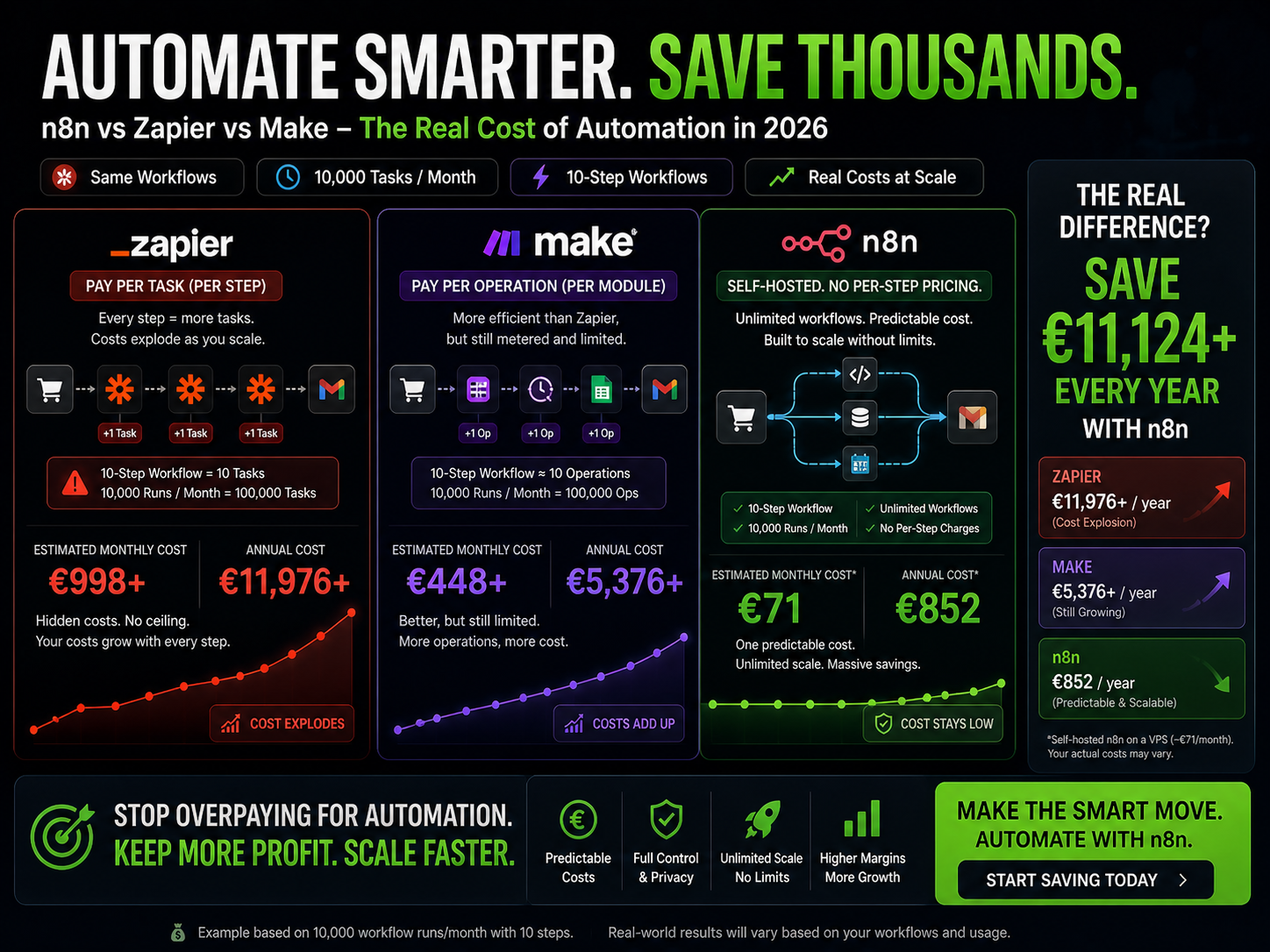
Most automation platforms charge per "task" or "operation", meaning every email sent, every record updated, every API call costs you money. At volume, these costs escalate quickly. n8n offers unlimited executions on self-hosted plans. Whether you run 1,000 or 1,000,000 automations monthly, your costs stay predictable.
400+ Native Integrations
n8n connects with the tools law firms already use: Clio, MyCase, LawPay, QuickBooks, Google Workspace, Microsoft 365, DocuSign, and hundreds more. If your practice management system has an API, n8n can integrate with it.
Open Source Flexibility
Unlike proprietary platforms that lock you into their ecosystem, n8n is open source. You're never dependent on a single vendor's roadmap or pricing changes. If you need custom functionality, you can build it, or hire someone who can.
Cost Comparison: The Scaling Advantage
A firm running 50,000 automation tasks monthly would pay $300-500+ on Zapier or Make. With n8n self-hosted, that same volume costs the price of a small server, often under $50 monthly. The savings compound as your automation maturity grows.
For law firms serious about automation, n8n offers the power, flexibility, and cost structure that makes sense at scale.
Ready to Transform Your Practice?
You went to law school to practice law, not to spend your evenings on administrative work. Workflow automation can give you back 15+ hours every week, recover thousands in lost billable time, and let you build the practice you actually envisioned.
The firms that embrace automation now will have an insurmountable advantage in five years. The technology is mature. The ROI is proven. The only question is whether you'll lead the transition or struggle to catch up.
If you're ready to explore what automation can do for your firm, visit N8Nme.com to learn more about implementation options, pricing, and how to get started with your first automation workflows.
Your future self, the one who leaves the office at 5 PM with a clear head and a full billable day, will thank you.