HR Automation for Small Businesses: How to Stop Drowning in Paperwork and Start Focusing on Your People

Discover how HR automation helps small business owners save time on recruiting, onboarding, and admin tasks, no coding or IT team required.
It's 8:47 on a Monday morning. Your inbox has 23 unread messages. Three are from job applicants asking for updates on positions you posted two weeks ago, positions that generated 94 resumes, most of which you haven't had time to properly review. One is from a new hire who still hasn't received their login credentials, even though they started last Thursday. Another is from your payroll provider flagging a discrepancy you now have 48 hours to fix. And somewhere in that pile is a compliance notice you really shouldn't ignore.
Sound familiar?
If you're managing HR for a small business, this isn't a bad day. This is just Tuesday. Or Wednesday. Or pretty much every day when you're one person, or a small team, responsible for recruiting, hiring, onboarding, payroll, benefits, compliance, performance reviews, and keeping employees happy, all at the same time.
You're not bad at your job. You're just doing four jobs with the resources of one.
The hard truth is that most small businesses are running HR the same way they did 15 years ago: spreadsheets, email threads, printed forms, manual reminders, and a lot of crossed fingers. It works, until it doesn't. And when it doesn't, the costs are real: a great candidate who accepted another offer because your follow-up was too slow, a compliance fine because a form slipped through the cracks, or an employee who quit partly because their onboarding experience felt chaotic and unwelcoming.
So What Is HR Automation, Actually?
HR automation simply means using software to handle the repetitive, rules-based tasks that currently consume your day. Instead of manually screening 100 resumes, automation filters them in minutes. Instead of chasing IT for laptop orders and payroll for tax forms, workflows trigger automatically when a candidate accepts an offer. Instead of coordinating interview schedules through endless email chains, candidates book their own slots from your team's real availability.
The technology isn't magic, and it doesn't replace human judgment. What it does is eliminate the administrative overhead that prevents you from doing the actual HR work: building relationships, shaping culture, developing talent, and solving the complex people problems that require empathy and experience.
In this post, we'll walk through four specific automation use cases that are delivering measurable ROI for small businesses right now. Each includes real statistics, concrete before-and-after scenarios, and practical guidance you can apply whether you're a team of five or fifty.
Recruitment Automation: From Sourcing to Offer
If you've posted a job recently, you already know the paradox: more applications than ever, yet somehow harder than ever to find the right person. Small businesses are drowning in resumes while still struggling to fill seats with qualified candidates. Something has gone seriously wrong with the traditional approach.
The Real Problem: Volume Without Quality
In 2025, two-thirds of recruiters report receiving more applicants per role than ever before. Yet nearly all of them are dissatisfied with candidate quality. What's happening? Candidates are using AI to mass-apply to dozens of positions without carefully considering fit. The result: your inbox fills with unqualified submissions while genuinely promising candidates get lost in the noise.
The manual screening math is brutal. At just two minutes per resume, screening 500 applicants requires over 16 hours of concentrated work. For a small business where HR responsibilities span multiple functions, that's nearly half a week spent on a single hiring decision. Meanwhile, qualified candidates are accepting offers from competitors who moved faster.
How Automation Changes the Game
AI-powered recruitment automation transforms this process from end to end:
Intelligent sourcing goes beyond keyword matching to understand career trajectories. When you need a "machine learning engineer who has scaled infrastructure at high-growth startups," AI can identify candidates whose actual experience matches that profile regardless of job title variations.
Automated screening processes hundreds of applications in minutes, ranking candidates by fit and providing match scores with explanations. The system learns from your hiring decisions, continuously improving its recommendations.
Interview scheduling eliminates the email chains. Candidates select from your team's real availability, receive automatic confirmations and reminders, and can reschedule without human coordination.
The ROI Numbers
The research on recruitment automation ROI is compelling:
- 31% faster hiring times (SHRM research)
- 50% improvement in quality of hire metrics
- 30-50% reduction in time-to-hire (Deloitte)
- Up to 40% reduction in cost-per-hire, saving approximately $1,880 per hire
For a small business hiring 10 people annually, that's $18,800 in direct savings. If you hire 50 people per year, savings exceed $94,000.
Before and After: A Real Scenario
Before automation: Sarah, the HR manager at a 25-person company, posts a marketing coordinator position. She receives 400 applications over two weeks. She spends 8 hours manually screening resumes, identifies 20 candidates for phone screens, and spends another 6 hours coordinating schedules via email. Three promising candidates withdraw before interviews because the process took too long. Total time invested: 14+ hours. Result: one hire after 6 weeks.
After automation: The same posting generates the same 400 applications. AI screening ranks all candidates in 30 minutes, surfacing the top 25 based on skills and experience alignment. Automated scheduling allows candidates to book directly into interview slots. Sarah spends her time on substantive conversations with pre-qualified candidates rather than administrative coordination. Total screening time: 30 minutes. Time-to-hire: 3 weeks. Candidate experience scores improve dramatically.
Onboarding Automation: Create Great First Impressions
Employee onboarding is a defining moment that sets expectations and influences how new hires feel from day one. Yet in many small businesses, it's a chaotic scramble of missed handoffs and last-minute coordination.
The Broken Onboarding Experience
Consider what typically happens when someone accepts your offer:
- HR owns the paperwork but doesn't know when IT will have the laptop ready
- IT doesn't receive the equipment request until someone manually forwards it
- Payroll needs tax forms but has no visibility into whether they've been completed
- The hiring manager isn't sure when the new person starts or what they should do first
With each department operating independently using different systems, critical handoffs get missed. The new hire's first experience is confusion and inefficiency, not exactly the impression you want to make.
How Automated Onboarding Works
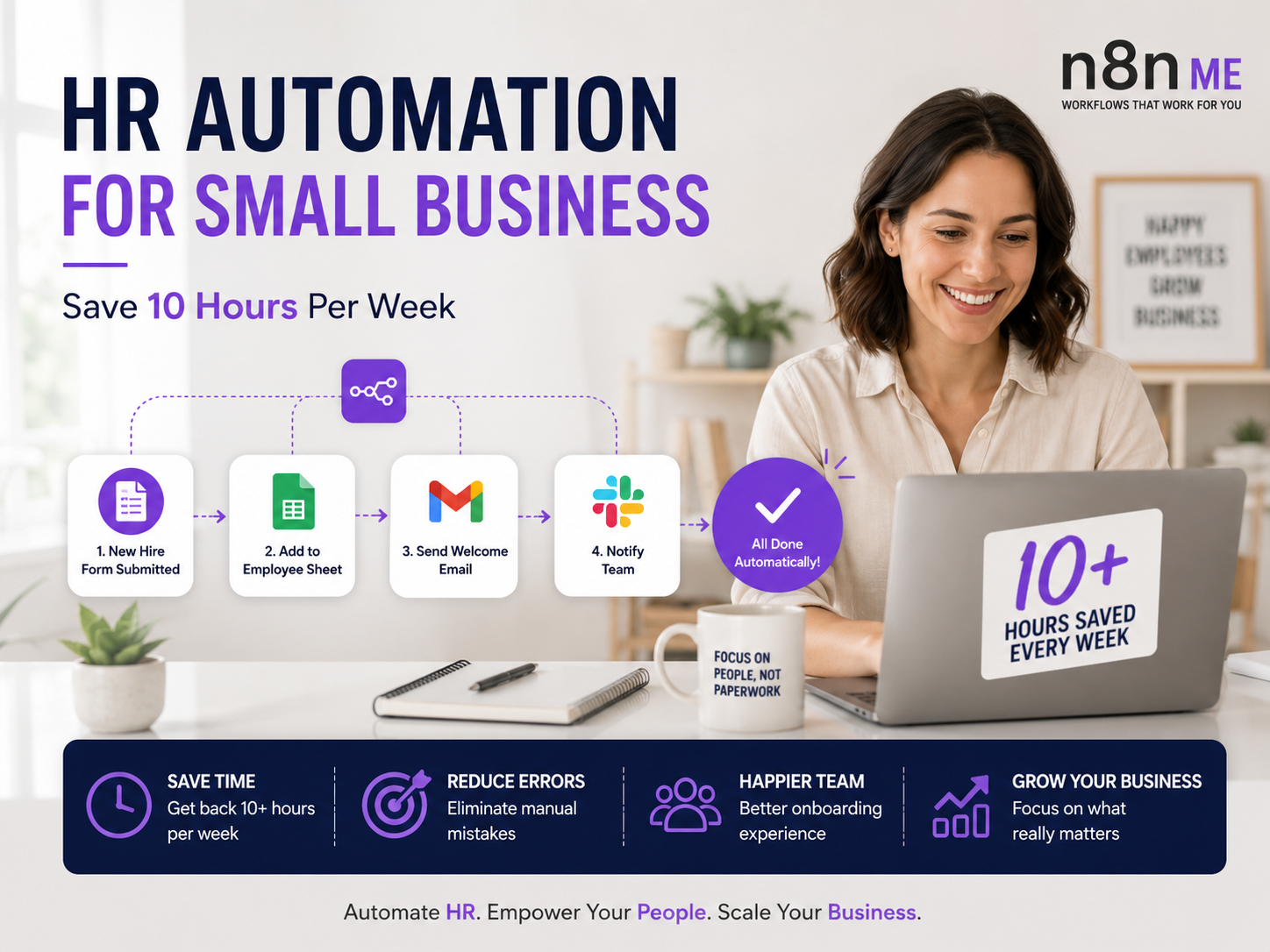
When a candidate accepts an offer, an automated workflow triggers instantly:
1. HR receives tasks to send welcome materials and schedule orientation
2. IT gets notified to provision equipment with a deadline tied to the start date
3. Payroll receives tax forms that can't route forward until complete
4. Facilities gets workspace requests with location details auto-populated
5. The manager receives confirmation of the new hire's arrival and first-week agenda
As the employee completes pre-boarding forms, AI validates submissions in real-time, flags missing information immediately, and routes completed forms to appropriate departments automatically. When all prerequisites are met, background checks cleared, paperwork submitted, equipment purchased, IT receives automatic notification to complete setup. The system sends the new hire tracking information and setup instructions.
The Impact
Organizations implementing onboarding automation report:
- 50% reduction in administrative time
- 90% improvement in data accuracy
- 40% faster time-to-productivity
- 25% reduction in early turnover
For a business onboarding 20 people monthly, 50% administrative time reduction represents 20-30 hours monthly of recovered HR capacity, 240-360 hours annually that can redirect toward culture, talent development, and strategic initiatives.
Interview Scheduling: Eliminate the Hidden Bottleneck
Interview scheduling occupies approximately 35% of a recruiter's workload, yet it's often treated as a tactical afterthought rather than a strategic priority. The hidden costs of manual scheduling are substantial.
The Scheduling Tax
Manual interview coordination involves endless email chains, calendar management across multiple participants, time zone coordination, and constant rescheduling. Each step introduces delay. When an interviewer is slow to decline an invitation, averaging 68 hours manually, they block that time slot for days, creating a "dead zone" where the coordinator can't offer that time to other candidates.
The candidate experience impact is severe: 64% of candidates who withdraw from hiring processes cite poor communication as their reason for dropping out. Slow coordination signals disorganization and costs you qualified applicants.
Automation Results
Teams using automated interview scheduling achieve dramatic improvements:
- 5.3x improvement in throughput: Coordinators handle 158 interviews/week vs. 30 manually
- 89% reduction in scheduling time: From 243 minutes to 27 minutes with self-scheduling
- 69% faster decline responses: From 68 hours to 21 hours with AI assistance
For an organization with 10 open positions and a standard 3-round interview process, automated scheduling reduces total coordination time from 385 hours to 38 hours, a 90% reduction that redirects recruiter effort toward candidate engagement and strategic activities.
Administrative Automation: Reclaim Hours Every Week
Beyond recruitment and onboarding, administrative tasks consume disproportionate HR time while adding limited strategic value. Expense management, benefits administration, and payroll processing represent substantial automation opportunities.
The Expense Report Problem
Despite available automation, 49% of businesses still use manual processes for expense management. The cost is staggering: each manual expense report costs $58 to process, and nearly 20% contain errors requiring $52 each to correct.
A company processing 200 expense reports monthly spends approximately $140,000 annually just on expense administration, before accounting for error correction costs.
Automated Solutions
Expense management: Employees photograph receipts using mobile apps. OCR technology extracts data automatically. Smart algorithms validate against company policies. Approved expenses trigger direct deposit reimbursement. Result: 67% reduction in processing time.
Benefits administration: AI-powered chatbots handle 80% of routine benefits questions, providing answers in 2 minutes versus 7 minutes for human agents. AI-assisted enrollment reduces errors by 35-45% and decreases support tickets by 30-40%.
Payroll automation: Integrated systems connect time tracking, tax calculations, benefits deductions, and direct deposit. Changes propagate automatically across systems, eliminating the manual data entry that causes most payroll errors.
Real-World Impact
iCAD, a medical device manufacturer, reduced expense report processing time by 67% and saved their accounting team 208 hours annually. Tampico Beverages saved their finance team 5-10 hours monthly by automating expense reporting.
Organizations automating benefits administration typically see 20-40% reductions in administrative costs once intelligent automation is applied.
Your 90-Day HR Automation Roadmap
Transforming your HR operations doesn't require a massive IT project or enterprise budget. Here's a practical 90-day implementation plan:
Phase 1: Assess and Prioritize (Days 1-30)
Map your current HR processes: recruitment, onboarding, payroll, benefits, compliance tracking. Document where delays occur, errors happen, and time gets consumed. Identify your highest-impact automation opportunity, typically recruitment or onboarding for most small businesses.
Phase 2: Pilot Implementation (Days 31-60)
Implement automation for your priority process. Start with one hiring team or employee group. Configure workflows, train users, and establish baseline metrics. Measure time savings, error reduction, and user satisfaction. Refine based on learnings.
Phase 3: Expand and Optimize (Days 61-90)
Roll out successful automation to additional teams or processes. Integrate with existing tools to eliminate duplicate data entry. Establish ongoing measurement practices. Plan next automation priorities based on ROI data.
Why n8n Is the Smart Choice
As you evaluate automation platforms, consider what matters for small businesses:
Self-hosted option gives you complete control over sensitive employee data, critical for HR compliance.
Unlimited executions mean no per-task pricing that penalizes you for automating more. Scale without surprise bills.
400+ integrations connect your existing HR tools, Greenhouse, BambooHR, Gusto, Slack, Google Workspace, without forcing platform switches.
Open source with an active community means no vendor lock-in, transparent pricing, and continuous improvement driven by real user needs.
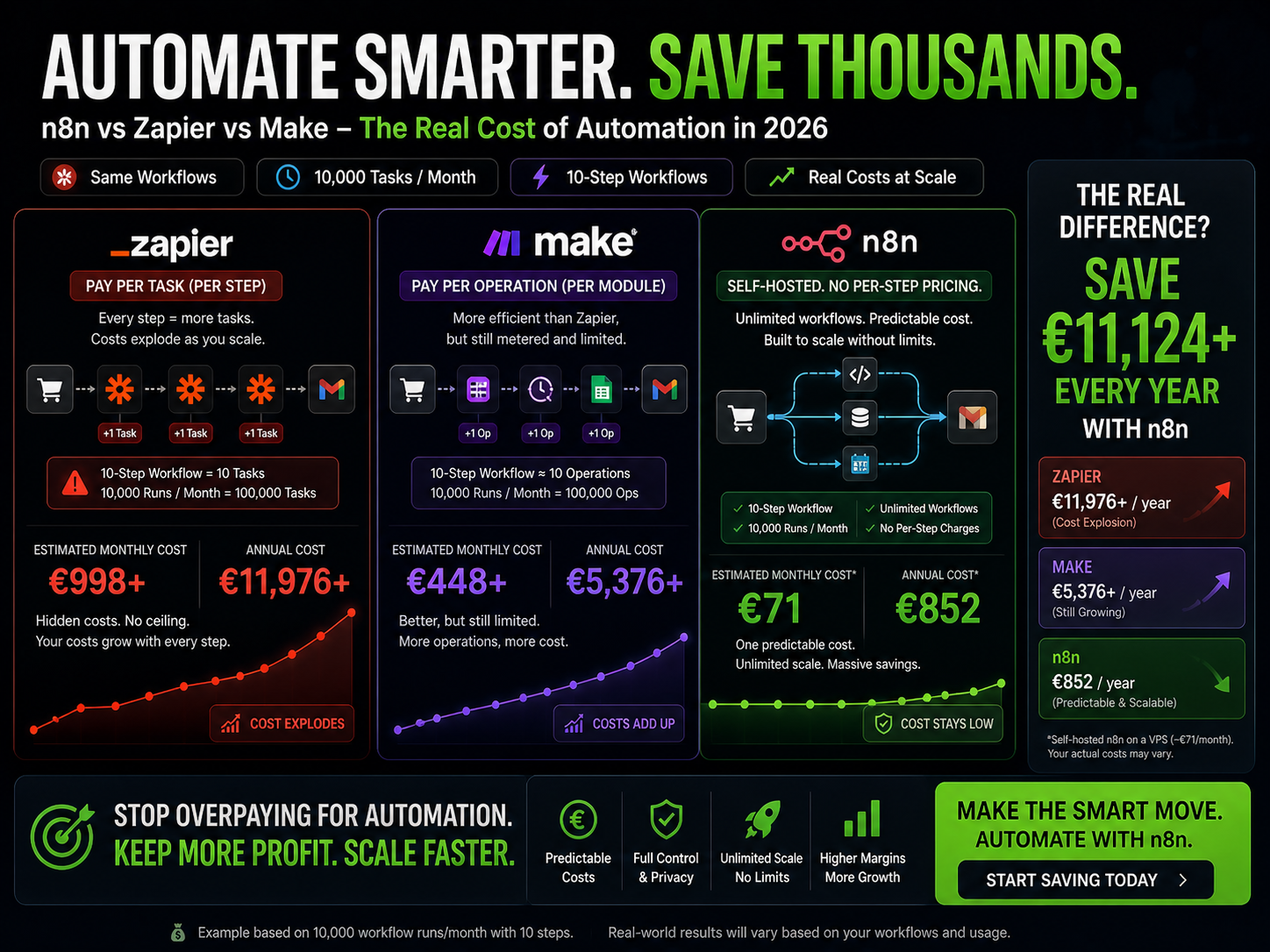
Cost-effective at scale, unlike Zapier or Make, n8n doesn't charge per operation, making it dramatically more affordable as your automation maturity grows.
Ready to stop drowning in administrative work and start focusing on your people? Get started with n8n today and build your first HR automation workflow in under an hour.
The technology is ready. The ROI is proven. The only question is whether you'll keep doing four jobs with the resources of one, or finally give yourself the tools to succeed.