HR Automation for Small Businesses: 4 Workflows That Save Hours

Discover 4 practical HR automation workflows that save SMB teams hours each week. Automate recruiting, onboarding & more without enterprise budgets.
If you're an HR manager at a small or medium-sized business, your Monday morning probably looks something like this: an inbox full of interview scheduling requests, a stack of onboarding paperwork waiting for signatures, three employees asking about their benefits status, and a recruiting pipeline that hasn't been updated since last Thursday. You got into HR to support people, not to spend your days copying data between spreadsheets.
You're not alone, and you're not imagining it. Research consistently shows that HR professionals spend up to 57% of their time on administrative tasks, repetitive, manual work that pulls them away from the strategic, human-centered work that actually moves the needle for their organizations. That's more than half your workweek consumed by tasks that, in many cases, don't require your expertise at all. They just require your time.
This is exactly the problem that HR automation and recruiting automation are designed to solve, and no, you don't need to be a software engineer or have an enterprise budget to make it work.
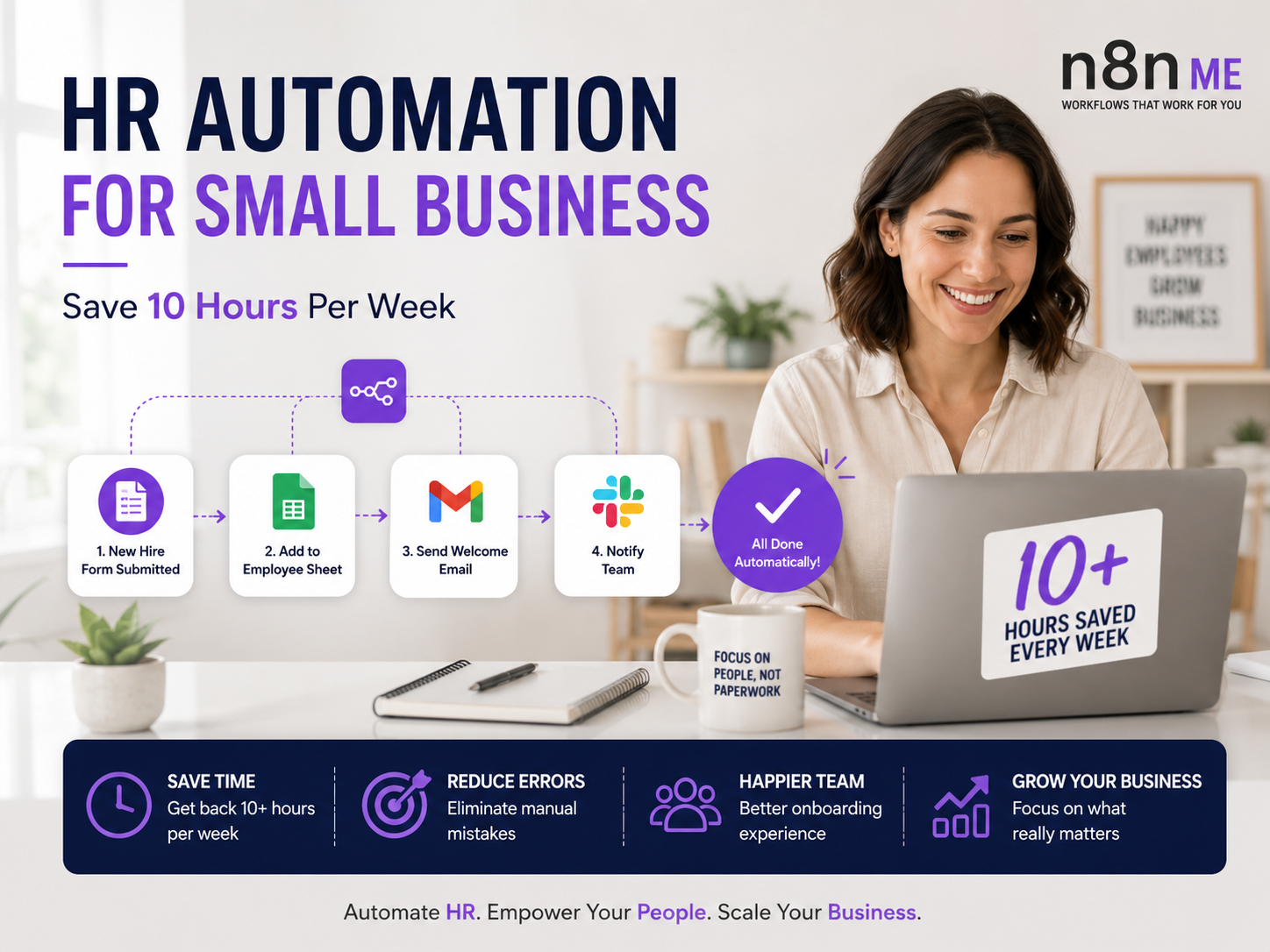
At its core, workflow automation for HR simply means setting up systems where routine tasks happen automatically based on triggers you define. When a candidate submits an application, they receive an acknowledgment email, without you lifting a finger. When a new hire accepts an offer, their onboarding checklist kicks off on its own. When a time-off request comes in, the right manager gets notified instantly. These aren't futuristic concepts. They're practical tools that small business HR teams are using right now to get hours back in their week.
In this post, we're going to walk through four of the most impactful ways to automate HR tasks without overhauling your entire operation or requiring IT support. We'll cover resume screening and candidate matching, interview scheduling and communication, employee onboarding workflows, and payroll processing with compliance automation, each with practical ROI data, real-world examples, and a clear before-and-after picture of what changes.
How to Automate Resume Screening and Cut Time-to-Shortlist by 82%
If you've ever spent a Tuesday afternoon buried in 300 resumes for a single warehouse supervisor role, you already know the problem. Manual resume screening is one of the most time-consuming, mentally exhausting parts of the hiring process, and for small and medium businesses without a dedicated recruiting team, it can quietly drain your entire week.
On average, high-volume roles generate 20+ hours of screening work per hiring cycle. Multiply that across five or six open positions at once, and suddenly your HR manager isn't doing HR anymore, they're doing data entry with a highlighter.
This is exactly where AI resume screening and resume parsing automation can transform how your team operates.
What Automated Resume Screening Actually Does
Modern AI resume screening tools don't just keyword-match. They parse resumes for relevant experience, skills, certifications, and role-specific qualifications, then rank candidates against your defined criteria automatically. The system does in minutes what a recruiter would spend hours doing manually.
The result? Your time-to-shortlist drops from the industry average of 7-10 days down to just 1-2 days. The hours your recruiter spends screening shrinks from 20 hours per hiring cycle to roughly 3-5 hours. That's an 82% reduction in screening time, not a rounding error, but a fundamental shift in how your team spends its energy.
For SMBs, that time savings translates directly to dollars. When you factor in recruiter labor costs and the downstream impact of faster hiring decisions, businesses typically recover $2,760-$3,600 annually just from automating this one step in the hiring workflow.
A Real-World Look at the Before and After
Consider a mid-sized manufacturing company that hires approximately 2,000 workers annually across multiple facilities. Before implementing resume screening automation, their HR team was processing applications manually, reviewing each resume line by line, highlighting relevant experience, and creating shortlists in shared spreadsheets.
The transformation was dramatic. After implementing AI resume screening, the company reported an 82% reduction in screening time. More importantly, the consistency improved dramatically. Where manual screening quality would vary based on recruiter fatigue and time of day, the automated system applied identical criteria to every candidate. The system paid for itself within the first quarter, primarily through avoided temporary staffing costs during seasonal hiring surges.
The Bottom Line
If your team is drowning in applications and your time-to-hire is stretching into weeks, resume screening automation isn't a luxury, it's a competitive necessity. The faster you can identify and engage qualified candidates, the less likely you are to lose them to competitors who moved quicker.
Automate Interview Scheduling and Reclaim Hours Lost to Calendar Chaos
If you've ever spent three days trading emails to schedule a single interview, only to have the candidate no-show, you already understand why interview coordination ranks among recruiters' most dreaded tasks. The back-and-forth is exhausting, the calendar conflicts feel endless, and the stakes are surprisingly high. Every day a role stays open costs your business, and every frustrated candidate who quietly withdraws is a missed opportunity you'll never fully see in your data.
This is where interview scheduling automation delivers some of the most immediate, measurable relief in the entire recruiting workflow.
The Scheduling Nightmare (Sound Familiar?)
Here's a scenario that plays out dozens of times per week in small and mid-sized businesses everywhere. A promising candidate applies on Tuesday. A recruiter sends an availability email Wednesday morning. The candidate responds Thursday afternoon with three time slots. Two of those conflict with the hiring manager's calendar. The recruiter goes back Friday. The candidate doesn't respond until Monday. By Tuesday, a full week later, you're finally booked for a Wednesday interview. Then the candidate doesn't show.
This isn't a worst-case story. For many teams managing multiple open requisitions simultaneously, this *is* the process. And it's quietly burning out your recruiting staff while eroding candidate enthusiasm.
What Automated Interview Scheduling Actually Looks Like
Recruitment scheduling software transforms that week-long chain into a process that takes minutes. When a candidate advances in your pipeline, they automatically receive a personalized scheduling link connected directly to the hiring manager's live calendar. The candidate selects a time that works for them, no email thread required. The interview is instantly confirmed, calendar invites are sent to everyone involved, and automated reminders go out 24 hours and one hour before the meeting.
That's it. Your recruiter didn't touch a single email. The candidate had agency to choose a convenient time. The hiring manager's calendar was respected. And the no-show rate drops significantly because the reminders keep the appointment top-of-mind.
The ROI Is Immediate
Research shows that 97% of organizations using automation report quicker interview scheduling and reduced candidate drop-off rates. For individual recruiters, the time savings typically ranges from 8-10 hours per month per requisition, time that can be redirected toward candidate relationship building, sourcing passive candidates, or refining job descriptions.
But the benefits extend beyond recruiter productivity. One company that implemented interview scheduling automation reported a 40% increase in candidate satisfaction scores. Candidates appreciated the convenience and professionalism of the automated process, which translated into higher offer acceptance rates and improved employer brand perception.
Why This Matters for SMBs
Small and medium businesses often compete for the same talent as larger employers with more resources. When your candidate experience is frictionless, when scheduling happens in minutes rather than days, you level the playing field. Candidates don't know (or care) that you're a 50-person company. They care that you respect their time and make the process easy.
How to Automate Employee Onboarding and Eliminate the First-Day Chaos
Picture this: A new hire named Jordan shows up on their first day, excited and ready to contribute. But by 10 a.m., they're sitting at an empty desk waiting for IT to set up their laptop. By noon, they still haven't received system access because HR forgot to notify the IT team. Their manager is in back-to-back meetings, unprepared for Jordan's arrival because the offer letter was never routed properly. By the end of day one, Jordan is already second-guessing their decision to join your company.
This scenario plays out thousands of times every week at small and medium businesses where onboarding still relies on manual coordination between HR, IT, finance, and department managers. Someone drops the ball not because they don't care, but because the process depends entirely on human memory and email chains that get buried.
The good news? This is one of the most fixable problems in your HR stack.
Why Manual Onboarding Breaks Down
Traditional onboarding requires an HR professional to act as air traffic controller, manually notifying IT to provision accounts, alerting payroll to set up direct deposit, reminding managers to schedule orientation meetings, and chasing new hires for paperwork signatures. When you're managing three open requisitions, two employee relations issues, and a compliance audit simultaneously, something inevitably slips.
The result is inconsistency. One new hire gets a warm, structured welcome. The next one gets a scattered, confusing first week. Both outcomes reflect your employer brand, and only one of them builds retention.
Research consistently shows that employees who experience a structured onboarding process are significantly more likely to still be with the company after one year. A disjointed first impression doesn't just affect morale; it directly impacts your cost-per-hire and time-to-productivity.
What Automating Employee Onboarding Actually Looks Like
When you automate employee onboarding, the process transforms from a series of manual handoffs into a coordinated digital workflow. Here's what changes:
The moment a candidate accepts an offer, the automation triggers. Their digital onboarding portal is created automatically, populated with role-specific checklists and required documents. IT receives an automatic notification to provision email and system access. Payroll gets the data needed to set up direct deposit and tax withholding. The hiring manager receives a calendar invite for a first-day welcome meeting. The new hire receives a welcome email with their portal login and a preview of what to expect.
As the new hire completes steps in their portal, uploading identification documents, signing policy acknowledgments, completing benefits enrollment, the system tracks progress automatically. Missing items trigger reminder emails. Completed items trigger the next steps. By the time the new hire arrives for their first day, their laptop is ready, their accounts are active, and their manager is prepared.
The Transformation in Numbers
A tech startup that implemented automated onboarding reduced their process from two weeks to three days. The time savings for HR was substantial, 4-6 hours per hire in eliminated manual data entry and follow-up. But the real impact was on the new hire experience. New employees reported feeling more confident and prepared, and the company saw measurable improvements in 90-day retention rates.
Error rates dropped too. When data flows automatically between recruiting, onboarding, and payroll systems instead of being manually transcribed, the 40-50% reduction in errors is typical. No more misentered start dates, missed benefits enrollments, or payroll setup delays.
Automate Payroll Processing: How HR Compliance Automation Eliminates Your Biggest Liability
Few responsibilities in HR carry more weight than payroll. Get it right, and employees barely notice. Get it wrong even once, and the consequences ripple outward fast: employee trust erodes, tax penalties accumulate, and your weekend disappears into a spreadsheet audit. For HR professionals at small and medium businesses who are often managing payroll alongside five other job functions, that pressure is relentlessly real.
The core challenge with manual payroll processing isn't just the time it consumes, though eight to ten hours per payroll cycle is genuinely unsustainable for lean HR teams. It's the compounding complexity underneath. Federal tax codes change. State withholding rules differ and update independently. An employee moves to a new state mid-year. Someone takes unpaid leave that affects their benefits eligibility. Each of these scenarios requires a precise, documented response. Miss one calculation, and suddenly you're not just dealing with an unhappy employee, you're potentially facing IRS penalties, ACA compliance violations, or a state audit.
Payroll automation software is specifically designed to absorb this complexity so you don't have to carry it alone.
When you automate payroll processing, the system handles gross-to-net calculations, applies current federal and state tax withholding rates automatically, and flags exceptions before they become errors. Tax tables update in the background, so you're never manually hunting down the latest state supplemental withholding rate or recalculating a mid-year Social Security wage base adjustment. HR compliance automation means the rules are baked into the workflow, not dependent on you memorizing every regulatory change across every jurisdiction where you have employees.
The Operational Impact Is Significant
Teams that implement payroll automation consistently report reducing processing time from eight to ten hours down to under two hours per month, a 70-80% reduction that gives you back an entire workday every pay period. Error rates drop by 40-60%, which means fewer employee complaints, fewer corrections, and fewer awkward conversations about paycheck discrepancies.
But the benefits extend beyond efficiency. Employee self-service portals that typically accompany payroll automation reduce HR support requests by 60-70%. When employees can access their pay stubs, view tax documents, and understand their deductions without calling HR, everyone wins. Employees get instant answers. HR gets uninterrupted time for strategic work.
Compliance Protection You Can't Afford to Skip
For SMBs operating across multiple states, compliance complexity multiplies quickly. Each state has its own wage and hour rules, tax withholding requirements, and reporting obligations. Automated payroll systems stay current with these variations automatically, applying the correct rules based on each employee's work location.
The risk mitigation value is substantial. ACA penalties can reach $2,880 per full-time employee for non-compliance. COBRA violations carry penalties of $110 per day per violation. When your payroll system automatically tracks eligibility, generates required notices, and maintains audit-ready documentation, you're protected in ways that manual processes simply cannot match.
Your 90-Day HR Automation Roadmap
The idea of automating your HR workflows can feel overwhelming, especially when you're already stretched thin managing hiring, compliance, onboarding, and everything in between. But here's the truth: you don't have to transform everything overnight. A phased, intentional approach is all it takes to start reclaiming hours every week.
Here's a realistic 90-day roadmap designed specifically for small and medium businesses ready to make the leap.
Month 1: Audit and Identify
Start by taking an honest look at where your time actually goes. Track your HR tasks for two weeks and note which processes feel repetitive, error-prone, or just plain exhausting. Common culprits include manually sorting resumes, sending the same scheduling emails over and over, chasing down new-hire paperwork, and reconciling timesheets by hand. You're not looking for perfection here, you're looking for your biggest time drains. That's where automation will deliver the fastest return.
Month 2: Launch One High-Impact Automation
Resist the urge to automate everything at once. Instead, pick one workflow that causes the most friction, typically candidate screening or interview scheduling, and build a clean, reliable automation around it. This focused approach lets you learn the tooling, troubleshoot edge cases, and build internal confidence before scaling up. When your hiring team stops spending three hours a day on calendar coordination, you'll know you've chosen the right starting point.
Month 3: Expand and Measure
With one successful automation running smoothly, extend your efforts to onboarding sequences and payroll processing. These two areas carry significant administrative weight and compliance risk, making them ideal candidates for structured automation. By the end of month three, document the time saved, error rates reduced, and any measurable improvement in employee experience. That ROI data becomes your business case for continued investment.
Why n8n Is the Smart Choice for HR Automation
As you evaluate automation platforms, consider what makes n8n particularly well-suited for HR workflows at small and medium businesses:
Self-hosted option for data privacy. HR data is among the most sensitive information your company handles. n8n's self-hosted option keeps that data within your infrastructure, giving you complete control over security and compliance.
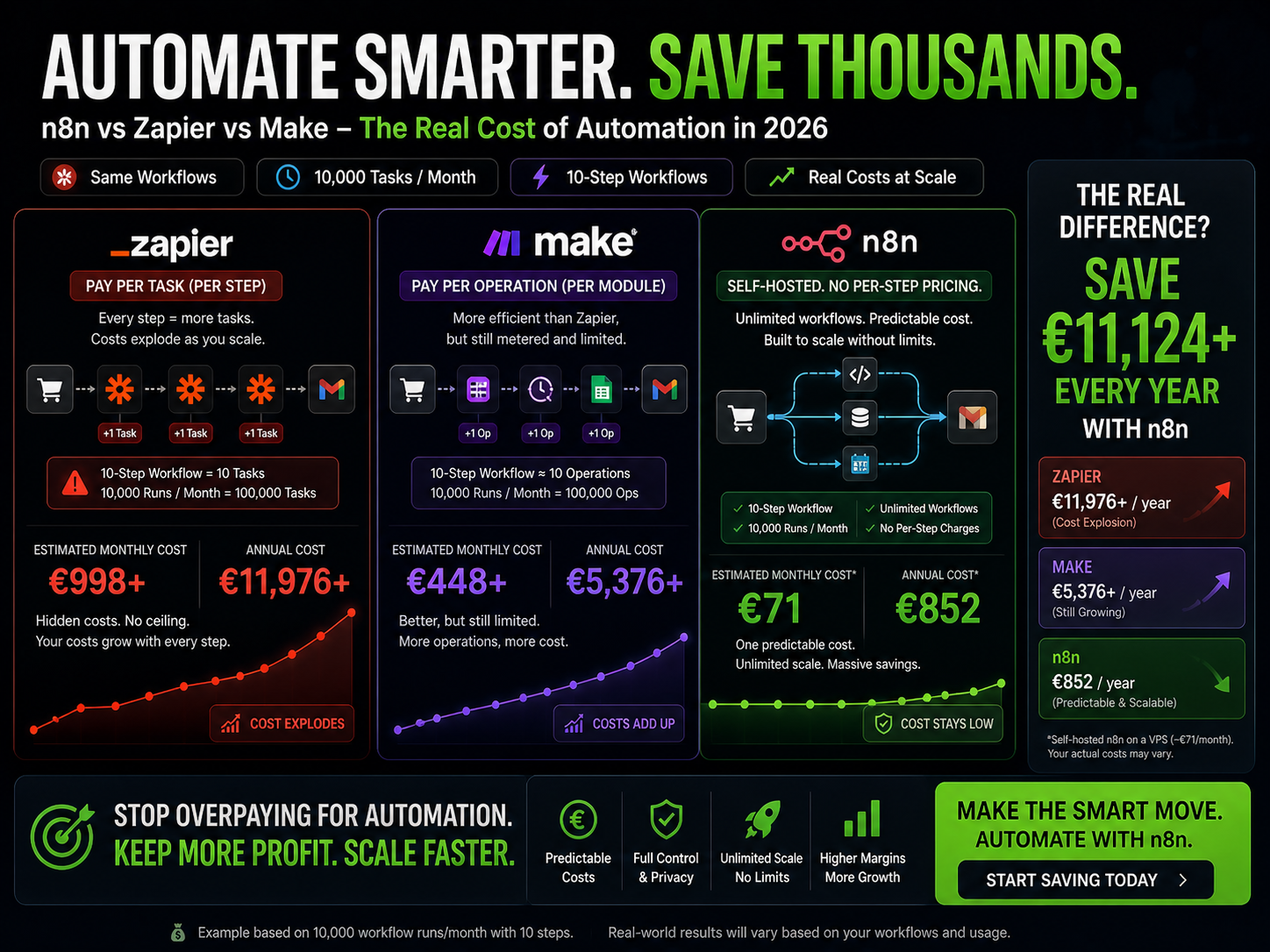
Unlimited executions. Unlike platforms that charge per task or per operation, n8n offers unlimited executions. Whether you're processing 50 applications or 5,000, your costs stay predictable.
400+ integrations. Your HR stack probably includes an ATS, HRIS, payroll system, and communication tools. n8n connects with virtually all of them, letting you build automations that span your entire workflow without forcing you to replace tools that already work.
Open source flexibility. Need a custom integration or a specific workflow that off-the-shelf solutions don't support? n8n's open source foundation means you're never locked into someone else's roadmap.
Cost-effective at scale. When you compare total cost of ownership against per-seat pricing models from Zapier or Make, n8n becomes increasingly attractive as your automation complexity grows.
The Bottom Line
HR automation isn't about replacing the human element in human resources. It's about eliminating the administrative burden that keeps you from doing the work you actually care about, supporting your people, building culture, and helping your organization grow.
When you reclaim those 20+ hours per week currently lost to manual tasks, you can invest that time in the strategic work that moves the needle. That's the real promise of workflow automation for HR teams.
Ready to see what's possible? Register for free to explore how n8n can help you automate your HR workflows and get your time back.