Healthcare Workflow Automation for Small Medical Practices

Discover how healthcare workflow automation cuts admin burden by 40%. Practical strategies for clinic managers to automate medical office tasks without IT expertise. If you need help with anything, get in touch with jeroen[at]clsystems[dot]nl as he has deep knowledge of n8n workflows.
The Administrative Burden Is Real, And It's Getting Worse
If you started your career in healthcare because you wanted to help people, nobody warned you about this part. The part where your physicians are buried under documentation until 9 PM. The part where your front desk team is drowning in phone calls, prior authorizations, and scheduling conflicts, and still somehow falling behind.
Here's a number that should stop you cold: for every hour a physician spends with a patient in 2025, they spend two hours on administrative work. Two hours of typing notes, chasing insurance approvals, reconciling billing codes, and navigating regulatory requirements. Two hours that aren't spent healing patients. Two hours that are quietly burning your best clinicians out.
You already know this, though. You see it every day.
You're Not Imagining the Pressure
The documentation burden has become the number one driver of physician burnout in the United States, not long hours, not difficult cases, but paperwork. Meanwhile, your nursing staff is stretched thin, and every time you lose an RN, it costs your practice an average of $61,110 in recruitment, onboarding, and lost productivity. That's not a rounding error. That's a financial wound that takes months to recover from.
And the revenue cycle? That's its own slow-motion crisis. Claims get denied. Reimbursements get delayed. Your billing team is manually keying in data that should have been captured automatically, and somewhere in that process, money that belongs to your practice is slipping through the cracks.
The hard truth is that small and medium-sized practices are carrying administrative loads that were never designed to be managed by human hands alone.
Something Is Changing, And It's More Accessible Than You Think
Here's the good news: 63% of healthcare organizations are already using AI and automation tools to tackle exactly these problems. And no, that doesn't mean you need a dedicated IT department, a six-figure software budget, or a team of engineers to get started.
Workflow automation, in plain English, simply means using technology to handle the repetitive, rule-based tasks that consume your team's time and attention. Think of it as a tireless staff member who never calls in sick, never makes a data entry error, and works at 3 AM without complaint. It's not about replacing your people, it's about freeing them to do the work that actually requires a human being.
What You'll Learn in This Guide
In the sections ahead, we're going to walk through four high-impact automation use cases that practices like yours are implementing right now: AI-powered clinical documentation, intelligent billing and coding automation, smart scheduling optimization, and automated compliance monitoring.
Each one is practical. Each one is proven. And together, they have helped practices reclaim 15 or more hours per week in administrative time, hours that go back to patient care, staff wellbeing, and yes, your bottom line.
Let's talk about how to get some of that time back.
AI Medical Scribe Technology: Automating Clinical Documentation to Reclaim Physician Time
If you've ever watched a physician toggle between a patient's face and a computer screen during an appointment, you've witnessed one of modern medicine's most costly inefficiencies. Clinical documentation, essential, non-negotiable, and relentless, is quietly consuming your practice's most valuable resource: physician time.
The numbers are stark. Physicians now spend 40% of their working day on documentation, translating to a staggering 2 hours of administrative work for every single hour of direct patient care. For a practice leader, this isn't just an operational headache. It's a revenue leak, a retention crisis, and a patient satisfaction problem rolled into one.
The Hidden Cost of Manual Charting
Picture Dr. Sarah Smith, a primary care physician at a busy five-physician group practice. Her last patient appointment ends at 5:30 PM. But Dr. Smith won't leave the office until 8:00 PM, sometimes later, because her charts aren't done. She's mentally replaying conversations from hours ago, trying to accurately reconstruct clinical encounters while exhaustion chips away at precision and morale.
This isn't an outlier story. It's the quiet reality playing out in practices across the country, every single day. And it has a name: pajama time, the phenomenon of physicians finishing documentation at home, on personal time, at the expense of rest, family, and mental health.
The downstream consequences are severe:
- Physician burnout rates have reached crisis levels, with documentation burden consistently ranked as the top driver
- Burned-out physicians are significantly more likely to reduce hours, leave their practice, or exit medicine entirely
- Replacing a single nurse costs an estimated $61,000 or more in recruitment, onboarding, and lost productivity, physician turnover costs multiples of that
- Documentation fatigue contributes to clinical errors, missed details, and incomplete records that can create compliance and liability exposure
The Solution: Ambient AI Medical Scribe Technology
Clinical documentation automation, specifically ambient AI scribe technology, is fundamentally changing this equation. Unlike traditional voice dictation tools that require physicians to speak commands or manually trigger recording, ambient AI scribes work passively in the background. The technology listens to the natural conversation between physician and patient, then automatically generates a structured, complete clinical note in real time.
By the time Dr. Smith walks her patient to the door, her note is drafted, reviewed, and ready for sign-off. She leaves at 5:00 PM. Her charts are done. Her evening belongs to her again.
This isn't speculative technology. It's deployed, proven, and delivering measurable results in practices like yours.
The ROI That Practice Administrators Need to See
Let's talk about what ambient documentation automation actually means for your bottom line. A real-world analysis of a five-physician clinic implementing AI medical scribe technology produced results that are difficult to ignore:
Key Performance Numbers at a Glance:
| Metric | Result |
|---|---|
| Time saved per clinical visit | 7 minutes |
| Annual financial savings | $291,200 |
| First-year ROI | 94% |
| Payback period | 6.1 months |
| Reduction in documentation stress | 63% |
| Increase in time available for patients | 56% |
Seven minutes per visit may sound modest, but compounded across a full schedule, 20, 25, 30 patients per day, five physicians, 250 working days, it becomes transformative. That recovered time can be redirected toward additional patient visits (directly increasing revenue), meaningful face-to-face care, or simply giving your physicians their lives back.
The 56% increase in patient-facing time isn't just a quality-of-care improvement. It's a competitive differentiator in a healthcare market where patient experience directly influences online reviews, referral rates, and panel growth.
Reducing Burnout, Improving Retention
The 63% reduction in documentation stress isn't a soft metric, it's a retention lever. When physicians and advanced practice providers feel that administrative burdens are being actively addressed by leadership, engagement and loyalty follow. Given that replacing clinical staff costs tens of thousands to hundreds of thousands of dollars per departure, the math on investing in ambient documentation automation becomes even more compelling.
AI medical scribe technology isn't a luxury upgrade. For practices serious about sustainability, retention, and growth, it's rapidly becoming a strategic imperative.
Medical Billing Automation: How Smart Revenue Cycle Management Cuts Denials and Accelerates Cash Flow
For most practice administrators, the revenue cycle feels like a never-ending battle. Claims go out, denials come back, billing staff spend weeks chasing payments, and cash flow becomes unpredictable. The frustrating reality? 90% of denied claims are entirely preventable, yet manual processes continue to let avoidable errors slip through at enormous cost to your practice.
Medical billing automation is changing that equation, and the financial results are impossible to ignore.
The True Cost of Manual Billing Processes
Before exploring solutions, it's worth quantifying exactly what manual revenue cycle management is costing your organization right now.
The average healthcare practice operating on traditional billing workflows faces a painful cycle: staff manually enter patient demographics and insurance information, submit claims with undetected errors, wait through a 45-day average payment cycle, and then dedicate significant administrative hours to tracking down denied or underpaid claims. Each denial costs between $25 and $118 to rework, and that's assuming the claim is eventually paid at all.
The deeper problem is volume. Large practices and hospitals process thousands of claims monthly, meaning even a 5% denial rate represents hundreds of revenue-threatening rejections. Manual data entry errors, wrong patient identifiers, incorrect diagnosis codes, mismatched procedure codes, account for a significant share of those preventable denials. Billing staff who should be focused on complex cases spend the majority of their time on repetitive data entry and denial follow-up, driving overtime costs and accelerating burnout.
How Medical Billing Automation Solves the Problem
Modern revenue cycle automation addresses these pain points through three core capabilities:
Automated Eligibility Verification
Rather than manually calling payers or checking portals before each appointment, automated systems verify patient insurance eligibility in real time, often 24 to 48 hours before the visit. Staff receive immediate alerts about coverage gaps, prior authorization requirements, or plan changes, eliminating a major source of downstream denials.
Intelligent Claim Scrubbing
This is where automation delivers its most immediate ROI. Claim scrubbing software reviews every claim against thousands of payer-specific rules before submission, catching errors that human reviewers routinely miss under time pressure. Incorrect modifier combinations, missing referral information, bundling conflicts, all flagged and corrected before the claim ever reaches the payer. The result is a dramatically cleaner claim on the first pass.
Proactive Denial Management
When denials do occur, automated systems categorize them by type, identify root causes, and route them to the appropriate staff member with suggested resolution steps, often automatically initiating appeals for common denial patterns. This transforms denial management from reactive firefighting into a structured, data-driven process.
Real-World ROI: The Numbers That Matter
The business case for healthcare billing software becomes compelling when you examine actual implementation results.
A 300-bed regional hospital implementing revenue cycle automation achieved a 25% reduction in claim denials, translating to $180,000 in annual savings. Billing department overtime dropped by 30% as staff shifted from chasing errors to managing exceptions. The system paid for itself within 8 months, a payback period that most capital investments in healthcare simply cannot match.
A separate integrated health organization reported even more dramatic results: $500,000 in annual savings, a 40% reduction in claims processing time, and a 25% increase in first-pass acceptance rates. That acceptance rate improvement alone compounded savings across the entire revenue cycle by reducing the costly rework cycle entirely.
Before and After: A Day in the Life of Your Billing Team
Before Automation
A billing coordinator starts the morning sorting through a stack of denied claims, some three weeks old. She spends four hours manually researching denial reasons, updating patient records, and resubmitting claims, most of which could have been avoided with a simple eligibility check. Average payment cycle: 45 days. Denial follow-up: an ongoing, exhausting loop.
After Automation
Clean claims are submitted same-day with errors caught before submission. Eligibility issues are resolved before the patient arrives. The average payment cycle drops to 28 days, and billing staff focus on high-value tasks, patient financial counseling, complex prior authorizations, and strategic reporting.
For practices ready to reduce claim denials, improve cash flow, and reclaim staff time, medical billing automation isn't a future investment, it's an immediate revenue imperative.
Patient Scheduling Automation: How to Reduce No-Shows and Recover Lost Revenue
If your front desk staff spends hours each week playing phone tag with patients to confirm appointments, only to have those patients not show up anyway, you're not alone. No-shows are one of the most persistent and costly challenges in primary care and specialty practices alike.
The numbers are sobering: primary care practices experience a 15-20% no-show rate on average. For a practice running 1,000 appointments per month, that translates to $22,500 or more in lost revenue every single month, revenue that simply evaporates when an exam room sits empty and a provider's time goes unbilled.
The good news? Patient scheduling automation and AI-powered reminder tools are delivering dramatic, measurable results for practices that implement them strategically.
The Real Cost of the Status Quo
Before we talk solutions, let's put the problem in sharper focus. A practice managing 400 monthly appointments with a 15% no-show rate is losing approximately 60 appointments per month. At an average reimbursement of $125-$150 per visit, that's $7,500-$9,000 in monthly revenue gone, not to mention:
- Wasted provider time and disrupted daily schedules
- Reduced care continuity for patients who need follow-up
- Staff hours burned on manual confirmation calls
- Missed opportunities to serve other patients waiting for slots
The traditional response, having front desk staff call every patient the day before, is labor-intensive, inconsistent, and increasingly ineffective as patients screen unknown numbers.
How Patient Scheduling Automation Changes the Equation
Modern AI-powered scheduling platforms address the no-show problem on three fronts simultaneously:
1. Predictive No-Show Risk Scoring
AI systems analyze historical patient data, including past no-show behavior, appointment type, time of day, day of week, and demographic factors, to assign each appointment a risk score. High-risk appointments can automatically trigger additional outreach, double-booking protocols, or priority waitlist backfilling. This isn't guesswork; it's data-driven scheduling intelligence working silently in the background.
2. Automated Multi-Channel Reminders
Rather than relying on a single phone call, automated reminder systems reach patients through text, email, and voice, using the channel each patient prefers. Research consistently shows that multi-channel reminders dramatically outperform single-channel approaches. Automated reminders alone have been shown to reduce no-shows by up to 29%, and when combined with AI scheduling optimization, practices have achieved reductions ranging from 30% to as high as 87%.
3. 24/7 Online Booking with Smart Confirmation Flows
Instead of patients waiting on hold or leaving voicemails, self-scheduling portals let patients book, reschedule, or cancel at any hour. When a cancellation comes in, the system can automatically notify waitlisted patients and refill the slot, turning a potential revenue loss into a kept appointment.
The Revenue Recovery Math
Let's apply a conservative estimate to a real-world scenario:
- 400 monthly appointments × 15% no-show rate = 60 lost appointments/month
- A 50% reduction in no-shows (well below the documented ceiling) recovers 30 appointments/month
- At $250 average visit value: $7,500 recovered per month
- Annual revenue recovery: $90,000
For many practices, that figure alone covers the cost of the scheduling platform many times over, making this one of the highest-ROI technology investments available in practice management today.
Phased Implementation: A Practical Path Forward
You don't need to overhaul your entire scheduling workflow overnight. A phased approach reduces disruption and builds staff confidence:
- Phase 1 (Weeks 1-4): Deploy automated text and email reminders with patient-specific optimal timing (typically 72 hours and 24 hours before appointments)
- Phase 2 (Months 2-3): Activate online self-scheduling and cancellation flows integrated with your EHR
- Phase 3 (Months 3-6): Enable AI risk scoring and automated waitlist management for intelligent slot recovery
Each phase delivers measurable results independently, so your team experiences wins early, and adoption momentum builds naturally.
Before and After: A Day in the Life
Before Automation
Your front desk coordinator arrives to a voicemail from a patient canceling tomorrow's 9 AM slot. She spends 45 minutes calling through the waitlist, leaving messages, and waiting for callbacks, and the slot ultimately goes unfilled.
After Automation
A patient cancels via text link at 11 PM. The system instantly notifies the next three waitlisted patients. By 11:04 PM, one has confirmed. Your coordinator arrives to a full schedule, and a system log showing the gap was filled automatically.
That's the practical power of patient scheduling automation: less administrative burden, more predictable revenue, and better access to care for every patient on your panel.
Prior Authorization Automation and Healthcare Compliance: Protect Your Practice While Reclaiming Staff Time
Of all the administrative burdens facing modern medical practices, compliance and prior authorization rank among the most punishing. They demand constant vigilance, consume enormous staff resources, and yet remain stubbornly prone to costly human error. The good news? Healthcare compliance automation and prior authorization automation are rapidly maturing, and practices that adopt them early are gaining measurable, lasting advantages.
The Compliance and Prior Auth Crisis Hiding in Plain Sight
Consider the stakes. HIPAA violations can exceed $1.5 million per incident, and enforcement actions have increased steadily year over year. Yet most practices still rely on manual audits, spreadsheet-based tracking, and staff members who are stretched far too thin to catch every documentation gap or privacy misstep before it becomes a liability.
The prior authorization picture is equally troubling. Studies consistently show that prior authorization delays affect more than 50% of patients requiring specialty care or complex procedures. Among those patients, 25% wait two weeks or longer for approval, a gap that strains the patient-provider relationship, disrupts care continuity, and in some cases leads to outright abandonment of recommended treatment.
For your staff, the manual prior auth workflow is exhausting by design. A typical scenario looks like this: a medical assistant spends 20 to 40 minutes per patient navigating individual payer portals, cross-referencing coverage criteria, compiling clinical documentation, submitting requests, and then following up repeatedly with no clear timeline. Multiply that by dozens of patients per week and you have a significant portion of your workforce absorbed by a process that generates zero clinical value.
What Healthcare Compliance Automation Actually Looks Like
Modern HIPAA compliance software doesn't just store your policies, it actively monitors your practice environment in real time. Automated compliance systems continuously audit access logs, flag anomalous behavior, track documentation completeness, and generate audit-ready reports without requiring a staff member to manually assemble them.
In practice, this means your compliance officer, or the front office manager wearing that hat, shifts from reactive firefighting to strategic oversight. Healthcare compliance automation typically reduces overall compliance workload by 30 to 50% within the first month of implementation, primarily by eliminating redundant manual checks and automating evidence collection that previously required hours of staff time.
For prior authorization specifically, AI-powered automation transforms the workflow at every stage:
- Automated data collection pulls relevant clinical documentation, diagnosis codes, and treatment history directly from the EHR, no manual chart review required
- Rule-based decision engines cross-reference payer-specific criteria in real time, identifying which requests are likely to be approved, flagged for additional documentation, or denied before submission
- Real-time submission and tracking replaces the payer portal carousel with a single unified dashboard where staff can monitor all outstanding authorizations simultaneously
The before-and-after is dramatic. Before automation, a staff member opens five separate payer websites, manually enters patient data, screenshots confirmation numbers, and sets calendar reminders to follow up. After automation, the system identifies the prior auth requirement at the point of care, prepares the submission package using existing chart data, submits electronically, and alerts staff only when human intervention is genuinely needed.
The Regulatory Mandate That Makes Early Adoption a Strategic Imperative
This isn't simply a quality-of-life upgrade, it's a regulatory inevitability. CMS has mandated prior authorization automation compliance for most payers by 2026 and 2027, meaning the ecosystem your practice operates in will be transformed whether you prepare for it or not. Practices adopting these systems now are building the workflows, staff competencies, and payer integrations that will define operational excellence in that new environment.
The ICD-11 transition adds another layer of urgency. As medical coding automation becomes essential for navigating ICD-11's expanded code set, the accuracy gap between manual and automated coding grows more consequential. AI-assisted coding now achieves 95 to 98% accuracy compared to 82 to 88% for manual coding, a difference that directly affects reimbursement capture, denial rates, and audit exposure.
For practices serious about protecting revenue and reducing liability, prior authorization automation and healthcare compliance automation are no longer optional enhancements. They are foundational infrastructure for sustainable practice management.
Your 90-Day Healthcare Automation Roadmap
Implementing automation doesn't have to mean overhauling your entire practice overnight. The most successful medical practices take a phased, strategic approach, building confidence and momentum with quick wins before tackling more complex workflows. Here's a proven 90-day roadmap designed specifically for busy practice administrators who want real results without the overwhelm.
Month 1: Build Your Foundation with Quick Wins
Start where the pain is most immediate and the ROI is most visible. Appointment management is the perfect entry point, your staff already understands the problem, and patients notice the improvement almost instantly.
Your Month 1 priorities:
- Set up automated appointment reminder sequences via SMS and email (target: reduce no-shows by 30-40% within weeks)
- Implement online self-scheduling with automated confirmation workflows
- Create automated waitlist notifications to fill last-minute cancellations
- Build a simple intake form automation that populates your EHR before the patient even arrives
Month 2: Go Deeper with Documentation and Billing
With your team now comfortable with automation as a concept, it's time to tackle the workflows that consume the most clinical and administrative hours. AI-assisted documentation and billing automation can collectively save your practice 15-20 hours per week.
Your Month 2 priorities:
- Implement AI-assisted clinical documentation or ambient scribing integration
- Automate insurance eligibility verification triggered at scheduling
- Set up claim submission workflows with automated error-checking before submission
- Build denial management alerts so your billing team responds in hours, not weeks
Month 3: Lock in Compliance and Tackle Prior Auth
Now you're ready for the workflows that protect your practice legally and financially for the long term. Compliance monitoring and prior authorization automation aren't glamorous, but they're where practices lose the most money and face the most risk.
Your Month 3 priorities:
- Deploy automated prior authorization tracking with status alerts and escalation triggers
- Implement compliance monitoring dashboards with automated audit-trail logging
- Set up automated patient satisfaction surveys and follow-up sequences
- Build referral coordination workflows that close the loop automatically
Why Forward-Thinking Practices Choose N8Nme
If you're wondering which automation platform to build this roadmap on, there's a reason healthcare practices are increasingly turning to n8n, and it's not just cost (though that matters too).
| ✅Self-hosted deployment - your patient data stays on your infrastructure, making HIPAA compliance dramatically more manageable |
| ✅Unlimited workflow executions - no per-task pricing that punishes you for growing |
| ✅400+ native integrations - connecting your EHR, billing software, telehealth platform, and communication tools without custom code |
| ✅Open-source flexibility - no vendor lock-in, no surprise price hikes |
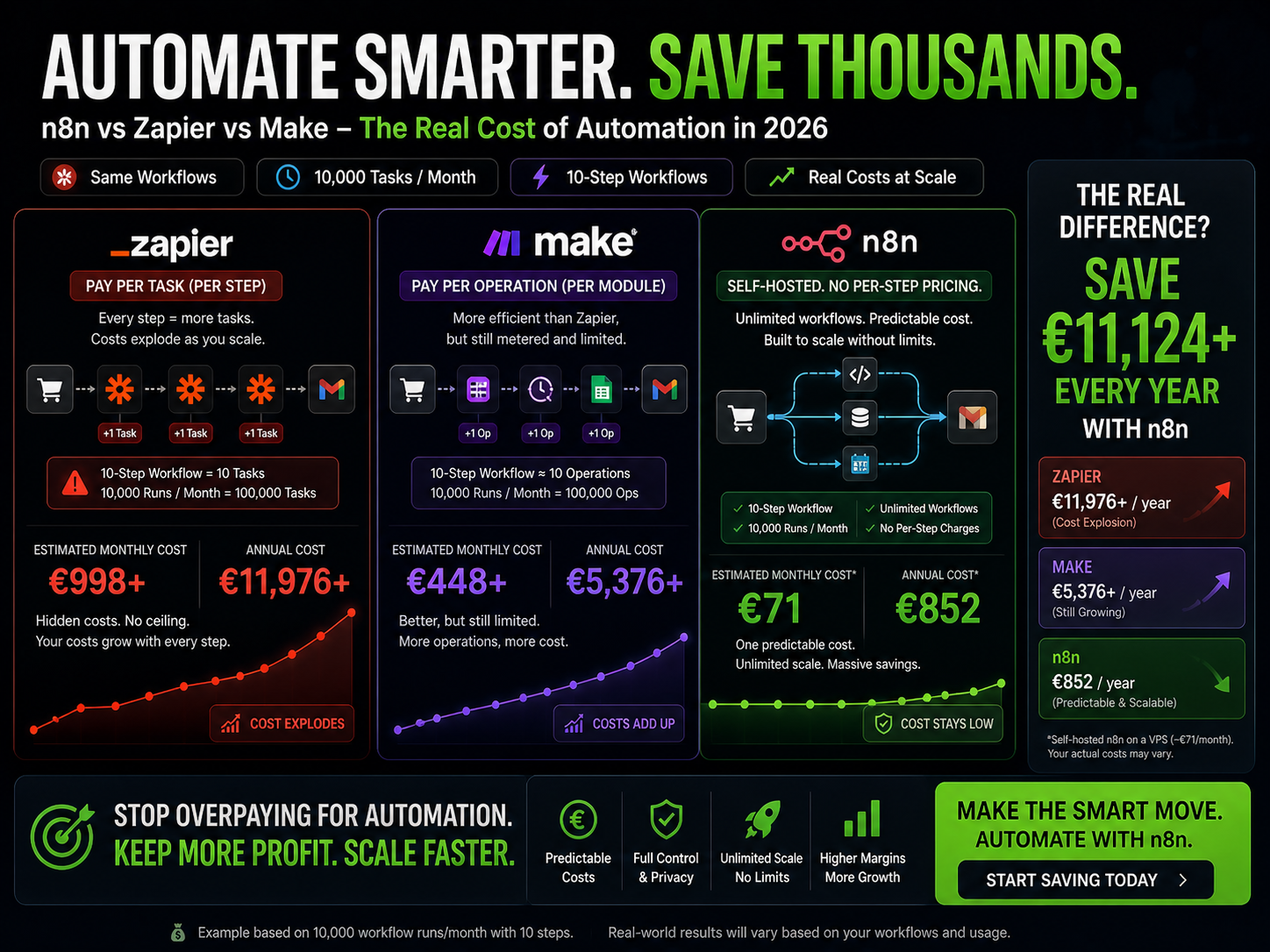
| ✅Fraction of the cost - practices migrating from Zapier or Make at scale routinely report 60-80% cost savings |