Ecommerce Automation: Scale Your Shopify Store on Autopilot

Discover how ecommerce automation transforms your Shopify store. Automate your online store, boost sales & save hours daily. Start automating smarter today!
It's 11 PM on a Tuesday. You're still at your desk, manually copying order details from your Shopify dashboard into a spreadsheet, firing off "your order has shipped" emails one by one, and trying to figure out why your inventory numbers don't match reality, again.
Sound familiar? If you're running an online store, this is just Tuesday.
The dirty secret of e-commerce success is that growth doesn't just bring in more revenue, it brings in more chaos. Every new order is another row to update. Every customer question is another tab to open. Every restock decision is another hour of squinting at numbers that may or may not be accurate.
And somewhere between the spreadsheets and the support tickets, you're supposed to find time to actually grow your business.
Here's the thing nobody tells you: you don't have to do it this way.
Workflow automation is exactly what it sounds like, software that handles your repetitive, rule-based tasks automatically, so you don't have to. Think of it like hiring a tireless digital assistant who never sleeps, never makes copy-paste errors, and doesn't need health insurance.
When a customer places an order? Your automation handles it. When stock drops below a certain level? Your automation flags it, or even reorders it. When someone leaves a review? Your automation responds or routes it to the right person.
No coding degree required. No enterprise budget needed.
Tools like n8n are making this kind of automation accessible to small and mid-sized e-commerce businesses for the first time. Whether you're selling on Shopify, WooCommerce, or Amazon (or all three), you can now connect your tools, automate your workflows, and reclaim your evenings.
In this post, we're going to walk you through four high-impact areas where automation can transform the way your store operates:
- Order Processing, From payment confirmation to fulfillment notifications, eliminate the manual steps that slow you down
- Inventory Management, Stop overselling, prevent stockouts, and keep your stock levels accurate across every channel
- Customer Service, Answer routine questions instantly, 24/7, while your team focuses on complex issues
- Marketing Automation, Recover abandoned carts, request reviews, and nurture customers without lifting a finger
Each section includes real ROI data, before-and-after scenarios, and practical implementation guidance. By the end, you'll have a clear picture of what's possible, and a roadmap to get there.
Let's dive in.
Automate Order Processing Shopify: End the Chaos, Start Scaling
If you're still manually processing every Shopify order, copying addresses, emailing suppliers, updating spreadsheets, you already know the quiet dread that comes with a busy sales day. What should be a celebration becomes a scramble. Every new order means more hours hunched over a screen, and the margin for error shrinks with every step.
This is exactly where the decision to automate order processing Shopify workflows becomes not just smart, but essential.
The Real Cost of Manual Order Processing
Manual order fulfillment is quietly bleeding your business. The average e-commerce merchant spends 4+ hours per day on order-related tasks, verifying payments, confirming stock levels, notifying fulfillment centers, and updating customers. For a store processing 50+ orders daily, that math is unsustainable.
The hidden costs go beyond time:
- Human error rates spike when teams handle repetitive data entry, leading to wrong addresses, incorrect SKUs, and missed shipments
- Customer expectations have never been higher, 88% of shoppers now expect delivery within two days of placing an order
- Staff burnout from repetitive, low-value tasks increases turnover and training costs
- Scaling becomes impossible because your capacity is capped by how many hours your team can work
Every delayed shipment chips away at your reputation. Every fulfillment error is a customer service ticket, a refund, and a lost repeat buyer.
Before and After: The Automation Transformation
Before automation: A customer places an order at 9 PM. You see it the next morning, manually check inventory across two warehouses, emails your 3PL, updates your internal spreadsheet, and send a confirmation email, by hand.
After automation: The same 9 PM order triggers an instant workflow. Payment is verified, inventory is deducted in real-time across all channels, your 3PL receives an automated fulfillment request, and the customer gets a personalized confirmation email within seconds.
How Order Processing Automation Works
- Payment processing, Orders are validated and flagged automatically based on risk scores
- Inventory synchronization, Stock levels update instantly across Shopify, Amazon, and other channels
- Fulfillment routing, Workflows determine whether to fulfill from your warehouse, a 3PL, or dropship
- Customer communication, Automated emails and SMS keep buyers informed at every stage
The result? Processing time drops from 4+ hours to 1-2 hours per day, error rates plummet, and your team can finally focus on growth instead of data entry.
Inventory Management Automation: Stop Losing Revenue to Stockouts and Overselling
If you've ever woken up to a flood of angry customer emails because you sold 47 units of a product you only had 12 of in stock, you already understand the inventory nightmare.
The Real Cost of Inventory Chaos
Stockout rates above 5% cost e-commerce businesses between 10-15% of their annual revenue.
For a $1 million store, that's up to $150,000 walking out the door every single year.
After Automation: Real-Time Sync and Predictive Intelligence
- Real-time synchronization, Inventory updates instantly across all platforms
- Overselling prevention, Customers see accurate stock levels
- AI-powered demand forecasting, Predicts reorder points with 90-95% accuracy
- Automated replenishment, Purchase orders trigger automatically
How to Automate Customer Service in E-Commerce: Be There 24/7 Without Hiring Anyone
Here's a scenario every growing store owner knows well. It's Saturday afternoon. You're at your kid's football match, phone in hand, trying to enjoy it, but your inbox is filling up with "where's my order?" emails, a customer is asking whether a product fits a specific use case, and someone wants to know your return policy for the third time this week.
You hired a support rep. They're off on weekends. Your response time is climbing. Your reviews are starting to reflect it.
This is the customer service paradox of e-commerce growth: the more customers you get, the more support you need, but scaling a human support team linearly with revenue is expensive, slow, and unsustainable for most independent stores.
The answer isn't hiring faster. It's automating smarter.
The Real Cost of Reactive Support
Before we talk solutions, let's look at what manual customer service is actually costing you.
Time: The average e-commerce support team spends 40-60% of their time answering questions that have the same answer every single time. Order status. Shipping timelines. Return windows. Size guides. These aren't complex support tickets, they're repetitive lookups that pull your team away from customers who genuinely need human attention.
Speed: Response time is now a competitive differentiator. Studies show that 42% of customers expect a response within an hour. If your support team works 9-5, Monday to Friday, you're failing that expectation for roughly two-thirds of the week.
Revenue: Poor support doesn't just lose you a ticket, it loses you a customer. Acquiring a new customer costs 5x more than retaining an existing one, and a single bad support experience is enough to make 61% of customers switch to a competitor.
The math is brutal. Every unanswered question is a potential lost sale. Every slow response is a review you won't like reading.
What Automated Customer Service Actually Looks Like
Modern e-commerce support automation isn't a clunky chatbot that frustrates customers with "I didn't understand that." It's a layered system that handles the predictable, routine interactions instantly, and escalates anything genuinely complex to a human who now has the bandwidth to handle it properly.
Here's what it looks like in practice, built with n8n workflows:
Order status enquiries (the #1 support ticket in e-commerce): A customer emails or messages asking where their order is. Instead of a human logging into Shopify, looking up the order, copying a tracking number, and composing a reply, an automated workflow does it in seconds. The customer gets a personalised response with their order details, current status, and live tracking link, without anyone on your team lifting a finger.
Returns and exchanges: A customer requests a return. The automation checks their order date against your return window, verifies eligibility, and, if approved, generates a prepaid return label and sends it automatically. If the request falls outside policy, it flags it for human review with full context already attached. What used to take 15 minutes of back-and-forth takes 30 seconds.
Product questions and FAQs: Common pre-purchase questions ("Does this work with X?", "What's the difference between Y and Z?") are matched against your product knowledge base and answered instantly. Customers get the answer they need to make a purchase decision, at 11pm on a Sunday, if that's when they're shopping.
Review requests and feedback loops: Three to five days after a delivery is confirmed, an automated workflow sends a personalised review request referencing the specific product they bought. No manual tracking, no forgetting. Stores that automate review requests see 3-4x more reviews than those relying on customers to volunteer them.
Before and After: A Real-World Picture
Before automation: Your store processes 80 orders a day. Your support inbox gets 40-50 messages daily, 70% of which are order status requests. Your one support rep handles these manually between 9am and 5pm. Anything that comes in outside those hours waits until the next morning. Average response time: 14 hours. Customer satisfaction: mediocre. Your rep is burned out and bored.
After automation: The same 80 orders trigger instant confirmation and tracking workflows. Order status requests are handled automatically around the clock. Your support rep now sees 12-15 tickets a day, the ones that actually need human judgement, a damaged item, an unusual exchange request, a frustrated long-term customer who needs a personal touch. Average response time for routine queries: under 2 minutes. Your rep is doing meaningful work. Your reviews improve.
The Numbers That Make the Case
- Automated support systems resolve 70-80% of routine e-commerce enquiries without human involvement
- Businesses using support automation report 35-50% reductions in support costs
- Response times drop from hours to under 2 minutes for automated resolutions
- Customer satisfaction scores typically increase, not decrease, because faster, accurate answers beat slow human ones for routine questions
- Your human support team shifts focus to complex, high-value interactions where empathy and judgement actually matter
The Human Element Doesn't Disappear, It Gets Better
The most common concern with support automation is that it will feel cold or impersonal. In practice, the opposite tends to be true.
When your team isn't buried in "where's my package?" tickets, they have genuine capacity to handle the customers who need real help, a wedding gift that didn't arrive in time, a product that broke after two weeks, a loyal customer who's had a frustrating experience. Those interactions, handled well by a human who isn't exhausted from repetitive lookups, are what build the kind of loyalty that turns a one-time buyer into a brand advocate.
Automation doesn't replace the human side of your support operation. It protects it.
Abandoned Cart Recovery Automation: Reclaim the Revenue You're Already Losing
Here's a number that should stop you cold: $260 billion in e-commerce revenue is lost to abandoned shopping carts every single year. Your store is contributing to that figure right now, today, whether you have a recovery system in place or not.
Think about what an abandoned cart actually represents. This isn't a cold lead who stumbled across an ad. This is someone who found your store, browsed your products, chose something they wanted, and made the active decision to add it to their cart. They were this close. Something pulled them away at the last second, a distraction, a hesitation about shipping costs, a phone call, a moment of "I'll come back to this later" that turns into never.
Between 60-70% of all shopping carts are abandoned before checkout. For most stores, that means the majority of your warmest, most purchase-ready visitors are leaving without buying. Without an automated recovery system, that revenue simply evaporates.
With one, a significant chunk of it comes back.
Why Manual Recovery Always Fails
Timing is everything with cart abandonment. The research is consistent: the optimal recovery window is within the first hour. A shopper who walked away at 2pm is most persuadable at 2:40pm, when the product is still fresh in their mind, their tab might still be open, and they haven't yet bought an alternative elsewhere.
By 2pm the next day, you've lost most of them. By the time someone on your team manually reviews abandoned carts and sends a follow-up, the window has long closed. Manual processes simply cannot move fast enough, consistently, at the volume a growing store requires.
This is where automation doesn't just improve the process, it fundamentally changes what's possible.
The 3-Message Recovery Sequence That Actually Works
The most effective abandoned cart recovery systems don't fire a single desperate discount email. They run a structured, timed sequence that mirrors how a thoughtful salesperson would follow up, helpful first, urgent later, incentive last.
Here's the sequence, and the reasoning behind each step:
Message 1, Within 30-60 minutes: The friendly nudge
No discount. No pressure. Just a clean, personalised reminder showing exactly what they left behind, product image, name, price, and a single clear "Return to your cart" button. The tone is helpful, not salesy. Something like: "Hey, looks like you left something behind, still interested?"
This email alone recovers a significant portion of genuinely distracted shoppers, people who meant to buy and simply forgot. You don't need to offer anything; you just need to remind them. Sending a discount at this stage is leaving money on the table.
Message 2, 24 hours later: Address the hesitation
If they didn't convert on message 1, there's a reason beyond distraction. This message works harder. It surfaces social proof (reviews of the specific product they abandoned), addresses common objections (clear return policy, shipping timeline, trust signals), and adds mild urgency, low stock levels if true, or a reminder that you can't hold items in carts indefinitely.
The goal here isn't to push, it's to remove whatever friction is blocking the decision.
Message 3, 72 hours later: The incentive
If they've seen two messages and still haven't converted, now is the time to deploy your offer. A 10-15% discount, free shipping, or a small bonus gift, whatever fits your margins. Crucially, this incentive is only sent to people who didn't respond to messages 1 and 2, which means you're not training every customer to abandon their cart just to wait for a coupon.
This sequencing discipline is what separates a profitable recovery system from one that quietly erodes your margins.
Don't Ignore SMS, It Changes the Maths Entirely
If you're running email-only recovery, you're leaving serious money on the table.
SMS messages carry a 98% open rate, compare that to email's average of 20-30%. A well-timed text sent 30-45 minutes after abandonment, short, personal, and linking directly back to their cart, reaches people where they already are. Most carts are abandoned on mobile in the first place; SMS meets the customer on the same device they abandoned from.
The ROI data is striking. SMS cart recovery delivers an average 36.8x return, meaning for every €1 spent on the message, you're recovering €36.80 in revenue. Used alongside email, the two channels create a recovery net that's genuinely difficult to slip through.
A simple combined sequence looks like this:
- T+30 min: SMS nudge, short, friendly, direct link to cart
- T+1 hour: Email 1, visual reminder, no discount
- T+24 hours: Email 2, social proof, objection handling
- T+72 hours: Email 3, incentive offer
The Revenue Maths: What This Is Worth to Your Store
Let's make this concrete. Say your store does €80,000 per month in revenue. With a 65% cart abandonment rate, roughly €149,000 in potential sales walks away from your checkout every single month. That's not hypothetical revenue, those are real people who wanted to buy something from you.
A well-built automated recovery sequence typically recovers 10-20% of abandoned carts.
At 10% recovery: €14,900 per month recovered. That's €178,800 annually, from customers who were already in your store, already committed enough to add something to their cart.
At 15% recovery: €22,350 per month. Over €268,000 a year.
The tool that runs this costs a fraction of that. The n8n workflows that power the sequence run on your N8Nme instance, unlimited executions, no per-email fees, no platform taking a cut of your recovered revenue. You set it up once, and it runs in the background every single day, recovering sales while you sleep.
Personalisation: What Separates Good From Great
Basic recovery sends everyone the same email. Effective recovery treats different customers differently.
A first-time visitor who abandoned a €200 order gets a different message than a loyal repeat customer who abandoned a €30 item. A cart full of perishable or limited-stock items creates different urgency than an evergreen product. Someone who's abandoned three times in the last month needs a different approach than someone who's never done it before.
n8n workflows let you branch your recovery logic based on:
- Cart value, higher-value carts justify more aggressive follow-up and bigger incentives
- Customer history, returning customers vs. first-time visitors
- Product type, high-margin items where a discount still works vs. low-margin products where you protect price
- Abandonment stage, did they leave on the cart page, or did they get all the way to entering their address before stopping?
This level of personalisation isn't reserved for enterprise retailers anymore. With the right automation setup, a lean e-commerce team can run recovery flows that rival what brands ten times their size are doing.
One More Thing: The Sequence Pays for Itself on Day One
Most stores that implement a proper abandoned cart recovery workflow see their first recovered sale within 24 hours of going live. The sequence is always running, always watching, always following up, and every recovery is revenue that would have been permanently lost without it.
You already did the hard work of getting these customers to your store and your product page. Automated cart recovery is simply making sure that work doesn't go to waste.
Your Path Forward: From Manual Chaos to Automated Clarity
The most successful store owners don't automate everything at once, they build deliberately, layer by layer.
Your 90-Day Automation Roadmap
Weeks 1-2: Lay the Foundation
- Audit manual processes
- Connect core tools
- Set up first simple trigger
- Document workflows
Weeks 3-6: Build Core Automations
- Automate order confirmations
- Create inventory alerts
- Set up abandoned cart recovery
- Connect helpdesk automation
Weeks 7-12: Unlock Advanced Capabilities
- Customer segmentation workflows
- Review request automation
- Dynamic pricing or restock alerts
- Automated analytics dashboards
Why Smart Shopify Store Owners Choose N8Nme to Power Their Automation
By this point, you're probably convinced that automation is the right move. The real question is: what's the smartest way to actually run it?
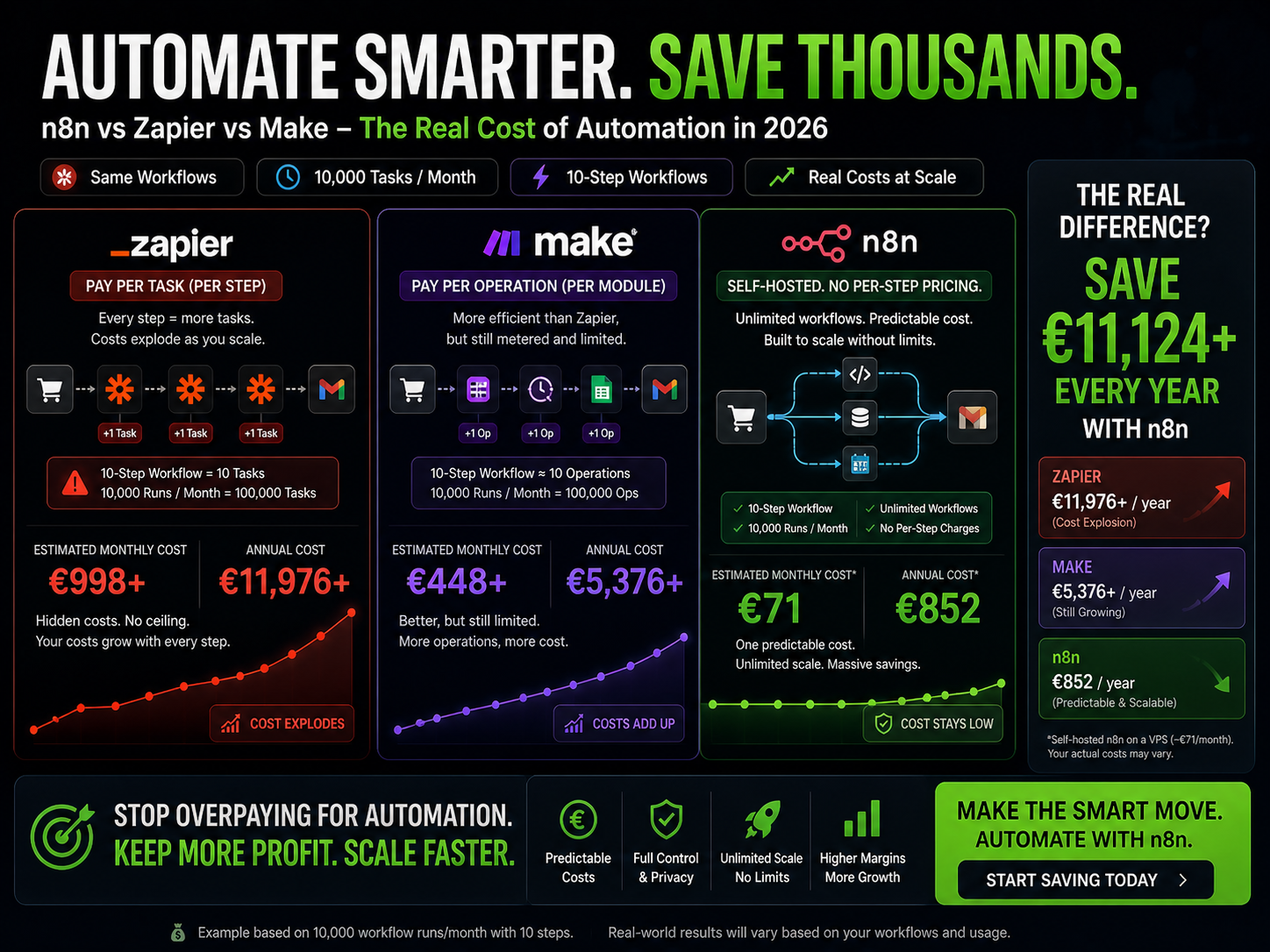
You have options. You could use Zapier. You could try Make. You could spin up your own n8n instance on a server somewhere and figure out the infrastructure yourself. Or you could sign up for n8n's official cloud offering and pay per workflow execution.
All of those work, to a point. Here's why a growing number of serious e-commerce operators land on N8Nme instead.
You Own Your Instance. Your Data Stays Yours.
This one matters more than most people realise until it's too late.
With Zapier, Make, and n8n Cloud, your customer data, order details, email addresses, purchase history, abandoned cart information, flows through a third-party platform's shared infrastructure. You're trusting another company's security practices, their uptime, their pricing decisions, and their terms of service with data that belongs to your customers.
With N8Nme, you get a dedicated VPS assigned exclusively to you. Your workflows run on your own server. Your customer data never touches shared infrastructure. For e-commerce stores handling payment-adjacent data, customer PII, or operating under GDPR obligations, this isn't just a nice-to-have, it's the right way to operate.
You get the data ownership and control of self-hosting, without any of the complexity of actually managing a server yourself.
No Per-Task Fees. Ever.
This is where the maths gets interesting, and where Zapier in particular becomes a problem at scale.
Zapier charges per task. At low volumes, it's fine. But consider what happens when your automation is actually working: your abandoned cart sequence fires hundreds of times a day, your order processing workflows run on every purchase, your inventory sync updates across three channels in real time. Suddenly you're processing tens of thousands of tasks per month, and your Zapier bill is climbing toward €500, €800, or more, every single month, scaling directly with your success.
N8Nme runs on a flat monthly fee. Unlimited workflow executions, no matter how many times your automations fire. Process 100 orders a day or 10,000, your bill doesn't change. For high-volume stores, this single difference can save thousands of euros annually compared to task-based platforms.
400+ Integrations, Including Everything You Already Use
Shopify. WooCommerce. Amazon. Klaviyo. Mailchimp. QuickBooks. Google Sheets. Slack. Every major shipping carrier. Your helpdesk platform. Your CRM.
n8n connects to over 400 tools natively, which means the e-commerce stack you've already built, the one you've spent months configuring and getting right, plugs straight in. No ripping out existing tools, no switching platforms, no starting from scratch.
And if something you use isn't natively supported, n8n's API capabilities mean you can connect it anyway. If a tool has an API, n8n can talk to it.
Built to Get You Started in Minutes, Not Days
One of the genuine barriers to automation for independent store owners is setup time. You know automation would help, but configuring a server, installing Docker, setting up SSL, managing updates, that's a weekend of work you don't have.
N8Nme removes that entirely. Your personal n8n instance is provisioned and ready in under 5 minutes. No command line. No infrastructure decisions. No DevOps knowledge required. You log in, and your automation environment is already running.
From there, our library of 9,000+ pre-built workflows means you're not starting from a blank canvas. The abandoned cart sequence, the order processing workflow, the inventory sync, templates for all of it exist, ready to install with a single click and customise to your store's specific setup.
As You Grow, Your Costs Don't Spiral
Most automation platforms are cheap when you start and expensive when you succeed. That's a fundamentally backwards pricing model for a growing store.
N8Nme's plans are designed to scale with you without punishing you for it. Start on the Free plan to get familiar with n8n and validate your first workflow. Move to Starter at €14/month when you're ready for a dedicated VPS and the full performance that comes with it. Step up to Pro or Expert as your store grows and your automation needs get more sophisticated.
At every tier, you're paying for infrastructure, not for the privilege of running your workflows more often. The more your automation does for you, the better value your plan becomes.
The Bottom Line
Zapier is expensive at scale. Make has complexity limits. Self-hosting n8n takes time and expertise most store owners don't have. n8n Cloud charges per execution and puts your data on shared infrastructure.
N8Nme gives you the full power of n8n, open source, unlimited executions, 400+ integrations, visual workflow builder, on a dedicated server that's yours, managed by a team that handles everything so you don't have to.
For a lean e-commerce team that wants enterprise-grade automation without an enterprise budget or an in-house DevOps engineer, that's a hard combination to beat.
Ready to Stop Doing Everything Manually?
You've seen what's possible: orders processed automatically, inventory synced in real time, abandoned carts recovered while you sleep, customer questions answered at 2am without waking anyone up.
The stores winning in e-commerce right now aren't necessarily the ones with the biggest budgets or the largest teams. They're the ones who've stopped doing manually what software can do automatically, and redirected that time toward the things that actually grow a business.
Your n8n instance is 5 minutes away. Start free, no credit card required →