Construction Automation: Save 15+ Hours Weekly in 2026

Discover how construction workflow automation saves small contractors 15+ hours weekly. Boost ROI, cut admin tasks by 50%, and win more bids effortlessly.
You Didn't Start a Construction Business to Drown in Paperwork
You got into this trade because you're good at it. Whether you're running a plumbing crew, managing roofing jobs across town, or juggling five active construction sites, the actual work is what drives you.
But somewhere between the job site and the office, something went sideways.
Now you're chasing down invoices at 10pm, manually typing up estimates you've written a hundred times before, playing phone tag with customers who never got their appointment reminder, and wondering why your cash flow looks nothing like your project list.
Sound familiar? You're not alone, and you're not doing it wrong. You're just doing it the hard way.
The Hidden Cost of Running Your Business Manually
Here's a number that might sting a little: processing a single invoice manually costs between $12 and $30 when you factor in your time. With the right construction invoicing automation, that same invoice costs $1 to $5. Multiply that across a month of jobs and you're looking at real money left on the table.
And it's not just invoicing. Consider what manual workflows are quietly costing you:
- Visibility gaps between your field crews and the office lead to miscommunication, duplicate work, and frustrated customers
- Slow follow-up on new leads means lost revenue, contractors who respond within 5 minutes convert leads at 21 times higher rates than those who wait
- Admin overhead eats 40-60% of time that could go toward billable work or actually running your business
- Cash flow delays stretch your days sales outstanding (DSO) by weeks, automation alone can shrink that by 25-40%
This isn't about working harder. It's about what's falling through the cracks while you're already working as hard as you can.
So What Is Construction Automation, Actually?
Forget the buzzwords for a second. Trade business automation just means connecting your tools so they talk to each other, eliminating the manual steps that eat your time.
Instead of your crew texting you job updates, then you updating a spreadsheet, then creating an invoice, the job completion triggers everything automatically. Photos get saved. The invoice generates. The customer gets notified. You get paid faster.
It's not about replacing you or your team. It's about removing the repetitive work that keeps you from focusing on the parts of your business that actually grow revenue.
In this guide, I'll walk you through four specific automation opportunities that deliver the highest ROI for small contractors and trade businesses. These aren't theoretical, they're workflows you can implement in the next 90 days.
Construction Scheduling Automation: Stop Losing Hours to Dispatch Chaos
Here's a scenario every contractor knows too well. It's 6:45 AM. Your phone's already ringing. One crew is stuck in traffic, another just showed up to the wrong job site, and you've got an angry customer asking where your tech is. You haven't even had your coffee yet.
Manual dispatching doesn't just waste time, it actively costs you money, every single day.
The Real Cost of Manual Scheduling
Most small contractors are still running dispatch from a whiteboard, a spreadsheet, or worse, their memory. When you're juggling 5, 10, or 15 jobs a day, that system breaks down fast.
Here's what that actually looks like in practice:
- Techs driving 45 minutes between jobs that are 10 minutes apart
- Double-booked appointments discovered at the last second
- No-shows because a job confirmation slipped through the cracks
- Office staff spending 2-3 hours a day just coordinating who goes where
With the industry already short 439,000 workers annually, you can't afford to burn the crew you do have on inefficient routes and wasted windshield time.
What Field Service Automation Actually Changes
Workflow automation for construction teams can connect your scheduling, GPS routing, and customer notifications into one seamless flow, without you having to babysit it.
Here's what an automated dispatch setup looks like in the real world:
- A new job request comes in and gets automatically slotted based on crew availability, skill set, and location
- The assigned tech gets a mobile notification with job details, customer info, and optimized turn-by-turn routing
- The customer gets an automatic confirmation text with an estimated arrival window
- If a job runs long, the system flags the next appointment and sends an updated ETA to that customer
No phone tag. No scrambling. No surprises.
Before vs. After: A Real-World Example
Before automation: Your HVAC company runs 10 service calls daily. Poor routing means each tech drives an extra 30 minutes between jobs. That's 5 hours of windshield time daily, time you pay for but can't bill.
After field service automation: Route optimization cuts travel time by 30%. Those same 10 calls now require 3.5 hours less driving. Your crew completes an extra 1-2 jobs daily without working longer hours.
At $150 per service call, that's $750-$1,500 in additional daily revenue, just from smarter routing.
The Bottom Line on Scheduling Automation
- 30% reduction in travel time through GPS-optimized routing
- 15-25% increase in technician utilization (more billable hours)
- Fewer missed appointments through automated confirmations and reminders
- Reduced dispatcher workload, the system handles the routine scheduling
For a small trade business, this one workflow change can pay for your entire automation investment.
Stop Chasing Paper: Construction Field Data Automation That Pays You Faster
Here's a scenario I hear constantly from contractors: your crew finishes a job on Friday afternoon, hands in paper timesheets on Monday, your office manager spends Tuesday deciphering handwriting and cross-referencing materials lists, and you finally send the invoice by Wednesday or Thursday, if you're lucky.
That's almost a full week of cash sitting on the table. And in construction, that's not just inconvenient. It's a survival issue.
The Real Cost of Paper Timesheets
Paper-based field documentation isn't just slow, it's expensive in ways most contractors don't even track. Every manual invoice your team processes costs between $12 and $30 when you factor in labor, errors, and follow-up. Lose a timesheet or a materials receipt, and that number climbs even higher.
The ripple effects hit everywhere:
- Delayed invoicing means delayed payment, sometimes stretching your Days Sales Outstanding (DSO) by weeks
- Illegible or incomplete timesheets create disputes with clients and payroll headaches internally
- Lost job site photos and notes mean you can't defend change orders or warranty claims
- Office staff spend hours reconciling field data instead of doing higher-value work
What Construction Field Data Automation Actually Looks Like
With the right contractor workflow software, your field techs log hours, snap photos, note materials used, and capture client signatures, all from their phones, in real time. That data flows automatically into your back-office systems before they've even packed up their tools.
No paper. No re-entry. No guesswork.
Before automation:
Crew finishes Friday → Paper timesheets collected Monday → Office reconciles Tuesday → Invoice sent Wednesday or Thursday → Payment arrives 3-4 weeks later
After field service automation:
Crew finishes Friday → Data captured on-site instantly → Invoice auto-generated → Sent same day → Payment arrives in 1-2 weeks
The Cash Flow Impact
Here's where this gets interesting. Contractors using automated field data capture typically see their DSO drop by 25-40%.
What does that mean in real dollars?
If you bill $100,000 monthly and your average collection time is 45 days, you're carrying about $150,000 in receivables. Cut that to 30 days through faster invoicing, and you free up $50,000 in working capital, cash you can use to hire, buy equipment, or just sleep better at night.
Additional Benefits Beyond Speed
- 40-60% reduction in admin overhead, your office staff focuses on growth, not data entry
- Fewer billing disputes, digital records with photos and signatures protect you
- Real-time job costing, know immediately if a job is going over budget
- Better customer experience, professional digital documentation builds trust
Construction Invoicing Automation: Stop Leaving Money on the Table
Here's a painful truth most contractors know but hate to admit: you probably have thousands of dollars in completed work sitting unbilled right now.
A job wraps up on Friday afternoon. Your tech drives home, the paperwork sits in their truck. You get around to creating the invoice Monday or Tuesday, maybe Wednesday if it's been a crazy week. Then you wait. And wait. Cash flow gets tight. You start wondering if you should've just stayed an employee.
This is the invoicing death spiral, and it's killing small trade businesses everywhere.
The Real Cost of Manual Invoicing
Most contractors I talk to have no idea what their manual invoicing process actually costs them. Here's the math that usually stops people cold:
- Manual invoice processing costs $12-$30 per invoice when you factor in labor, errors, and follow-up time
- Automated invoicing drops that cost to $1-$5 per invoice
- If you're sending 50 invoices a month, that's potentially $750-$1,250 in pure waste every single month
And that's before we even talk about how long it takes to actually get paid.
Before Automation vs. After Automation
Before: Your tech completes a job, fills out a paper work order (or maybe texts you a photo of it). You manually enter the data into your invoicing software, chase down job notes to make sure everything's captured, and send the invoice two to four days after the work is done. The customer pays whenever they feel like it.
After: The moment your tech marks the job complete in the field, on their phone, the system automatically pulls the labor hours, materials used, and job notes to generate a clean, professional invoice. It goes to the customer within minutes. Automated payment reminders follow up so you don't have to feel awkward about it.
The result? Contractors using field service automation for invoicing see 25-40% faster payment collection on average.
The Compound Effect on Your Business
Faster invoicing doesn't just improve cash flow, it changes how you run your business:
- Predictable revenue means you can plan hiring and equipment purchases with confidence
- Reduced stress around payroll and bills, no more wondering if checks will clear
- Better customer relationships, professional, prompt invoicing builds trust
- More time for business development, you're not chasing payments, you're winning new work
A Quick ROI Calculation
Let's say you process 40 invoices monthly:
- Manual cost: 40 invoices × $20 average = $800/month in processing costs
- Automated cost: 40 invoices × $3 average = $120/month
- Monthly savings: $680
- Annual savings: $8,160
That's just the direct cost savings. Add in faster payment collection (25-40% DSO reduction) and the ability to capture early payment discounts more consistently, and the real return is significantly higher.
Contractor Compliance Automation: Stop Chasing Certificates Before They Bite You
Here's a scenario every general contractor has lived through. You're two days into a project, your sub's insurance expired three weeks ago, and nobody caught it. Now you're potentially on the hook for liability, the project is stalled, and you're spending your morning making frantic phone calls instead of running your business.
This is the compliance documentation nightmare, and it's entirely preventable.
The Real Cost of Manual Compliance Tracking
Tracking subcontractor certificates, insurance renewals, licenses, and safety documentation manually is basically a part-time job you didn't hire anyone to do. Most contractors are juggling this across spreadsheets, email threads, and sticky notes.
The risks pile up fast:
- Expired COIs that expose you to six-figure liability claims
- Lapsed contractor licenses that can void permits mid-project
- Missing OSHA documentation that triggers costly work stoppages
- Compliance gaps that disqualify you from bids with larger GCs or public projects
And the burden isn't shrinking. Compliance tracking overhead is one of the biggest hidden time-sinks in field service automation surveys, eating hours every week that should be billable.
What Automated Compliance Tracking Actually Looks Like
With trade business automation tools, you set the rules once and let the system do the watching for you. It connects your document storage, your subcontractor database, and your communication tools into one living compliance system.
Here's what runs automatically:
- 30/60/90-day expiration alerts sent directly to subs and your project manager
- Automatic document requests when a cert is about to lapse
- Project access flags that notify your team if a sub's documentation is out of date before they step on site
- Centralized compliance dashboard updated in real time, no more hunting through email
The Risk Mitigation Value
One general contractor who implemented compliance automation reported a 60% reduction in compliance tracking overhead, and more importantly, zero surprise insurance lapses in the first year.
Consider what a single uninsured incident could cost you:
- A worker injury on your site without proper COI coverage: potentially $100,000+ in liability
- A project stoppage due to lapsed permits: thousands in delay costs plus reputation damage
- Lost bid opportunities because you can't prove compliance: untold revenue impact
Compliance automation isn't just convenient, it's insurance against the kind of surprises that put contractors out of business.
Additional Compliance Benefits
- Audit readiness, all documentation organized and accessible instantly
- Subcontractor accountability, automatic reminders mean you're not the bad guy chasing certs
- Scalable processes, add new subs and projects without drowning in paperwork
- Professional credibility, larger GCs and commercial clients expect this level of organization
Your 90-Day Automation Roadmap
You don't have to overhaul everything overnight. The contractors I've seen succeed with trade business automation do it in phases, and within 90 days, they barely recognize their old workflow.
Here's a simple roadmap that works:
Month 1: Fix the Field-to-Office Gap
Start where the pain is loudest, visibility. Set up automated job updates, photo capture, and digital checklists so your office knows what's happening in real time without 14 text messages a day.
- Before: Your crew finishes a job, you find out when they drive back to the shop
- After: Job completion triggers automatic status updates, customer notifications, and next-day scheduling, hands-free
This alone can cut admin overhead by 40-60% and push technician utilization up by 15-25%. That's more billable hours without hiring anyone new.
Month 2: Get Paid Faster
Once your field data flows cleanly, tackle invoicing. Manual invoices cost you $12-$30 each to process. Automated construction invoicing brings that down to $1-$5, and you'll collect faster too.
- Before: Invoices sit in a stack until Friday. Some get lost. Cash flow suffers.
- After: Job completion auto-triggers invoice generation, delivery, and payment reminders
Contractors who automate this step typically see a 25-40% reduction in days sales outstanding (DSO). That means real money hitting your account weeks sooner.
Month 3: Stop Dreading Compliance
Certifications, safety logs, insurance renewals, the paperwork that keeps you up at night. In month three, build automated reminders and tracking so nothing falls through the cracks.
- License expiration alerts sent 60, 30, and 7 days out
- Safety training completions logged automatically
- Incident reports filed and stored without chasing anyone down
This is where contractor workflow software really earns its keep. You stay compliant without dedicating hours every week to spreadsheet maintenance.
Why n8n Is the Smart Choice for Construction Automation
By now you're probably wondering which tools to use. There are plenty of options out there, Zapier, Make, dedicated construction software suites. Here's why I recommend n8n for most small contractors:
Self-hosted means control. Your data stays on your servers, not in some third-party cloud you don't control. For contractors handling sensitive customer and project data, this matters.
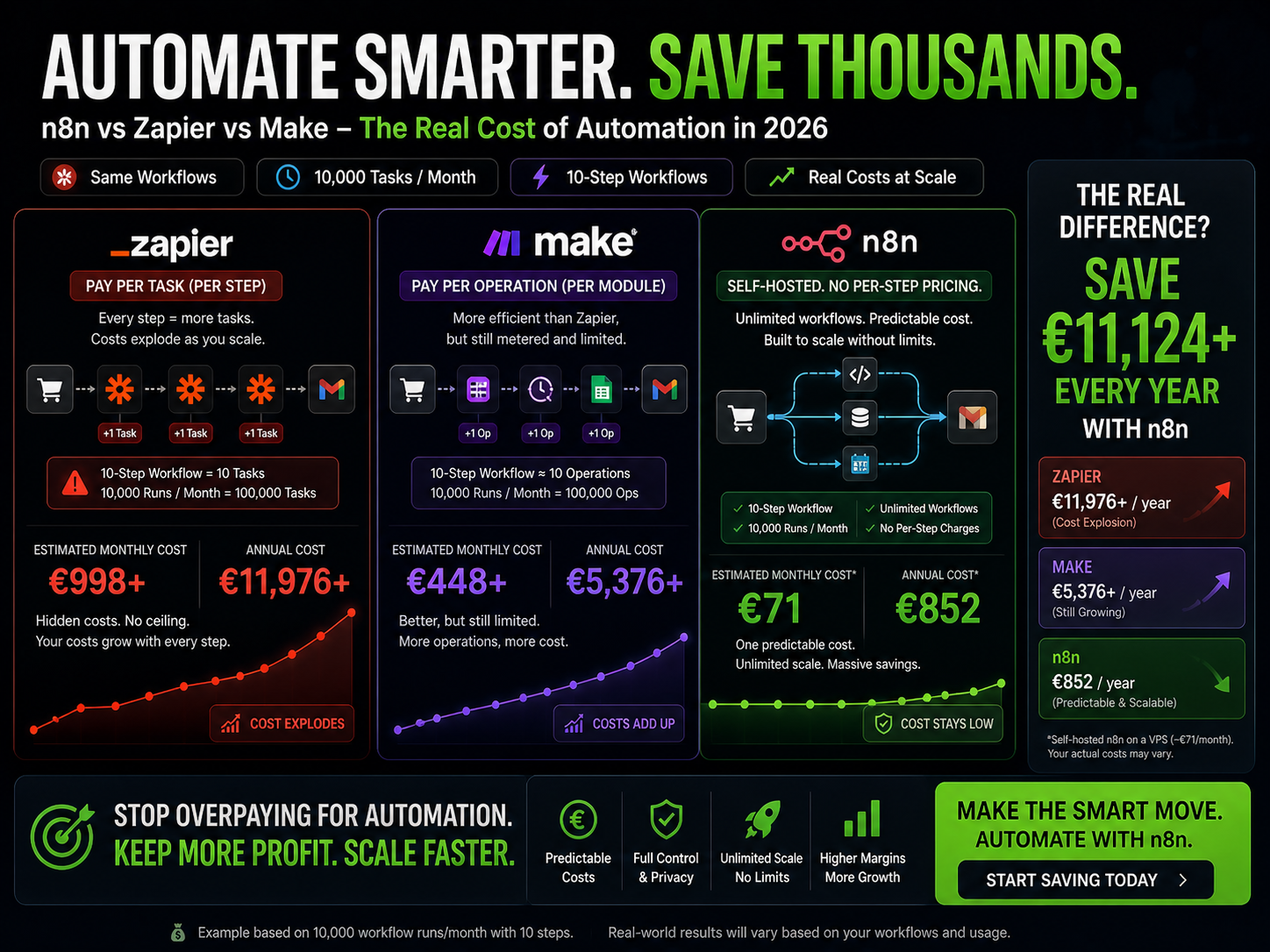
Unlimited executions. Unlike Zapier, which charges per task, n8n doesn't penalize you for running workflows frequently. Process thousands of invoices, not dozens.
400+ integrations. Connect your existing tools, QuickBooks, Salesforce, Google Workspace, your field service app, without replacing everything.
Open source. No vendor lock-in. If you need to customize something, you can. If pricing changes, you have options.
Cost-effective at scale. For growing contractors, n8n becomes significantly cheaper than alternatives as your automation volume increases.
Ready to Reclaim Your Time?
You didn't start your construction business to spend evenings chasing paperwork. You started it to build things, solve problems, and create something that lasts.
The right automation doesn't replace your expertise, it removes the friction that's keeping you from using it.
If you're ready to explore how construction automation could work for your specific business, I'd love to help. Register for free to learn more about implementing these workflows in your operation.
The tools exist. The ROI is proven. The only question is whether you'll still be doing this manually six months from now.